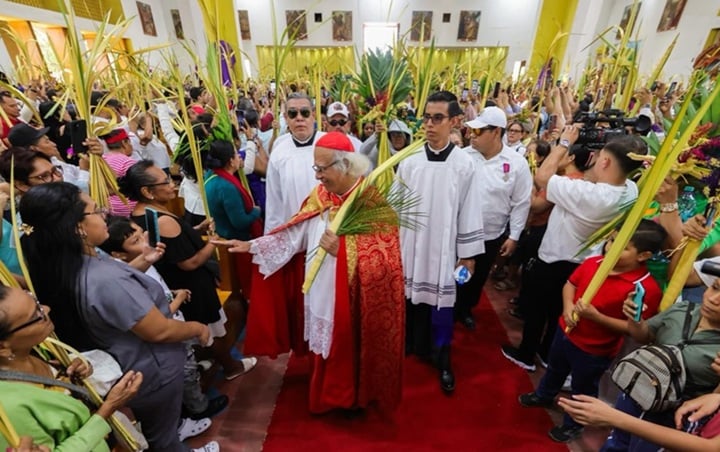
Catholic parishes across Nicaragua welcomed thousands of faithful on Sunday, March 29, who attended Mass, palm blessings, and processions featuring the image of Jesús del Triunfo, also known as the “procession of the little donkey.” This Palm Sunday tradition marks the beginning of Holy Week celebrations. As has been the case since the outbreak of the sociopolitical crisis that continues to affect the country, these Catholic rites were carried out under restrictions.
In an effort to create the appearance that no restrictions or harassment of Catholic priests exist in Nicaragua, the dictatorship of Daniel Ortega and Rosario Murillo ordered its propaganda outlets to flood social media with images of these religious activities. Across the country, however, these events were largely held inside churches or in their courtyards, rather than through city streets as was customary before the sociopolitical crisis erupted in 2018.
Read also: Ortega-Murillo Purge Targets Key Financial Operator Francisco López, Former FSLN Treasurer
Processions Confined to Church Grounds
Official images gave the impression that, in many cases, the regime’s police allowed processions to take place in the streets. In reality, religious activities were limited to church patios or atriums, as has been the case since 2018, when the government launched a campaign of persecution against the Catholic Church and the broader population.
Some parishes without enclosed courtyards held processions just outside their buildings, but participants did not move beyond church premises. Police officers—including some in plain clothes—were also embedded among the faithful to monitor attendees.
Lawyer Martha Patricia Molina, who has documented the Ortega-Murillo government’s actions against the Catholic Church, stated that Palm Sunday celebrations marking the start of Holy Week were carried out under repression, despite the regime’s attempts to suggest otherwise.
In an interview with La Prensa, Molina said that 409 Jesús del Triunfo processions were banned. Additionally, some laypeople were fined for parking their vehicles outside churches, there was intense surveillance, and some priests were pressured to cooperate in intimidation efforts, including being required to submit photos and videos.
Catholic Church: A Beacon of Hope
For journalist Israel González, who specializes in religious affairs, it was striking that Channel 4—one of the regime’s main propaganda outlets—broadcast the Palm Sunday Mass from Managua’s Metropolitan Cathedral. Since the civic protests of 2018, pro-government media had largely avoided covering Catholic Church activities.
Nevertheless, González said that seeing churches filled with worshippers despite ongoing persecution was “a powerful sign of the support the Church continues to enjoy among the Nicaraguan people.”
“It is a sign of a Church that, despite a persistent state of religious persecution—evidenced by restrictions on processions, harassment, and intimidation—remains a beacon of hope for a population living under an authoritarian regime,” González told La Prensa.
He also lamented that processions are now conducted “entirely within church premises.”
Read also: Indian Billionaire Vikram Sodhi Visits Nicaragua, Meets Ortega´s Son Amid Mining Sector Scrutiny
Fines and Other Violations of Religious Freedom
Despite the well-known fact that churches are filled with worshippers during Holy Week and lack sufficient parking space, police under the Ortega-Murillo government fined many parishioners for leaving their vehicles outside church grounds, Molina reported. The fines amounted to 500 córdobas (US$13.5 dollars).
She also noted that numerous plainclothes officers infiltrated Palm Sunday religious activities to monitor attendees.
Regarding the processions, Molina explained that some churches lack perimeter walls, which may have created the impression that events were held in the streets—but this was not the case.
She further clarified that, days in advance, police had demanded that priests submit images of prior religious activities, particularly Stations of the Cross processions. Many of these images were later used by pro-government media.
“These are the photos they are using to claim that processions in Nicaragua are proceeding normally, but they do not say that they are taking place inside church grounds and under surveillance,” Molina said.
You may be interested: Nicaragua Challenges U.S. as Ortega Regime Strengthens Russia Ties in Managua
Images Manipulated to Project Normalcy
Some of the images creating a false impression of free processions were published by pro-government outlets showing activities at the San Juan Bautista parish in La Concepción, Masaya, and the Sangre de Cristo parish in Jinotega.
“A parishioner told me that this church does not have fencing around its atrium. The images shown are from the corner of a school to the church entrance—it is not the street, it is parish property. Everything is taking place within church grounds,” Molina emphasized.
The researcher also lamented that priests were unable during Mass to pray for exiled individuals or mention the names of bishops and auxiliary bishops, despite this being a standard requirement.
In Managua, priests were unable to mention Bishop Silvio Báez; in Siuna, Isidoro Mora; in Jinotega, Carlos Herrera; and in Estelí and Matagalpa, Rolando Álvarez, Molina said.