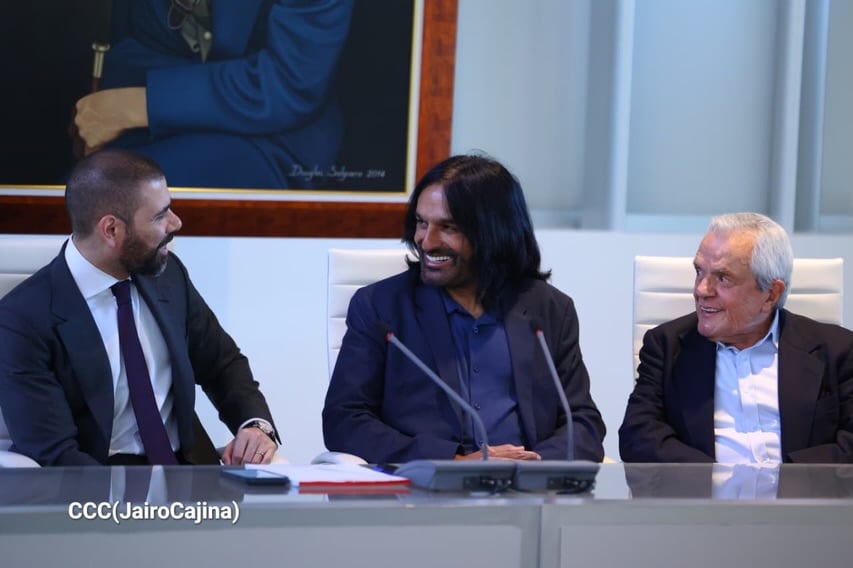
Millionaire Vikram Sodhi, British of Indian origin, majority shareholder of Colombia’s Mineros Group and owner of Hemco Nicaragua, traveled to the country to review with authorities the “status” of the company’s operations and its work plans. The visit comes after Mineros Group lost a tax dispute over alleged back taxes, which required it to allocate part of its 2025 profits to pay $75 million to the General Directorate of Revenue (DGI).
This marks the second visit in less than a week by major international investors with interests in Nicaragua’s mining sector. These meetings are part of an official strategy to project an image of normalcy in mining—a sector currently under scrutiny by the United States due to alleged abuses by the Ortega-Murillo regime to profit from the gold business while granting hundreds of mining concessions to Chinese businessmen.
Despite losing the tax dispute, Mineros Group has set its 2026 growth targets based on its operations in Nicaragua. According to its 2025 annual reports presented to investors, the company is confident that rising gold prices—currently exceeding $5,000 per ounce—will allow it to continue delivering strong results. To achieve this, it plans to increase the processing capacity of the Hemco plant in Nicaragua from 1,800 to 2,500 tons per day.
Read also: BHMB Mining Sues Nicaragua for $80 Million, Citing Illegal Expropriation of Gold Facility
Meeting with Laureano Ortega
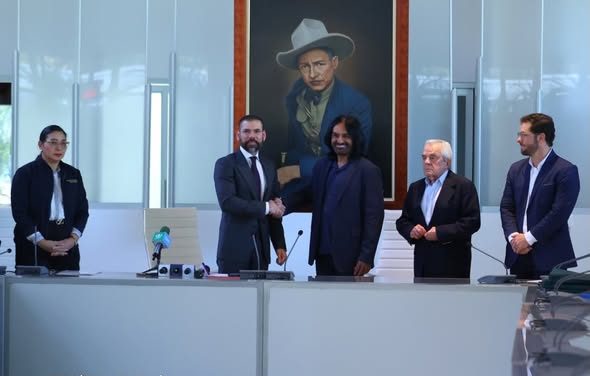
During the meeting, Laureano Ortega Murillo, son of the country’s ruling leaders, said that he and the visitors reviewed the status of Hemco’s operations, as well as prospects for continuity and expansion. They also discussed the possibility of continuing to generate benefits for communities where the company operates.
He reiterated the willingness of his parents, Daniel Ortega and Rosario Murillo, to support mining activity so that, in the long term, companies can continue expanding their investments in Nicaragua.
For several years, Hemco has promoted the “Bonanza Model” for artisanal mining. Under this scheme, the company purchases and processes part of the material extracted by approximately 6,000 artisanal miners. In addition, through the Municipal Commission for Artisanal Mining (CMMA), it has strengthened mechanisms for systematizing, recording, and monitoring statistical data.
The official delegation led by Ortega Murillo included Wendy Morales, head of the Attorney General’s Office (PGJ); Salvador Mansell, Minister of Energy and Mines and executive president of the National Electric Transmission Company (Enatrel); and Ovidio Reyes, president of the Central Bank of Nicaragua (BCN).
According to Mineros’ website, the company is listed on the Toronto Stock Exchange. The meeting with Laureano Ortega took place despite the fact that the Canadian government sanctioned him in 2019, along with the dictator Murillo. In total, that government has sanctioned more than 20 officials.
Projecting Stability to Mining Companies
These meetings with representatives of two of the country’s three most important mining companies are taking place as the sector faces scrutiny from the U.S. government following the confiscation of the processing plant of BHMB Mining Nicaragua, S.A., owned by BHMB Inc., a company with U.S. and British capital.
BHMB Inc. has been stripped of its investment and has already begun proceedings to sue the Nicaraguan state before the International Centre for Settlement of Investment Disputes (ICSID), a World Bank body that resolves investor disputes under the mechanism established in the Dominican Republic–Central America Free Trade Agreement (DR-CAFTA).
Prior to these two meetings, officials from the Ortega-Murillo administration had made other efforts to project normalcy in the mining sector, which underpins the country’s exports. Last year, gold exports exceeded $1.9 billion, largely driven by shipments from Equinox Gold and Hemco.
On February 21, the Attorney General’s Office (PGJ), now overseeing the General Directorate of Mines (DGM), issued a statement defending the transparency, legality, and legal certainty of mining concessions that “have complied with due process,” while rejecting “speculation” aimed at discrediting the sector.
You may be interested: Nicaragua Challenges U.S. as Ortega Regime Strengthens Russia Ties in Managua
Commitment to Curb Smuggling
Research by La Prensa exposed mechanisms allegedly used by the ruling elite, in coordination with Chinese investors, to conduct business in the sector, including engaging in unfair competition with the aforementioned companies.
In a further effort to reassure the sector, Nicaraguan authorities met with their Costa Rican counterparts at the Peñas Blancas border crossing in late February. There, they agreed to strengthen coordination between their security forces to combat illegal mining and gold smuggling along the shared border.
The meeting took place after Costa Rica’s Minister of Public Security, Mario Zamora, denounced that illegal miners extract gold in Costa Rica to process and sell it in Nicaragua. This prompted a response from Costa Rican President Rodrigo Chaves, who said he would raise the issue with U.S. President Donald Trump.