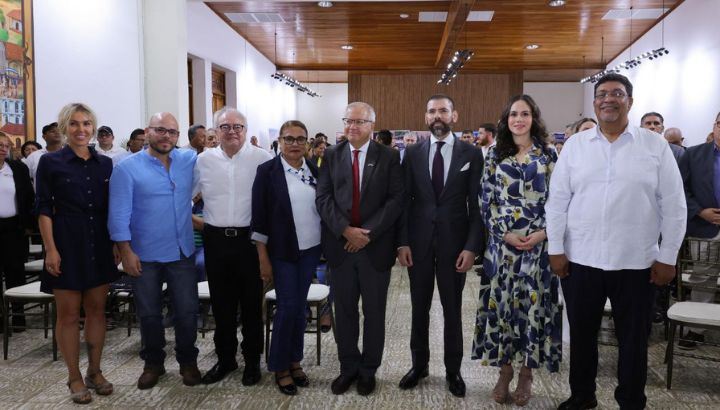
The son of the ruling couple, Laureano Ortega Murillo, joined Russian Ambassador Mikhail Nikolaevich Ledenev in celebrating the 12th anniversary of Crimea’s reunification with the Russian Federation. The event took place amid mounting pressure from the United States on Nicaragua over human rights violations and Russia’s uncomfortable presence in Latin America from the perspective of U.S. national security.
The gathering was held Thursday afternoon at the confiscated and reopened Casa de los Tres Mundos in Granada, where Laureano Ortega, representing the ruling authorities, declared that “Nicaragua reaffirms its recognition and support for the reunification of Crimea with the Russian Federation”—a territory disputed with Ukraine and considered under Russian occupation since its forced annexation in 2014.
Hours before the celebration, U.S. Navy General Francis L. Donovan told the U.S. Senate that “Russia continues to project its maritime power in the Western Hemisphere through the deployment of various warships—from submarines to destroyers and intelligence-gathering vessels—in Nicaragua and other countries in the region.”
Read also: New Fortress Energy Near Bankruptcy, Bets on Nicaragua Gas Plant Launch in October 2026
Regime Challenges the United States
Costa Rican professor and international relations analyst Carlos Murillo views such events involving the Ortega-Murillo government and Russia as a “challenge” to the United States. “It is undoubtedly challenging the United States,” he emphasized, noting that the regime supports initiatives such as the Crimea reunification celebration “so that Moscow sees it as a reliable partner that continues to stand by it.”
“It is a matter of currying favor with its Russian ally while also exerting some pressure on the United States,” Murillo added. According to the analyst, following the fall of Nicolás Maduro in Venezuela and ongoing talks between the United States and Cuba, Nicaragua has become “the central point” in Russia’s positioning strategy in the Caribbean to “maintain influence over the rest of Central America.”
Russia’s positioning in Latin America has kept U.S. military forces on alert, particularly in light of the revived “Monroe Doctrine,” proclaimed in 1823 by U.S. President James Monroe, which established the policy of “America for the Americans.” The doctrine has been revived by the Trump administration and incorporated into its new National Security Strategy, whose most notable outcome was the capture of Nicolás Maduro in Venezuela on January 3.
In line with this policy, on Thursday, March 19, General Francis L. Donovan of the U.S. Southern Command stated he was “ready to provide support” to Chargé d’Affaires Elias Baumann and the U.S. diplomatic mission in Nicaragua.
“We remain firmly committed to promoting security and stability for the peoples of the region, in close collaboration with our nation’s respected and professional diplomatic corps, which works daily to advance stability, prosperity, and democratic values in the Western Hemisphere,” reads a post on the official U.S. Southern Command account on X.
Trump Close to Putin, says an analyst
However, the U.S. government does not appear to be paying much attention to the relationship between Russia and Nicaragua, according to Costa Rican lawyer and analyst Carlos Cascante, who argues that “the White House has taken an ambivalent position, and Trump himself has been very close to (Vladimir) Putin.”
According to Cascante, “President Trump tends to view Russia more as an ally in relation to China. This could, in some ways, even benefit Nicaragua’s regime.”
“The key question is whether the Ortega-Murillo regime offers sufficient conditions and concessions to be considered a friend of Washington. The position of this administration is clear: it does not matter who is in power, as long as they are aligned with Washington. If the relationship, as President Trump says, becomes friendly and easy to manage, there would be little issue with maintaining a regime like Nicaragua’s compared to others in the region,” Cascante explained.
Read also: British Billionaire Nick Candy Meets Ortega’s Son in Nicaragua Despite UK Sanctions on Regime
However, sustaining a model similar to that of Delcy Rodríguez in Venezuela appears more complicated in Nicaragua due to the role of Rosario Murillo, who seeks to remain in power at all costs, as demonstrated by the brutal repression unleashed since April 2018. “The United States would seek a change in leadership even if the regime remains… but finding a replacement for Ortega and Murillo within a system shaped by those relationships could prove difficult,” Cascante added.
Faced with ongoing pressure from the United States—which has even labeled Rosario Murillo “illegitimate”—the dictatorship is “trying to survive through concessions,” according to the analyst. To do so, it may be forced to “cool” its relations with China and Russia, a scenario that “could unfold in the coming days.”