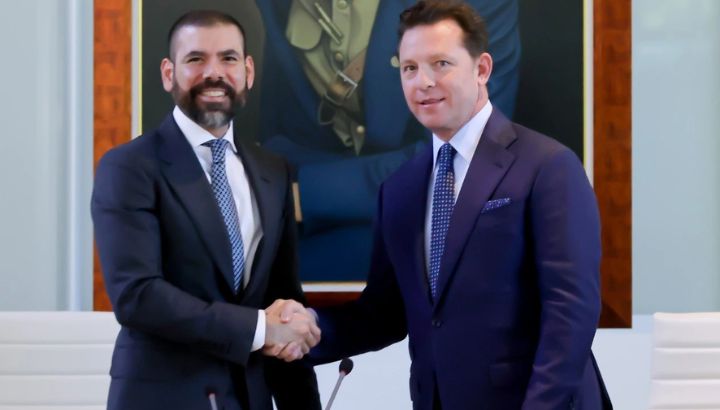
British billionaire and mining investor Nicholas “Nick” Candy has met with Laureano Ortega Murillo, son of Nicaragua’s ruling couple, during a visit to the country—despite ongoing UK sanctions against senior figures in the regime.
Candy is the majority shareholder of Metals Exploration, a mining company that last year acquired Condor Gold, owner of several mining concessions in Nicaragua, including the La India gold mine.
His visit comes at a sensitive moment. The United Kingdom previously sanctioned Vice President Rosario Murillo and other top officials, accusing them of undermining democracy, repressing civil society and the political opposition, and committing human rights violations. At the same time, Nicaragua’s mining sector is facing renewed scrutiny from the Trump administration following the recent confiscation of the BHMB Mining Nicaragua processing plant, owned by BHMB Inc., a company with U.S. and British capital.
Candy, a businessman and political figure who serves as treasurer of the right-wing Reform UK party, took control of Metals Exploration after it acquired Condor Gold from another British group. He now chairs the company’s board. Condor Gold holds multiple concessions, including the La India mine in León, which Metals Exploration says is expected to enter production before the end of this year.
A real estate magnate who has more recently expanded into mining, Candy has long maintained ties to politics. He has been described in media reports as close to former Prime Minister Boris Johnson and previously played a significant role within the UK’s Conservative Party—the same government that imposed sanctions in 2021 on eight high-ranking Nicaraguan officials, including Murillo.
In December 2024, Candy became the chief fundraiser and treasurer of Reform UK, a right-wing populist party that evolved from the Brexit movement advocating the United Kingdom’s exit from the European Union.
Official welcome
Candy was received by a delegation led by Laureano Ortega in his role as presidential adviser for investment promotion, trade, and international cooperation. He was joined by Energy and Mines Minister Salvador Mansell—who also heads the state electricity transmission company Enatrel—and Attorney General Wendy Morales. All three officials have been sanctioned by the United States.
Ortega expressed the government’s willingness to support Candy’s investment and encouraged him to expand operations, inviting him to promote Nicaragua as an attractive destination among global business circles.
In addition to the La India project, Condor Gold holds two other significant concessions—La Estrella and Río Luna. However, after two decades of exploration and development, the company is currently focused on launching gold extraction at La India and has not announced major new investments in the other sites.
You may be interested in: Nicaragua Revokes U.S. Mining Concession After $80 Million Plant Seizure, Granting Rights to Chinese-linked Firm
Attempts to Reassure the Sector
The Ortega-Murillo government has made efforts to project stability in the mining sector following the seizure of BHMB Mining Nicaragua’s facilities. Mining is a key pillar of Nicaragua’s export economy, dominated by gold shipments, largely from Canadian and Colombian-backed companies.
On February 21, the Attorney General’s Office—now overseeing the General Directorate of Mines—issued a statement defending the transparency and legal security of mining concessions that have “followed due process,” dismissing what it called “speculation” aimed at discrediting the sector.
The statement followed investigations by La Prensa and Fundación del Río, which alleged that political elites and Chinese investors benefit from gold extraction through unfair competition and illegal mining practices.
Regional Concerns and Costa Rica Talks
Another effort to ease tensions came on February 28, when the foreign ministers of Nicaragua and Costa Rica met at the Peñas Blancas border crossing. They agreed to increase coordination between security forces to combat illegal mining and gold smuggling along their shared border.
The talks were prompted by claims from Costa Rica’s Public Security Minister, Mario Zamora, that illegal miners extract gold in Costa Rica before processing and selling it in Nicaragua. Costa Rican President Rodrigo Chaves said he would raise the issue during a March 7 regional summit in Miami that brought together U.S. President Donald Trump and several Latin American leaders.
Regime Ties to the Gold Trade
The government of Daniel Ortega and Rosario Murillo has also expanded into the lucrative mining sector. U.S. authorities and investigative reports have linked the ruling elite to at least three mining companies.
These include Compañía Minera Internacional S.A. (Comintsa), associated with Energy Minister Salvador Mansell, and Capital Mining Investment, directly tied to Laureano Ortega—both under U.S. sanctions. A third firm, Grupo Minero Xiloá S.A. (Grumixsa), is also reportedly connected to the ruling family.
Analysts cited by La Prensa say the government exerts pressure on both artisanal miners and formal companies to benefit its own interests and those of Chinese-backed firms. According to reports, 15 Chinese-linked companies have been granted 71 concessions covering more than 1.01 million hectares—about 8.5% of Nicaragua’s territory.
Read also: Ortega–Murillo Government Hands 8.5% of Nicaragua’s Territory to Chinese Mining Companies
Pressure on Foreign Mining Firms
Several foreign mining companies have faced financial and legal pressure. Hemco, owned by Colombia’s Mineros, paid $49.3 million to settle a tax dispute covering the years 2019 to 2024.
Canadian firm Equinox Gold, which acquired Calibre Mining in June 2025 and now operates the La Libertad and El Limón mines, was also required to pay $36.6 million in alleged back taxes.
Meanwhile, the seizure of BHMB Mining Nicaragua’s processing plant—reportedly carried out in coordination with Chinese firm Zhong Fu Development—has raised further concerns about legal certainty for investors in the country.
Together, these developments underscore growing risks in Nicaragua’s mining sector, even as the government seeks to attract new foreign investment.