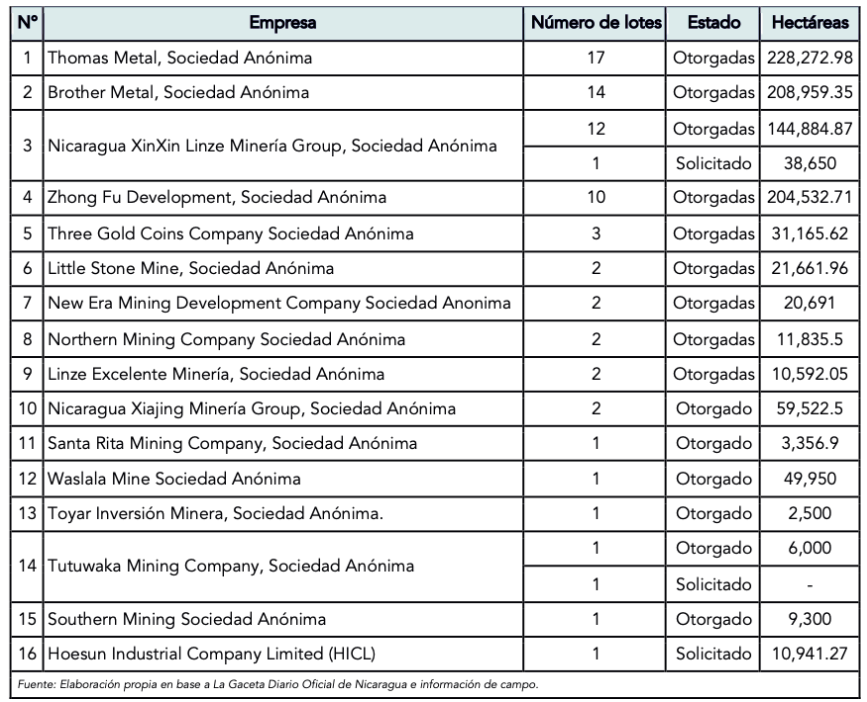
The dictatorship of Daniel Ortega and Rosario Murillo has granted a total of 71 mining concession lots to 15 Chinese companies between 2021 and 2026, according to the report “Chinese Mining Invasion in Nicaragua.”
The study, presented on March 11 by Fundación del Río in San José, found that these concessions cover 1,013,225.44 hectares—equivalent to 8.5% of Nicaragua’s national territory.
Concessions granted through the Energy Ministry
The concessions were issued through the Ministry of Energy and Mines of Nicaragua (MEM), explained Amaru Ruiz, president of Fundación del Río, during the presentation of the investigation.
More recently, however, authority over these concessions has shifted to the Office of the Attorney General of Nicaragua, which is directly controlled by Murillo through the powerful “super-minister” Wendy Morales.
You may want to read: Illegal Gold Mining by Nicaraguan Artisanal Miners Causes Major Environmental Damage in Costa Rica’s Conchudita Hill
Companies with the largest concessions
According to the report, the company holding the largest number of concessions is Thomas Metal S.A., with 17 lots totaling 228,272.98 hectares.
Other companies benefiting from major concessions include:
- Brother Metal S.A. – 14 lots covering 208,959.35 hectares
- XinXin Linze Minería Group S.A. – 12 lots covering 144,884.87 hectares
- Zhong Fu Development S.A. – 10 lots covering 204,532.71 hectares
Fundación del Río noted that the mining sector is directly controlled by the Ortega–Murillo family, which has accelerated the granting of concessions to Chinese firms since the regime restored diplomatic relations with China in December 2021.
Many of the companies receiving concessions lack prior track records and have little publicly known information about their representatives.
Suspicious operations and seized assets
Investigations by La Prensa revealed that XinXin Linze exported $25.6 million in gold to Miami between January and August 2025 despite not owning mines or processing plants.
Meanwhile, Zhong Fu Development benefited directly from the regime when authorities transferred confiscated assets from BHMB Mining, a company with U.S. and British capital. The seized facility in northern Nicaragua was valued at $80 million, a case that has drawn attention in Washington due to concerns about risks to foreign investors linked to the government’s alliance with China.
U.S. sanctions tied to the gold sector
In May 2024, the United States Department of the Treasury imposed sanctions on Compañía Minera Internacional S.A. (COMINTSA) and Capital Mining Investment Nicaragua S.A.
The companies are linked to Laureano Ortega Murillo—the son of the ruling couple—and Energy Minister Salvador Mansell.
According to U.S. authorities, Capital Mining forms part of an extortion scheme through which the ruling family is earning millions from the gold business.
Mining sector undergoing rapid transformation
Fundación del Río’s report says Nicaragua’s mining industry has undergone a rapid and dramatic shift, citing opaque concession processes, unfair competition, and changes to environmental legislation and social safeguards.
The mining sector is one of the country’s most important industries, generating more than $1.96 billion in exports in 2025.
Read also: Chinese Mining Firm Transfers More than 60,000 Hectares of Concessions in Nicaragua in just months
Ruiz told La Prensa that the government had already gained control of artisanal mining, and is now expanding control over industrial mining, either through Chinese companies or regime-linked firms operating through frontmen.
“The regime is reconfiguring the sector, pushing out previous capital and competing unfairly,” Ruiz said. “They are even expropriating facilities because controlling those operations helps them dominate illegal or artisanal mining.”
Lack of transparency around Chinese firms
Ruiz also highlighted the lack of basic public information about the Chinese companies receiving large concessions.
“None of these companies has a website where we can verify their economic activity, mining experience, environmental impact studies, or planned investments in the country,” he said.
This absence of transparency, he added, raises serious suspicions and suggests discretionary management of the sector.
Read also: Trump Ally Richard Grenell Calls Nicaragua’s Seizure of $80 Million U.S. Mining Plant «Outrageous»
Changes in laws favor Chinese companies
The report also notes that legislative changes have allowed the regime to grant concessions within designated mining reserve areas and to correct legal irregularities in concessions awarded in border regions.
In 2022, Nicaragua amended its Special Law on the Exploration and Exploitation of Mines, enabling the government to bypass sanctions imposed on the state mining company Eniminas by the United States and to form joint ventures with Chinese firms inside state-reserved mining zones.
According to Ruiz, some of these areas have been transferred to Chinese companies without publicly disclosed agreements, leaving unclear how profits and responsibilities are divided between the state and private operators.
Impact on Indigenous and Afro-descendant communities
The expansion of mining concessions is also affecting Indigenous territories.
Fundación del Río found that at least 29 concession lots overlap with Indigenous and Afro-descendant territories, in violation of international standards on Free, Prior and Informed Consent established under Nicaragua’s communal property law.
In some cases, the organization said, local communities were not even aware that their lands had been granted as mining concessions.