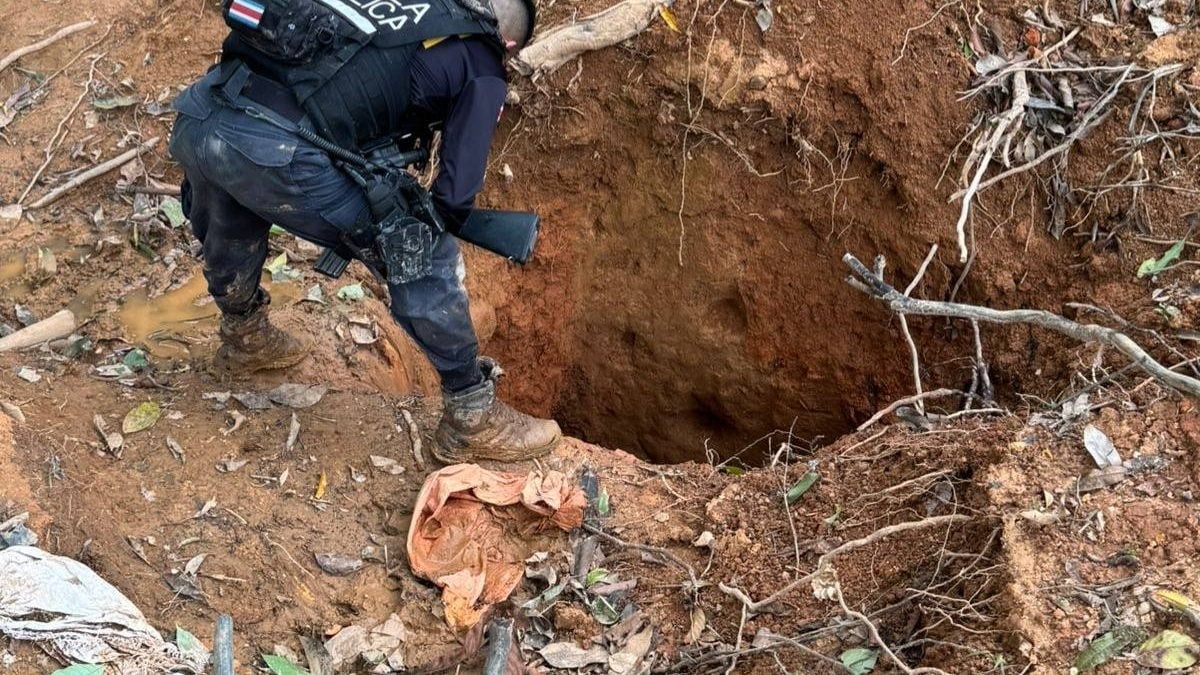
Illegal mining in the Crucitas area and on Conchudita Hill in San Carlos, Costa Rica, is advancing rapidly, causing significant environmental damage, including deforestation and possible soil contamination with toxic substances such as cyanide. The chemical is reportedly used by coligalleros—mostly Nicaraguan artisanal miners—to extract metals such as gold and silver, according to an investigation by La Nación.
Costa Rican authorities continue to struggle to halt the practice. As regularly reported on the social media accounts of the country’s Fuerza Pública (police force), weekly operations are carried out in Crucitas and on Conchudita Hill, resulting in the arrest of dozens of coligalleros, who in Nicaragua are known as güiriseros or artisanal miners.
Between March 6 and 8, Costa Rica’s Fuerza Pública reported on its social media channels the arrest of more than half a dozen Nicaraguan güiriseros in the Crucitas and Conchudita areas.
In an investigation published this week, La Nación visited illegal mining sites on Conchudita Hill in San Carlos and documented the devastation caused over roughly eight months, since the area was taken over by güiriseros in July 2025, according to a police source consulted by the newspaper.
Read also: UN Experts Accuse Ortega-Murillo Regime of Funding Transnational Repression and Global Spy Network
The report details how illegal mining becomes increasingly evident the deeper one enters the area. There, investigators found “tunnels, razed vegetation, indiscriminate logging, and what was once an almost untouched mountain now marked by patches of mud without forest cover, visible even from a drone.”
Extraction sites reaching 20 to 30 meters deep
To reach the extraction zones, La Nación journalists undertook a round trip of at least 10 hours. Their visit confirmed two major illegal excavation sites.
At one location, they identified a mining pit about 20 meters deep, from which güiriseros extract material that is later transported in sacks.
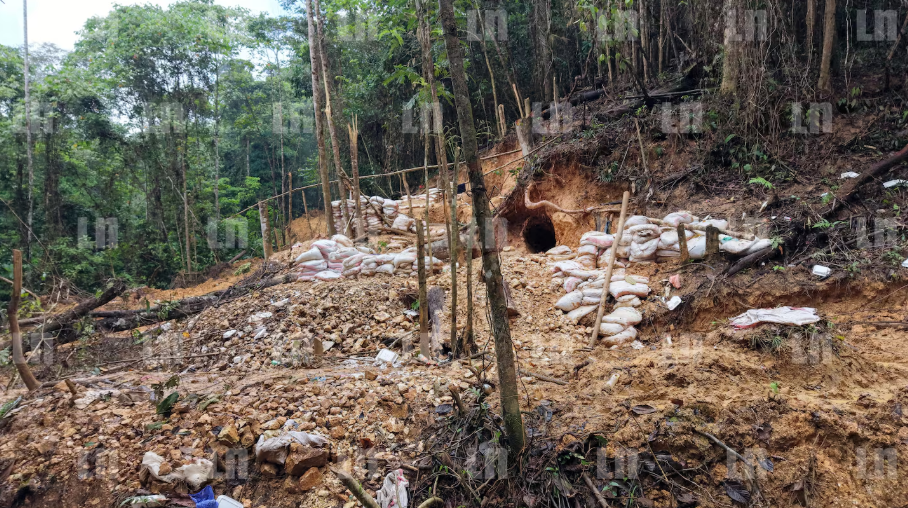
At that first site alone, the publication counted 45 sacks of quartz ready for transport. Inside the massive excavation pits, reporters also found wooden posts—cut from previously felled trees—some about 30 meters long, which miners use as makeshift ladders to climb in and out of tunnels filled with muddy sediment.
Another extraction point visited by the journalists reached roughly 30 meters in depth and showed traces of what had been a miners’ camp. According to the report, the miners had fled the area “due to a police incursion just hours before” the reporters arrived.
Cyanide pools built on Conchudita Hill
Those miners are believed to include eight individuals detained between March 6 and 8 during Public Force operations targeting illegal extraction.
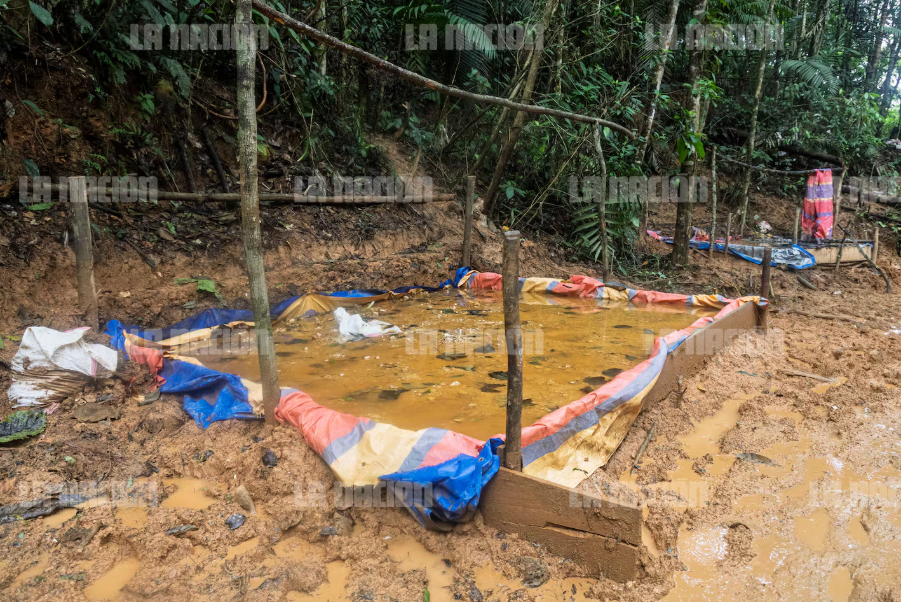
About 50 meters from one of the mining pits, the investigation found two pools roughly four by five meters in size. According to Costa Rican authorities, güiriseros pour cyanide into these pits to process gold.
The report also notes that in the highest part of the hill there are “multiple drill holes in the rock face in search of veins.” Small structures made from sticks and plastic—resembling makeshift tents or shacks—suggest that, as in Crucitas, miners spend the night there whenever police are not present.
Along the banks of the San Juan River on the Costa Rican side, La Nación journalists also observed several bundles or sacks—apparently material extracted illegally—left stranded or awaiting transport across the river into Nicaragua.
Minister of Public Security warned about Chinese companies from the Nicaraguan side
Last month, Costa Rica’s Minister of Public Security, Mario Zamora, told lawmakers that Chinese companies operating “on the other side of the San Juan River,” in Nicaraguan territory, are purchasing sacks of sediment extracted illegally from Crucitas and Conchudita in San Carlos.
Zamora made the claim while presenting the report “Let’s Save Crucitas,” in which he highlighted a more than 200 percent increase in illegal gold extraction in the Crucitas area, as well as the expansion of mining operations to Conchudita Hill. He argued for the urgent approval of a bill promoted by the current Costa Rican government that would legalize open-pit mining in Crucitas.
Also read: Costa Rica Alleges Chinese Companies in Nicaragua Are Buying Stolen Gold From Crucitas
According to the minister, the area affected by illegal mining has expanded from about 900 hectares to more than 3,000 hectares across Crucitas and now Conchudita Hill. He also warned that transnational organized crime operating in the region has evolved illegal extraction methods from artisanal to semi-industrial techniques.
Following the complaints by Costa Rican authorities, Costa Rica and Nicaragua agreed to join forces to intensify patrols in the affected areas to combat illegal mining. However, to date there are no details on the actions to be implemented—or already underway—on the Nicaraguan side.
Read also: Ortega Regime Seized $80 Million U.S. Mining Facility, Handed Assets to Chinese Firm