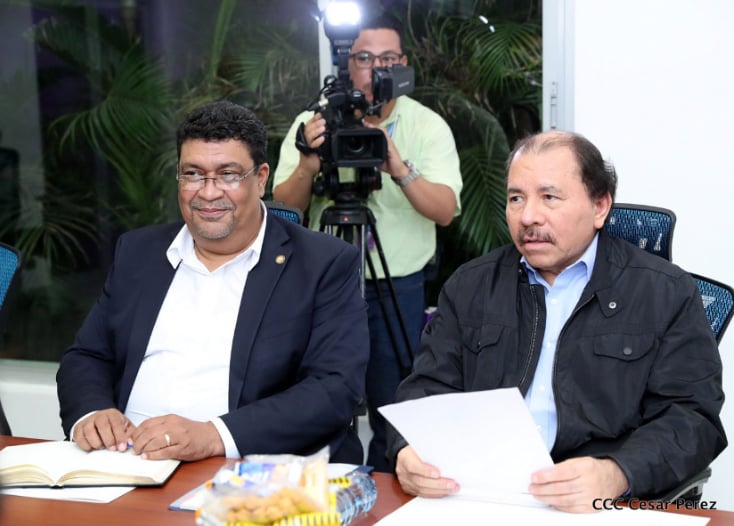
The UN Group of Human Rights Experts on Nicaragua (GHREN) revealed in a report published March 10 in Geneva how the regime of Daniel Ortega and Rosario Murillo uses public funds to finance transnational repression and an espionage network targeting exiles. The document identifies 26 regime operators described as “key” figures in transnational human rights violations, including the current vice foreign minister and former presidential adviser for Policy and International Affairs, Valdrack Ludwing Jaentschke Whitaker.
Jan-Michael Simon, president of the UN expert group, said the political persecution is financed by the dictatorship, carried out through state institutions, and “extends beyond borders to ensure that no one—absolutely no one—stands in the way of the regime.”
The report, based on 73 interviews and more than 1,700 documents, shows that the repression is not improvised but rather “a structure funded with public resources and projected beyond national borders,” Reed Brody, a member of the expert group, told La Prensa.
According to Brody, Ortega and Murillo have built a power apparatus that merges the state with the ruling Sandinista National Liberation Front (FSLN) in order “to silence all dissent inside and outside the country».
Social funds used “to eliminate dissent wherever it exists”
The report states that government funds originally intended for social assistance, sanitation projects, and operational expenses were redirected to finance violent security operations. Among them was the so-called “Operation Clean-Up,” one of the bloodiest phases of the 2018 crackdown, when state repression left hundreds dead.
According to the Organization of American States (OAS), 355 people were killed during protests between April 18, 2018, and July 31, 2019, based on reports from human rights organizations.
The UN document says the regime also created an “extensive transnational architecture” of surveillance and intelligence used to monitor, intimidate, and attack the hundreds of thousands of Nicaraguans living abroad. It highlights the denationalization of 452 Nicaraguans and the existence of thousands of exiles left in de facto statelessness, whose documents have been denied or whose return to Nicaragua has been blocked.
“Diplomatic and consular structures have been instrumentalized to track, monitor, and intimidate Nicaraguans in exile,” said Ariela Peralta, a GHREN member, according to the statement released in Geneva. “This is a deliberate policy to eliminate dissent wherever it may be.”
Brody also revealed that investigators identified companies linked to members of the Sandinista Front operating through nominal budgets by issuing inflated invoices for services never provided.
Who is involved?
According to the report, the intelligence structure of transnational repression involves the army, police, migration authorities, the telecommunications regulator Telcor, diplomatic missions, and FSLN operatives. It specifically mentions the Directorate of Defense Information (DID) and the Military Intelligence and Counterintelligence Directorate (DICIM), both recognized espionage bodies.
The repression includes surveillance, harassment, smear campaigns, misuse of Interpol mechanisms, property confiscations, digital surveillance and harassment, hacking, and the disclosure of personal data (doxing) used to silence critics.
It also documents crimes committed beyond Nicaragua’s borders, including the killing of retired Major Roberto Samcam, who was shot dead on June 19, 2025, in his apartment in Moravia, San José, Costa Rica.
The 26 regime operators of the transnational repression
The report identifies 26 individuals described as “key” actors responsible for transnational human rights violations. The list is headed by:
Néstor Moncada Lau, Valdrack Ludwing Jaentschke Whitaker, Luis Roberto Cañas Novoa, Francisco Javier Díaz Madriz, Juan Victoriano Ruiz Urbina, Zhukov Serrano Pérez, Julio César Avilés Castillo, Leonel José Gutiérrez López, Álvaro Martín Peña Núñez, and Rigoberto Boanerge Balladares Sandoval.
Other names are:
Nahíma Janett Díaz Flores, Roberto José López Gómez, Gustavo Eduardo Porras Cortés, Marvin Ramiro Aguilar García, Juana Méndez Pérez, Alba Luz Ramos Vanegas, Ernesto Leonel Rodríguez Mejía, Octavio Ernesto Rothschuh Andino, Karen Vanessa Chavarría Morales, Nadia Camila Tardencilla Rodríguez, Ana Julia Guido Ochoa, Douglas Roberto Vargas Flores, Javier Antonio Morazán Chavarría, Wendy Carolina Morales Urbina, Fidel Antonio Moreno Briones, and Milton Ruiz García.
Also read: The heartless Luis Cañas: A henchman of the Ortega-Murillo dictatorship
In April 2025, an earlier GHREN report on repression in Nicaragua identified 54 regime officials accused of participating in a systematic policy of repression against the population since 2018. The new list of 26 focuses specifically on those linked to transnational human rights violations.
Valdrack Jaentschke and the direction of transnational repression
Brody cites the example of current foreign minister Valdrack Ludwing Jaentschke Whitaker, formerly Ortega’s adviser on international affairs. Before joining the Foreign Ministry, Jaentschke served as minister-counselor in Nicaragua’s embassies in Guatemala, Honduras, and Costa Rica.
“He was part of a high-level decision-making group that directed the strategy of transnational repression,” Brody said. “Due to his direct proximity to the presidency, he was able from his diplomatic posts to establish influence networks, particularly in Costa Rica, and ensure operational coordination between state and non-state actors. He formed part of a structured political intelligence apparatus abroad.”
Brody noted that Jaentschke’s frequent diplomatic postings are suspicious, especially given that in the 1980s he served as an intelligence officer in the General Directorate of State Security (DGSE) under Cuban advisory support.
“His rapid appointments as minister-counselor and ambassador in one country and then another were not the result of administrative efficiency but rather part of a strategy of external political control that deliberately limited the number of actors capable of carrying out international repression,” Brody said.
According to the expert, Jaentschke’s missions focused on systematic information gathering, monitoring individuals considered opposition figures, and transmitting strategic intelligence to authorities in Managua.
“He has played an important role in transnational repression against Nicaraguans in exile,” Brody added.
Regime should be brought before the ICJ
The UN experts’ report emphasizes the need for international accountability, which they say “is more urgent than ever.” Although Nicaragua has suspended cooperation with the UN Human Rights Council and withdrawn from several UN bodies, Brody said one possible path is a case before the International Court of Justice (ICJ).
“For us, the ICJ is a very powerful avenue in Nicaragua’s case for one fundamental reason: the government of Daniel Ortega and Rosario Murillo recognizes the legitimacy of the International Court of Justice since the historic 1984 case against the United States,” Brody explained.
“Since then, Nicaragua has filed nine cases there. It would be important for a state—or a group of states—to bring Nicaragua before the Court.”
Brody, a U.S. lawyer known as “the dictator hunter,” worked in Nicaragua in the mid-1980s as a human rights investigator during the conflict between the Sandinista government and the Contra insurgency. His research contributed to Nicaragua’s victory in its ICJ case against the United States for supporting the Contras.
Today, he says he views the repression carried out by the Ortega-Murillo government with deep sadness.
“For me it is deeply painful to see that someone who rose up against a family dictatorship is now organizing his own with his wife as co-president,” Brody said. “I have great affection for the Nicaraguan people. It hurts me deeply on a personal level. I hope to see a better country.”