Costa Rica’s Minister of Public Security, Mario Zamora, told members of the Costa Rican Parliament that Chinese companies operating «on the other side of the San Juan River,» in Nicaraguan territory, buy sacks of sediment—from which they then extract gold—that is stolen from Costa Rica.
Speaking before Costa Rica’s Legislative Assembly during the presentation of the report “Salvemos Crucitas (Let´s Save Crucitas),” Zamora said companies operating “on the other side of the San Juan River,” in Nicaraguan territory, are buying sacks of sediment — from which gold is later extracted — that have been illegally removed from Costa Rica.
According to the minister, illegal gold mining in Crucitas, located in the canton of San Carlos, has increased by more than 200 percent. He cited the surge as justification for a bill promoted by the current Costa Rican government that would legalize open-pit mining in the area.
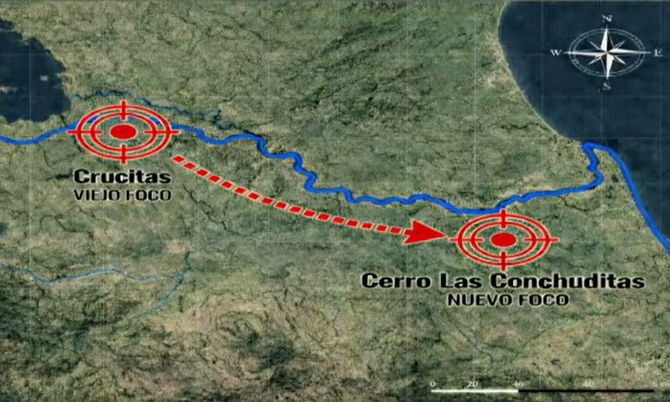
Zamora said the affected area has expanded from 900 to more than 3,000 hectares, now encompassing both Crucitas and Cerro Las Conchuditas. He denounced what he described as evolving transnational criminal networks that have shifted from artisanal to semi-industrial extraction techniques.
Nicaraguan «Coligalleros» Extract Gold Illegally
“This phenomenon affects not only our country’s ecological sovereignty, but our sovereignty in general terms,” Zamora told lawmakers. “Ninety percent of the ´coligalleros´ are foreign nationals, primarily Nicaraguans who cross the border to participate in this illegal activity.”
He added that newer extraction methods are based in Nicaraguan territory. “When a sack of sediment is removed, a skilled ´coligallero´ using mercury or cyanide can extract between 15 and 20 percent of the gold contained in that sack,” he explained.
“At this moment, there are Asian companies on the other side of the San Juan River purchasing these sacks of earth. Their extraction techniques allow them to recover up to 95 percent of the gold contained in each sack,” Zamora said.
When questioned by lawmaker Gilberto Campos of the Liberal Progressive Party about the origin of those Asian companies, Zamora specified that they are Chinese firms.
No Coordination With Nicaragua
Campos also asked whether Costa Rica had established any coordination with Nicaraguan authorities to address the issue. Zamora initially declined to answer publicly, saying he would only share that information confidentially. Pressed further, he suggested there is no formal communication between authorities in the two countries.
More Than 16,000 Sacks Seized
During the report’s presentation, Zamora detailed that security forces seize approximately 3,000 sacks of sediment per operation, each weighing about 50 kilograms.
“To date, we have seized more than 16,000 sacks. The average weight is 50 kilograms. We are talking about 150 metric tons in just 3,000 sacks,” he said.
Without those seizures, Costa Rica would have lost at least 800 metric tons of sediment from which gold could have been extracted, according to official estimates.
Zamora stated that all sediment removed from Costa Rican territory is sent to Nicaragua by organized criminal groups and later purchased by Chinese companies that, he said, do not question its origin.
Mining Concessions Near the Border
In recent years, the government of Daniel Ortega and Rosario Murillo has granted thousands of hectares of mining concessions to Chinese firms.
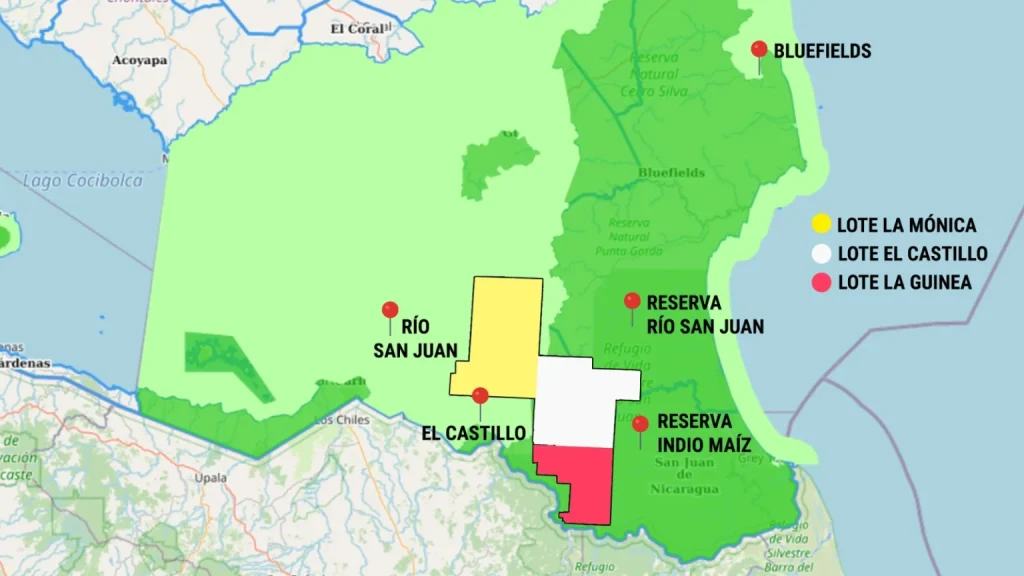
The company Thomas Metal, according to previous reports, holds more than 180,000 hectares in mining concessions. At least three lots — awarded in July and August of last year — are located in border areas near Costa Rica.
Two of those lots, El Castillo and La Guinea, together total 61,054.3 hectares in Nicaragua’s Río San Juan department. Environmental organization Fundación del Río has warned that the concessions overlap with or lie near the Indio Maíz Biological Reserve, a protected area.
Border Markers Altered
Zamora also alleged that illegal mining groups have destroyed or altered border markers defining the boundary between Costa Rica and Nicaragua, allowing them to evade arrest when security patrols approach.
Markers 3, 8, 10, and 11 have allegedly been removed or destroyed. Costa Rica’s National Geographic Institute has been notified and will work with police protection to restore them to their official positions, he said.
Mounting Costs and Arrests
The minister stated that the monthly cost of combating organized crime linked to illegal mining in the region amounts to $1 million for Costa Rica’s Security Ministry.
Approximately 200 members of the Public Force are deployed to the area. Authorities have dismantled more than 114 illegal mining tunnels, arrested 125 individuals caught in the act, and detained 3,692 others for related offenses.
Security forces have also seized generators, mixers, mercury, and cyanide, and have intervened in boarding houses and logistical hubs used by coligallero groups involved in illegal gold extraction.