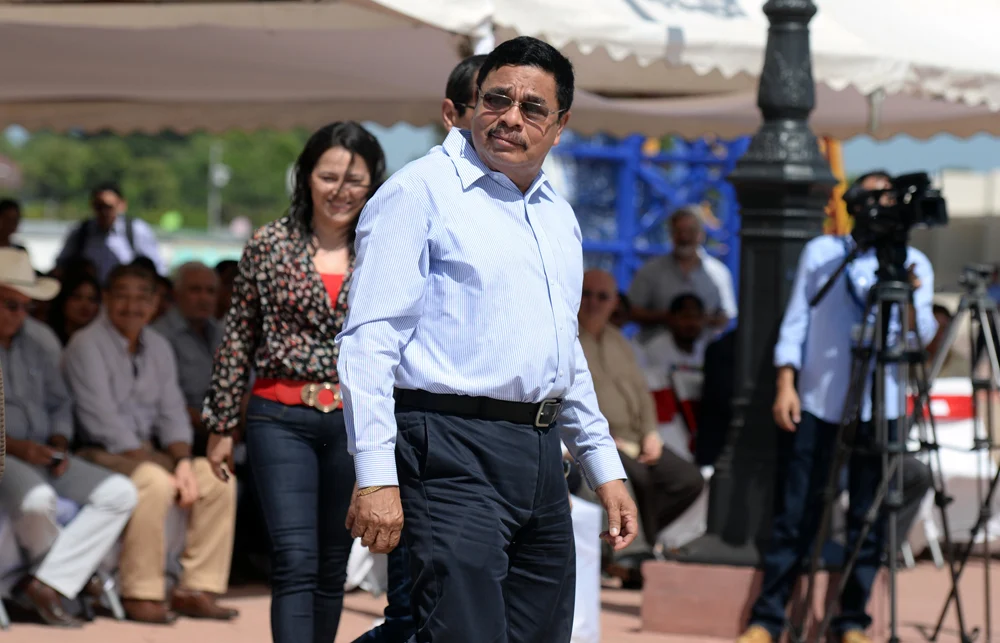
Internal purges within the Sandinista regime continue to target figures who historically safeguarded the economic interests of the Ortega-Murillo leadership. The latest to fall is Francisco “Chico” López Centeno, long-time treasurer of the ruling Sandinista National Liberation Front (FSLN) and a key figure in managing Venezuelan oil cooperation through Alba de Nicaragua, S.A. (Albanisa).
López has reportedly been stripped of all responsibilities related to managing the nearly $4 billion obtained through the oil agreement with Venezuela—funds that never entered the national budget and whose whereabouts remain unknown.
López’s removal from his former role overseeing Venezuelan oil cooperation—administered with broad discretion—also extended to his deputy at Albanisa, retired Major General Ramón Calderón Vindell, who is reportedly in custody.
Read also: Indian Billionaire Vikram Sodhi Visits Nicaragua, Meets Ortega´s Son Amid Mining Sector Scrutiny
Before retiring in February 2010, Calderón was third in command of the Army. He served on the General Command and was inspector general of the military institution. After his retirement, he became involved in managing Venezuelan cooperation funds, eventually becoming a key operator in handling these resources.
Economic operators fallen from grace
With Chico López and Calderón Vindell, five long-standing economic operators of the Sandinista regime have now fallen from favor. As in previous cases, the purge removes loyalists to Daniel Ortega who for decades allegedly engaged in corruption, enabling both themselves and their former allies and patrons—Daniel Ortega and Rosario Murillo—to enter various businesses and accumulate wealth illicitly. These figures and other loyal operatives are now being replaced by individuals closer to and more loyal to Rosario Murillo.
Sources close to La Prensa confirmed Calderón Vindell’s arrest on Tuesday, March 24, and his subsequent transfer to holding cells at a police station in Managua. His detention may serve as a clear warning to Chico López, who could eventually join the growing list of former allies now imprisoned and accused of corruption—acts that were previously promoted and tolerated by Ortega and Murillo, as long as they shared in the profits.
The distribution of profits may be at the root of these figures’ downfall. Some opposition voices suggest that failing to deliver the “agreed share” of earnings from corrupt business dealings to their superiors could be driving these internal purges within the ruling circle.
Growing list of purged historical allies
With López and Calderón, the list of historical Sandinista figures now effectively held by their former political allies—whom they helped enrich and protect—continues to grow. First came investment adviser and retired general Álvaro Baltodano Cantero and his son Álvaro Baltodano Monroy, followed by former economic adviser and revolutionary commander Bayardo Arce. Arce was accused of laundering more than $5 billion, allegedly with the assistance of his aide Ricardo Bonilla Castañeda, his wife Amelia Ybarra-Rojas, and his brother-in-law Amílcar Ybarra-Rojas, the latter two shareholders in the company Agricorp.
Chico López’s relationship with Calderón Vindell in managing Venezuelan cooperation dates back to 2010, but it strengthened in July 2018. After the United States sanctioned López under the Global Magnitsky Act, he “resigned” from his positions as chairman of the boards of Petróleos de Nicaragua (Petronic) and the Nicaraguan Mining Company (Eniminas).
On the same day his resignation was accepted, Daniel Ortega appointed Ramón Humberto Calderón Vindell as president of both Petronic and Eniminas, with ministerial rank. Prior to that, the military officer had already been managing Alba Generación, one of Albanisa’s commercial arms.
Calderón Vindell, a man sanctioned by the United States
The retired military officer remained at the helm of Petronic until February 2019, stepping down after the United States sanctioned Venezuela’s state oil company, Petróleos de Venezuela, S.A. (PDVSA), which owns 51 percent of Albanisa.
He remained president of Eniminas until February 2022, when the U.S. Department of the Treasury sanctioned six officials, including Calderón Vindell, for “state acts of violence” against political opposition and protests, which left more than 350 dead, thousands injured and imprisoned, and over one million people in exile.
In Calderón Vindell’s specific case, the sanction aimed to target profits the regime was obtaining from gold production and commercialization through state control. A similar measure was applied to Salvador Mansell Castrillo, also sanctioned by the Treasury Department as a member of the boards of the state-owned Petronic and Eniminas.
Read also: BHMB Mining Sues Nicaragua for $80 Million, Citing Illegal Expropriation of Gold Facility
What happened to Venezuelan cooperation?
The relationship between Venezuela’s Chávez-era government and the Ortega-Murillo leadership materialized in financial cooperation over several years, reportedly exceeding $4 billion. According to reports from the Central Bank of Nicaragua (BCN), this began in 2007 following Daniel Ortega’s return to power, with an initial contribution of $70 million.
The funding grew annually, peaking in 2013 at $558.5 million. However, it began to decline in 2014 and dropped to zero by 2019. In subsequent years, the BCN no longer recorded any inflows from Venezuela.
In official external cooperation reports for 2019 through 2022, the Central Bank recorded zero income from PDVSA loans—the mechanism used to log this debt, which was classified as private. In its 2023 report, the most recent published to date, PDVSA no longer appears on the list of external financiers. Only Venezuela is listed, also showing zero contributions.