The departure of 77-year-old Alba Luz Ramos Vanegas from Nicaragua’s Supreme Court of Justice (CSJ) completed a sweeping reshaping of the country’s highest court, dominated by officials with ties to the ruling Sandinista National Liberation Front (FSLN) and the state repression apparatus. Several have been sanctioned or cited internationally over their involvement in the persecution of government opponents and human rights violations.
The court’s overhaul, which followed a purge of the judiciary and accelerated in 2025, removed nine of the 10 justices previously listed as members of the Supreme Court. Eight of those 10 were also FSLN members. The changes are part of a broader restructuring of the Nicaraguan state under the new Constitution and the “co-presidential” model headed by Daniel Ortega and his wife, Rosario Murillo.
Constitutional changes approved in 2025 established Murillo as co-president and further subordinated Nicaragua’s state institutions, including the judiciary, to the presidency. The tenure of Alba Luz Ramos was also marked by a judicial system used to advance Ortega’s political interests, including actions against opposition parties and the prosecution and imprisonment of government opponents.
Experts consulted by LA PRENSA say the changes have eliminated remaining internal centers of power and further centralized political and administrative control over the judiciary under Daniel Ortega and Rosario Murillo.
Also read: Why Beijing Is Defending Ortega’s Constitutional Overhaul in Nicaragua
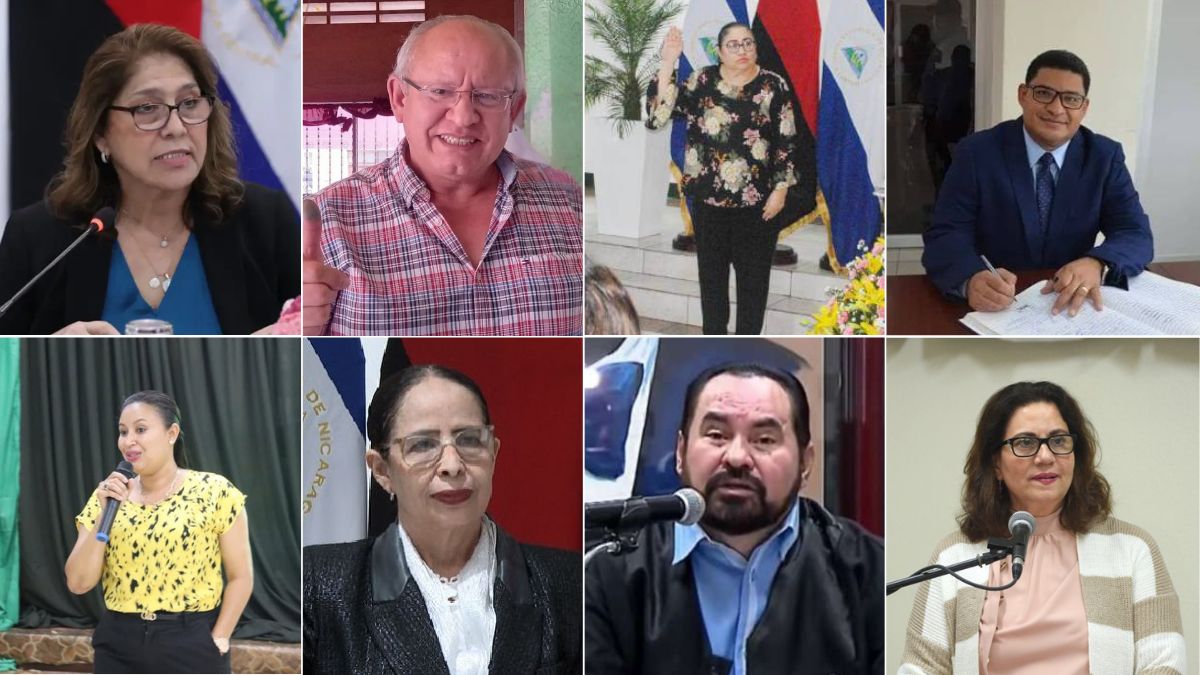
Who are the new justices?
Ana Julia Guido, 67, has officially served as president of the Supreme Court since Sept. 1. She has spent 47 years in public service, including 27 years in the National Police, where she was second in command during Edwin Cordero’s tenure. She later served eight years as deputy attorney general and 11 years as attorney general before being appointed to the Supreme Court in November 2025.
Guido has been sanctioned by the United States, Canada, the European Union, the United Kingdom and Switzerland over her role in the government’s repression since 2018. The European Union said she created a specialized unit that fabricated allegations against protesters and brought charges against them.
José Manuel Fuertes, 65, has no known previous career as a judge or justice. He served on the Departmental Electoral Council and was an FSLN political secretary in Boaco. His wife, Yaoska Espinoza Peña, is a former two-term mayor of Boaco. After recently being elected vice president of the Supreme Court, Fuertes pledged “zero tolerance” for corruption.
María Elsa Frixione Ocón is a lawyer and notary public who has represented the Nicaraguan state before the Inter-American Court of Human Rights. Before her appointment to the Supreme Court on Dec. 4, 2025, she served as the national constitutional and administrative litigation prosecutor in the Attorney General’s Office. As a state representative before international bodies, she denied in 2014 that human rights were being violated in Nicaragua.
Rosa Argentina Solís has been an FSLN territorial leader in Managua and served on the First Criminal Chamber of the Managua Court of Appeals. During Nicaragua’s political crisis, she participated in so-called “informational hearings” involving political prisoners held at El Chipote, proceedings criticized for irregularities. In July 2023, the United States placed her on the Engel List over her role in actions against opponents of the Ortega-Murillo government. She was sworn in as a Supreme Court justice on Nov. 28, 2025.
Ernesto Leonel Rodríguez Mejía began his judicial career in 2003 as a hearings judge in Matagalpa before moving to Managua, where he became a criminal judge in 2016. In February 2019, he was promoted to the Managua Court of Appeals and became its president in October 2021.
The United States sanctioned Rodríguez in 2023 over his involvement in stripping 94 Nicaraguan government opponents of their citizenship. The U.N. Group of Human Rights Experts on Nicaragua (GHREN) also identified him in connection with the supervision of proceedings against political prisoners. He was promoted to the Supreme Court in late 2025.
Octavio Ernesto Rothschuh Andino served as a judge in Nueva Guinea, Juigalpa and Managua before being appointed to the Managua Court of Appeals in 2018. In July 2021, he became president of its First Criminal Chamber.
Rothschuh is also known for declaring 222 Nicaraguans “traitors to the homeland” and ordering their “immediate deportation.” The United States sanctioned him a month later. GHREN included him among 54 officials it identified in connection with repression in Nicaragua.
Shura Bonilyn Welcome Crawford, a native of Corn Island, worked there as a prosecutor and local judge before moving to the Criminal Trial District Court in Bluefields. She is also known for convicting journalist Kalúa Salazar of “slander” in 2020. She has family ties to Supreme Electoral Council magistrate Lumberto Campbell. Welcome was sworn in as a Supreme Court justice on Nov. 25, 2025.
Juana Méndez Pérez joined the FSLN at a young age and was part of the General Directorate of State Security in the 1980s. She is the widow of guerrilla commander Walter Ferretti.
As a judge, Méndez became known for shelving the sexual abuse complaint filed against Daniel Ortega by his stepdaughter, Zoilamérica Ortega Murillo. She also sentenced former President Arnoldo Alemán to 20 years in prison on multiple charges in 2003. She joined the Supreme Court in 2007. Méndez was briefly removed from the court in 2025 but returned a day later. She is the only justice from the court’s previous lineup to have survived the purge.
Before the recent appointments, the judiciary’s website listed 10 Supreme Court justices: Alba Luz Ramos Vanegas, Marvin Ramiro Aguilar García, Yadira Centeno González, Armengol Cuadra López, José Manuel Martínez Sevilla, Armando José Juárez López, Gerardo Arce Castaño, Ellen Joy Lewin Downs, Virgilio Gurdián Castellón and Juana Méndez Pérez.
With the exception of Méndez, all are now gone: Ramos resigned this year and the others left in 2025.
A replacement for Ramos has yet to be named. The backgrounds of the current justices, however, show a pattern of ties to the FSLN and the government, while several have been sanctioned or cited internationally over human rights violations and actions against political opponents.
Judicial control serving political interests
Human rights expert Uriel Pineda says the purge of the judiciary and the appointments to the new Supreme Court are part of an effort to eliminate remaining internal “fiefdoms of power” and shift from political control to direct administrative control.
Ramos and other former justices retained some room to appoint personnel, exercise influence and control lower-level networks, Pineda said. The restructuring, he argues, eliminates that autonomy.
“It is about centralizing every operation of power in Nicaragua through control of the judiciary,” Pineda said.
Pablo Cuevas, founder and director of the Nicaraguan Human Rights Defense organization (DNDH), said the new court “will operate according to the interests of the ruling couple” and that the purges within the judiciary are intended to instill fear among its employees.
Also read: Ortega’s Electoral Reform Explained: Seven-Year Terms and a Ban on Nicaragua´s Opposition