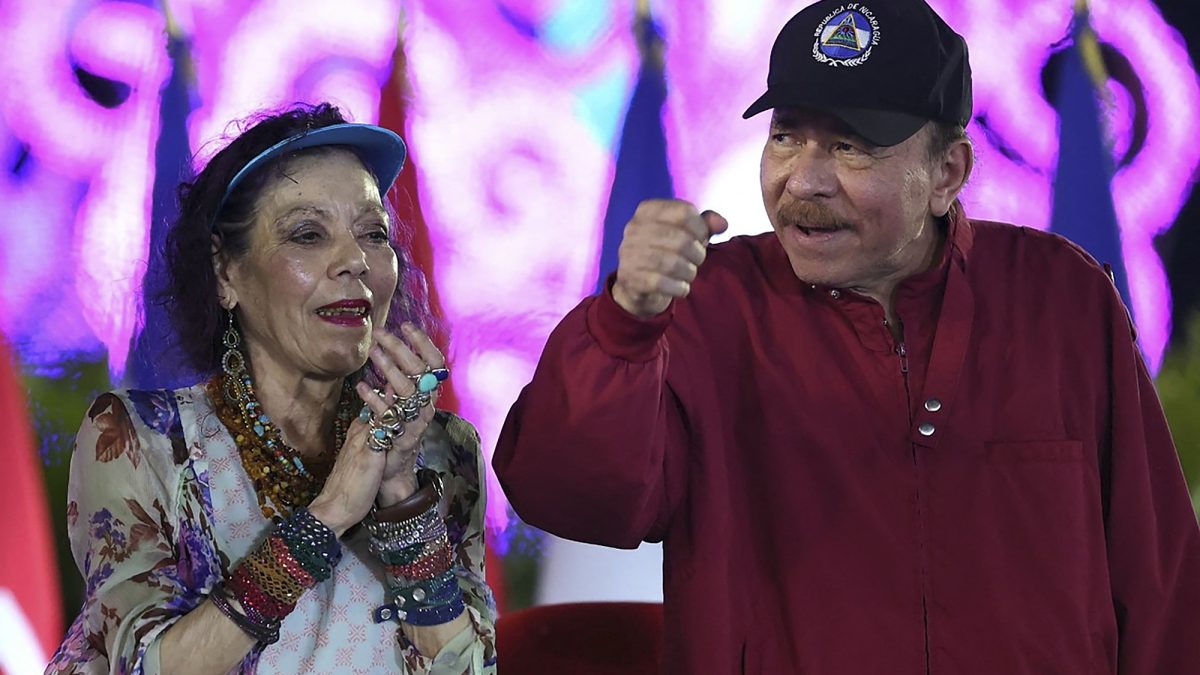
As the international community continues to pressure the regime of Daniel Ortega and Rosario Murillo over its decision to abolish elections in Nicaragua, the co-dictators remain defiant. In early September, the National Assembly is expected to approve electoral reforms designed to cement their indefinite hold on power.
Since Ortega declared on the night of July 19 that «there will never again be elections» in Nicaragua, the international community has responded with widespread condemnation. The government’s narrative then shifted to insisting that «there will be elections,» but without what it calls «traitors to the homeland,» as pro-Ortega National Assembly Speaker Gustavo Porras has stated in interviews and as the dictator reiterated last Friday.
«We are working on constitutional reforms. The National Assembly is working so that elections can be held in Nicaragua with sovereignty, and not as they were during the era of U.S. invasions,» Ortega said Friday during a ceremony marking the 47th anniversary of the Army’s Air Force and Air Defense. That same evening, he insisted the reforms would leave no room for what he called «terrorists» and «coup plotters,» terms he uses to describe exiled and banished opposition figures.
The reforms, which would amend several articles of the Constitution and other laws, are currently undergoing what the government describes as a consultation process. As part of that effort, the regime has summoned the diplomatic corps accredited in Nicaragua, senior military officers, the National Police, the Ministry of the Interior, representatives of the banking and financial sectors, and other groups to appear before the National Assembly’s Constitutional Commission. The proposed text has not been made public, but Gustavo Porras, Daniel Ortega, and Rosario Murillo have all outlined its main provisions.
Read also: Chronicle of the Original Illegitimacy of the Ortega-Murillo Regime
No Room for the Opposition
One of the central elements of the proposal is the elimination of political competition to the dictatorship. By amending Article 47 of the Constitution, the reform would effectively eliminate any possibility that opposition figures—most of whom are now living abroad—could participate in future elections.
Under the 2025 constitutional reform, Article 47 established that citizens have the right to vote, be elected, and hold public office, «subject to the limitations established» in the Constitution itself. The new proposal would prohibit Nicaraguans from seeking public office if they are deemed to have violated the Constitution, been labeled «coup plotters» or «traitors to the homeland,» or acted against the country’s independence, sovereignty, or self-determination.
«The reform includes constitutional changes to ensure that all those who participated in coup attempts… cannot take part in electoral processes,» Porras said in an interview with Telesur on August 1.
Elections Every Seven Years
As Ortega, Porras, and Murillo have repeatedly stated, the government insists that «there will be elections,» but they would be held every seven years.
«We are giving full authority to the Supreme Electoral Council (CSE) to apply the principles we have discussed and to call elections every seven years,» the National Assembly speaker said.
The reforms would also make it easier for the government to eliminate political parties and candidates viewed as potential challengers. The proposal grants the CSE the authority to revoke the legal status of political organizations that receive «foreign funding» or whose members «call for foreign intervention,» whether military intervention or international sanctions.
Extending Time in Power
The regime remains committed to extending its rule indefinitely. Under the proposed reform, the presidential term would be lengthened by another year. Last year, Ortega and Murillo secured six-year presidential terms, up from the previous five years. The new proposal would extend those terms to seven years, with the possibility of reelection.
«The proposal we are developing and consulting with the people is that, in Nicaragua, stability means having seven-year electoral terms,» Porras said.
Seven-Year Terms for the Regime’s Inner Circle
Ortega and Murillo would not be the only officials to remain in office longer. The reforms also reward the loyalty of the regime’s closest allies. Military and police chiefs—who have already endorsed the initiative and pledged loyalty, obedience, discipline, and commitment to the country’s leadership—would also receive seven-year terms, as would lawmakers, mayors, regional governments, ministers, and other senior officials.
«Seven years for all elected offices, but also for positions appointed by the president or elected by the National Assembly,» Porras said.
The National Police, the Army, the Ministry of the Interior, and 54 public officials have been identified by the Group of Human Rights Experts on Nicaragua (GHREN) as participants in the brutal repression unleashed since 2018. Several of them have also been sanctioned by the United States, Canada, the United Kingdom, Switzerland, and the European Union. Murillo heads that group.
Defying the United States
The regime faces widespread international condemnation not only over its decision to abolish elections and overhaul the electoral system, but also over alleged crimes against humanity and human rights violations committed, particularly since the protests that erupted in April 2018.
The U.S. State Department has said that Washington and the international community will not «stand idly by» following Ortega’s announcement that Nicaragua will no longer hold elections. More than a dozen countries have issued similar condemnations. The United Nations, the Inter-American Commission on Human Rights (IACHR), and the Organization of American States (OAS) have also denounced the move, with the OAS even considering convening a meeting of foreign ministers.
The growing international isolation comes after the capture of their ally Nicolás Maduro and his wife in Venezuela, while Cuba’s government is also facing mounting pressure from the United States. In Latin America, Ortega’s government no longer enjoys the support of Brazil or Bolivia, much less that of governments that have shifted to the political right. Its remaining close allies are Russia, China, and Iran, none of which intervened to help Maduro. Despite this, Nicaragua’s ruling couple and their inner circle insist they are not intimidated.
A Regime Accustomed to Pressure
«We are not afraid in Nicaragua. We are not afraid of whatever pressure may come. I understand they are once again calling that farce they call the OAS… but they will never erase from the hearts of the Nicaraguan people the progress we achieved during the first ten years of the Revolution, from 1979 to 1990, despite the war imposed by those same Yankees,» Porras said.
The National Assembly speaker argued that the government is accustomed to such pressure.
You may be interested: How Daniel Ortega Ended Elections in Nicaragua: Five Key Moments That Led to Dictatorship
«We fought the Contras for ten years—they were the military expression of the Yankees during that period—and you had the devil himself as president, Ronald Reagan,» he added.
Since returning to the presidency in 2007, Ortega has steadily dismantled institutional checks to secure his continued rule. In 2009, a Supreme Court ruling cleared the way for presidential reelection. Between 2013 and 2014, constitutional and legal reforms placed both the Army and the National Police directly under presidential authority. The 2025 constitutional reform then extended terms for elected offices from five to six years, a change that also benefited the commanders of the armed forces.
Ortega has remained in power for more than 19 years through what civil society organizations, political groups, and international bodies have described as electoral fraud and systematic repression. To avoid accountability for alleged abuses, critics argue, his government has increasingly invoked the concept of national sovereignty while using it to justify the persecution of political opponents.