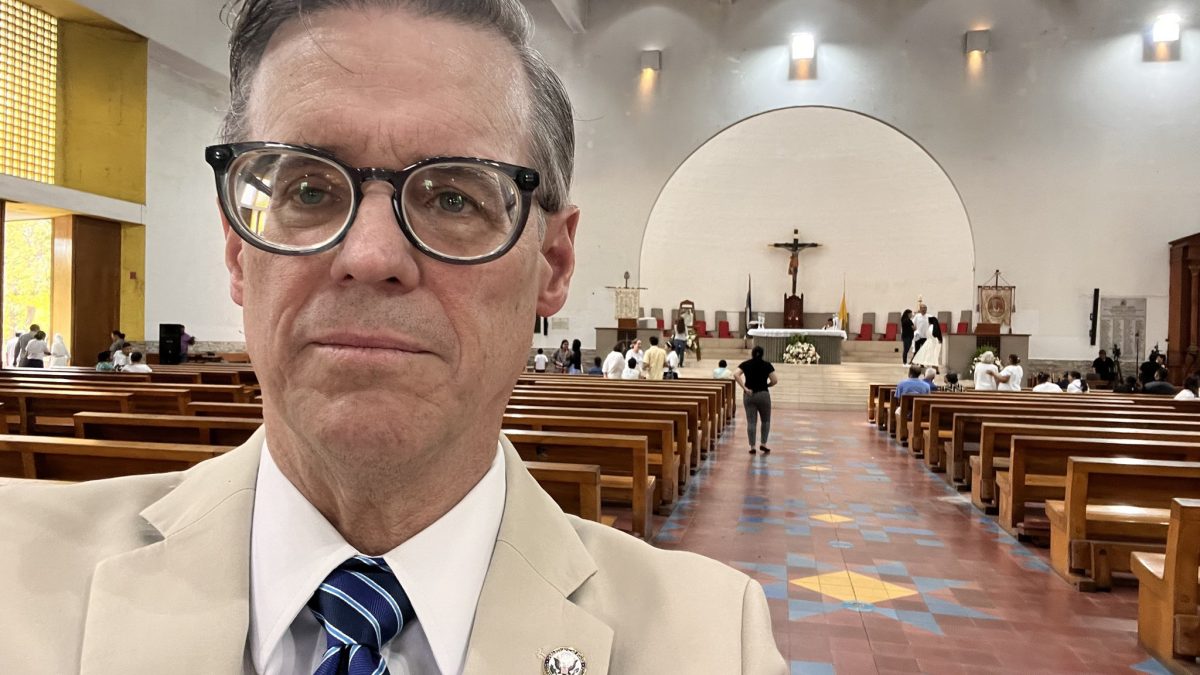
Historian Kevin O’Reilly, former head of mission for the United States in Nicaragua, uses four words to describe the family dictatorship that rules Nicaragua: “It is an unstable structure.” But the diplomat paints a broader and more complex portrait of a rigid system led by Daniel Ortega and Rosario Murillo, where “even the family itself has the right to support the parents, but not to assume (political) responsibilities.”
O’Reilly recently retired from the U.S. Foreign Service, ending a 38-year career that took him to different parts of the world, including Mexico City, Santo Domingo, Buenos Aires, Jakarta, and, of course, Nicaragua.
From his experiences in Nicaragua, he treasures many memories, several bags of coffee gifted by friends, and a pet that unexpectedly entered his life in Managua. “He’s an immigrant from Nicaragua. His name is Lorenzo,” he explains during a Zoom interview from Washington, just as the gray cat walks behind him looking for a window to reach the backyard.
Read also: Another Challenge to U.S.: Laureano Ortega to Sign “Biological Security” Accord With Russia
The diplomat reappeared publicly on May 5 at a forum in Washington, D.C., where he spoke about the dictatorship. Originally from Evanston, Illinois, he holds a Master of Arts degree from the U.S. Naval War College. He likes to quote poet Walt Whitman and is descended from Irish immigrants. His grandfather William arrived in Chicago in 1915.
Many Nicaraguans believe that the possible fall of Maduro in Venezuela and U.S. talks with Cuba could place Nicaragua at the center of Washington’s political attention. The diplomat says the current U.S. administration could consider “more direct pressure,” though he emphasizes he is speaking now as a private citizen outside the Foreign Service.
“You said you left the Foreign Service in April. How does it feel to retire after being such a globetrotter?”
“No, it’s fine! I entered our diplomatic service at a fairly young age, directly after legal studies and postgraduate work in international relations. I had the opportunity to begin in Southeast Asia, but I spent most of my career in the Americas, or working in various government institutions here in Washington.
“I had the chance to work on cultural issues, public security, political analysis, and bilateral relations between my country and Mexico, Argentina, Indonesia, the Dominican Republic, Nicaragua, Panama, and several other challenges. It was not always easy, but it was always deeply rewarding — an opportunity to contribute.”
“And Nicaragua?”
“Managua was also interesting, because Nicaragua is in an… interesting situation,” he says with a laugh. “With serious difficulties. I often told my friends, colleagues, and family that it is a wonderful country with an unpleasant government.”
“Two problems: repression and difficulty mobilizing support abroad”
Asked about the country’s current situation months after giving a previous diagnosis, O’Reilly says he deliberately stopped using the word “regime” during his time in Nicaragua.
“I adopted the practice during my stay there — in our communications and in the way I spoke — of never using the word regime. ‘Regime’ can sound abstract. Dictatorship is very clear. Even people who do not follow Nicaragua day by day understand perfectly well that it is a dictatorship.
“You understand better than any foreigner that there has been a destruction and corruption of state institutions. I read last night that another radio station disappeared in the last 24 or 36 hours. This simply indicates a long-term trend in which they no longer even try to hide the objectives of the state.”
The diplomat refers to the 2018 crisis, when the dictatorship violently suppressed mass protests. The Inter-American Commission on Human Rights reported that 355 people were killed between April 18, 2018, and July 31, 2019. Repression has since included imprisonment, denationalization, exile, tighter internal social control, and surveillance of exiles abroad.
“There are two problems I see for Nicaragua. First, repression is increasing — not gradually, but continuously. That makes it difficult to mobilize support outside the country. There are no dissenting voices within the government, the justice system, the National Assembly, municipalities, the media allowed to operate inside the country, or even at the borders.
“It is a very rigid structure. And rigid structures maintain themselves by placing restrictions on society until they break.”
“It is a personalist dictatorship”
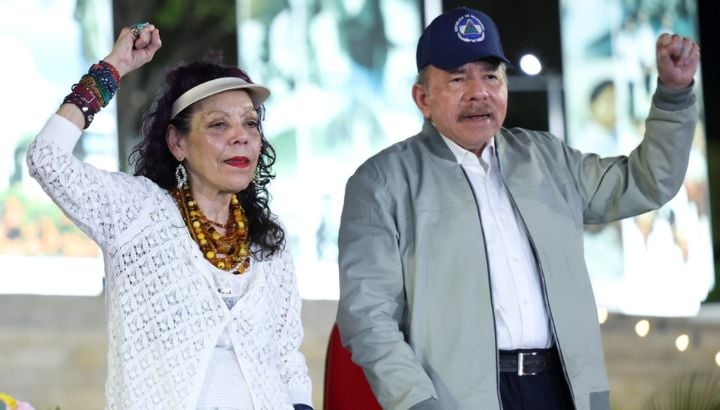
“What could happen? You described the dictatorship as personalist during the May 5 discussion organized by the Inter-American Dialogue.”
“To prepare for our discussion, I revisited Sandinista statements from 1975, 1976, and 1980 — the promises they made to Nicaraguans at the time. I would say they betrayed the people by abandoning those institutional commitments. They betrayed many of their own members who supported what happened in 1979.”
He argues that even many supporters of the 1979 revolution now see “a betrayal of all the principles” once used to mobilize the population.
“They sidelined not only members of the Sandinista Renovation Movement, but also people who stood beside them for decades. There is very little flexibility. The people making decisions today were the young revolutionaries of 1979. Now they are 74, 80 years old or older. Their companions from that era are in prison or exile.”
“And that is why I said it is a personalist institution. People do not make independent decisions without the personal approval of one of the so-called ‘co-presidents.’ There is no sustainability to the system itself, because once they leave the scene, a national crisis is almost inevitable.”
You may read: Russia Boosts Military Presence in Latin America with Nicaragua Agreement
Rosario Murillo as “chief of operations”
Asked about the unusual structure of a husband-and-wife dictatorship, O’Reilly compares it to ancient Rome.
“I remember reading about this during my university studies. Eventually Octavian consolidated power and became the first emperor of the Roman Empire. But aside from that, it’s not very common,” he says with a smile.
On Rosario Murillo, he says testimonies from former Sandinistas portray her as the figure who ordered the 2018 repression.
“Laureano Ortega is 43 years old, but he is not ready to assume serious responsibility. Yes, he is the liaison with the Russians and certain business figures, but the final voice always remains with the couple. And the chief of operations appears to be Rosario. Perhaps the veto power, or the broad strategic framework, remains with Daniel Ortega.”
He emphasizes that the inner circle is extremely small.
“Even trusted people such as Humberto Ortega, Álvaro Baltodano, and even family members end up outside the circle. They have the right to support the parents, but not to assume political responsibilities. I am not speaking about democracy, but simply how the dictatorship functions. That makes it a very unstable structure.”
“I do not see support”
Why does this instability concern you?
“First, because their system itself could enter into crisis. Second, because when the country’s political direction changes — and it will change — the transition will be difficult.
“I see a society that is silenced and restricted, but I do not see support. People inside the state apparatus seek stability, a paycheck at the end of the month, food for their children. But I do not see revolutionary enthusiasm as perhaps existed in other periods.”
He warns that Nicaragua faces a major institutional vacuum.
“There is no justice system, no judges in the way the world understands the concept — people able to act autonomously with social legitimacy. The challenges will be enormous when transition comes. Hopefully it will not be violent, because Nicaraguans do not want to relive the violence that has marked so much of their history.”
“The dictatorship itself threatens violence”
Asked whether he fears violence, O’Reilly says:
“People must find ways to avoid an explosion of violence. Since Central American independence 205 years ago, Nicaragua has suffered too long under violence, and society deserves something better.
“Sometimes explicitly, the dictatorship’s threat is: ‘Do not challenge us, or violence will come.’ This is not a stable structure either politically or socially.”
Still, he believes commitment to peaceful democratic change runs deep among Nicaraguans.
“But a disorderly collapse of this dictatorship could provoke at least a period of instability. Hopefully that will not happen.”
“The United States will always play a role”
In his farewell message to Nicaragua during Christmas 2025, O’Reilly said Nicaragua was suffering “undeniable difficulties” and insisted that the country’s future would ultimately be built by Nicaraguans themselves.
Asked whether Nicaragua could become more important in Washington after developments in Venezuela and renewed discussions with Cuba, he says:
“Sovereignty belongs to the Nicaraguan people, not to the dictatorship or the party. We have an interest in a prosperous, stable, democratic Nicaragua. But ultimately, we will never define another country’s future.
“Nicaraguans themselves must assume responsibility for the future of their country and society.”
Still, he notes the deep connection between the two nations.
“There are now thousands of Americans of Nicaraguan origin. There are naturalized Nicaraguans, refugees, asylum seekers displaced by the situation in their country. That is a permanent reality.”
He also points out the geopolitical reality of proximity.
“We are neighbors and partners. We will always have a role — positive, negative, direct, whatever it may be — but that is reality. And that is why diplomacy exists.”
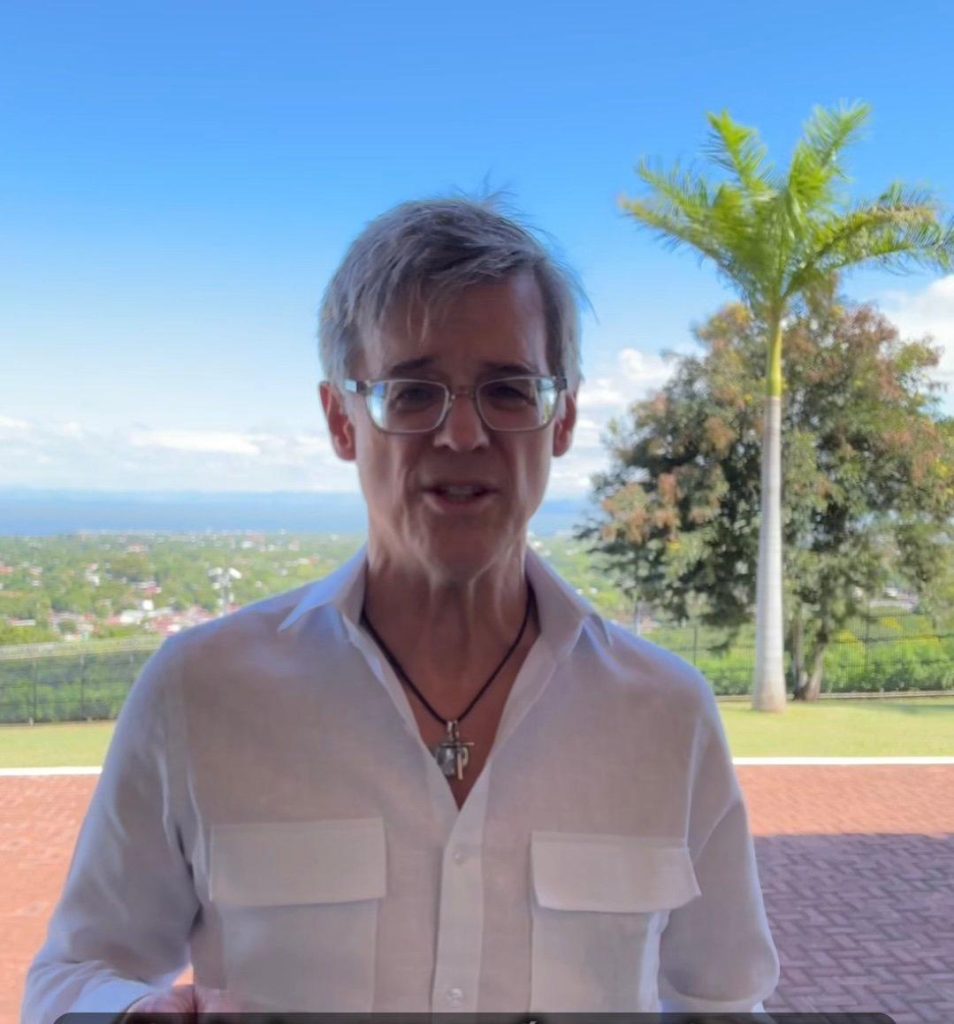
Kevin O’Reilly, former chargé d´affaires of the US in Nicaragua
“More direct pressure” remains possible
Speaking candidly as a retired diplomat, O’Reilly acknowledges that Washington could eventually adopt stronger measures.
“I am not a fan of direct interventions in the internal life of other countries. As a diplomat, my duty was always to protect the interests of my citizens and my nation.
“But I see it as at least possible that the current U.S. administration could consider more direct activities or pressure — perhaps not in the same way we have seen in Venezuela, but the possibility must be considered.”
He says Nicaraguans must think carefully about how to respond if such a situation arises.
“They must always think about restoring fully representative institutions, autonomy, and sovereignty belonging to the nation and its people — not to a narrow interest group. The dictatorship has dragged many institutions down with it, and reconstruction will take time, effort, and goodwill.”
Read also: Nicaragua’s Gold Industry Under Fire: U.S. Sanctions Escalate Pressure on Ortega
“Hope is always the last thing to disappear”
Reflecting on his years in Nicaragua, O’Reilly says ordinary Nicaraguans consistently treated him with generosity.
“Sometimes I may have seemed distant, but it was simply to avoid creating problems for individuals or their families with the dictatorship.”
Despite political repression, he sees resilience within society.
“People may not be able to speak freely, but they remain capable of thinking.”
Quoting Walt Whitman, he concludes:
“Hope is never the first thing to disappear — it is the last. It only vanishes when the last person who remembers freedom disappears. And that will never happen.”