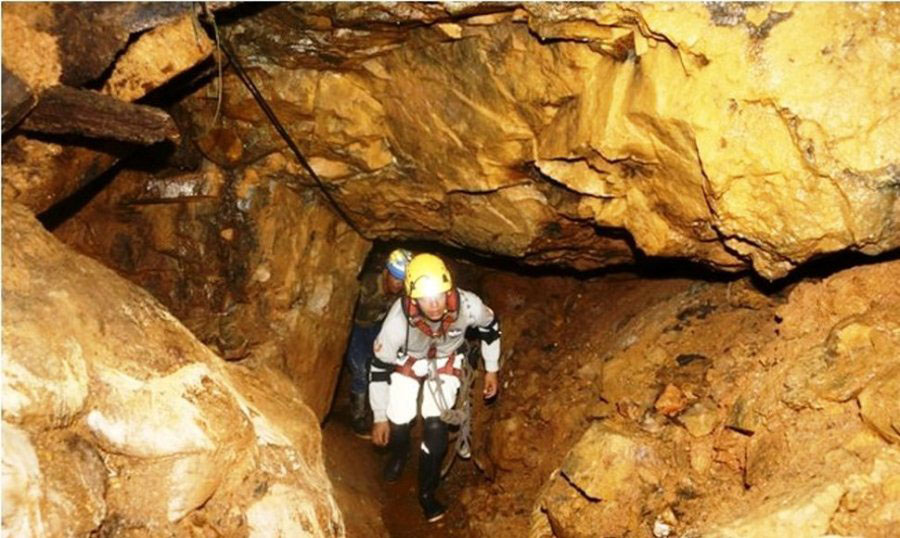
On Thursday, April 16, the U.S. Department of the Treasury’s Office of Foreign Assets Control (OFAC) announced new sanctions targeting individuals and entities linked to Nicaragua’s gold sector. According to the Treasury itself, the measures respond to the Ortega-Murillo regime’s use of the industry as a key source of funding for repression and for the enrichment of the ruling family through corrupt practices, as well as to the recent expropriation of BHMB, a U.S.-owned company.
These factors have placed the regime under growing international scrutiny, as the gold sector is increasingly seen as a tool to sustain a system of power operating outside the bounds of legality and transparency.
None of this should come as a surprise. Senior officials connected to the U.S. government had previously warned the regime about the possibility of such sanctions. On several occasions, Ambassador Richard Grenell explicitly conveyed that Washington would not overlook the illegal expropriation of U.S. companies and that failure to address the situation would carry consequences.
Read also: Trump Ally, Richard Grenell, Pressed for Nicaragua Mining Sanctions Prior to Treasury Action
The seizure of BHMB
Despite these warnings, the Ortega-Murillo regime did little to resolve the illegal seizure and takeover of BHMB’s processing plant. There were no signs of course correction, no credible attempts at compensation, and no gestures suggesting a willingness to avoid mounting pressure on the sector.
This may be only the beginning. Unless the concerns raised by the U.S. Treasury are addressed, it is highly likely that sanctions will continue to expand in scope. The precedent is clear: in other contexts, when an economic sector is used to finance authoritarian regimes or becomes tainted by illicit practices, the response has been to escalate toward broader measures. In Nicaragua’s case, it is not far-fetched to expect the entire gold sector to face more severe, sector-wide sanctions, with direct implications for exports, financing, and market access.
But the consequences extend beyond sanctions alone. There is another, less visible yet potentially more far-reaching risk. Following a lengthy investigation, the Office of the U.S. Trade Representative (USTR) determined that Nicaragua committed a series of trade violations under Section 301 of the Trade Act of 1974, including the confiscation of U.S. companies. That determination opened the door to the imposition of tariffs as a corrective measure.
Gradual sanctioning is not guaranteed
So far, those tariffs have followed a gradual and limited approach. But that gradualism is not guaranteed. If the regime continues to enrich itself illicitly, finance repression with foreign currency generated by the gold sector, and expropriate U.S.-owned companies operating in the industry to hand them over to Chinese actors, Washington could abandon its incremental approach—raising tariff rates and potentially extending them to all goods, not just those outside the framework of the Dominican Republic–Central America Free Trade Agreement (CAFTA-DR). The economic impact of such a move would be deep and widespread.
Against this backdrop, a pressing question arises: why has the regime not acted to prevent an escalation that clearly harms the country? The answer, though uncomfortable, is evident. For the dictatorship, the priority is neither economic stability nor the well-being of Nicaraguans. It is the preservation of power at any cost.
You may be interested: Washington Targets Nicaragua Ruling Family’s Gold Business, Sanctions Ortega Sons
High price to be paid
Within the gold sector, the ruling circle has built a network of companies operated by close associates, creating mechanisms for wealth accumulation. In that context, the cost of sanctions—even if they affect loyal allies or key operators—is viewed as acceptable collateral damage.
Nor does it appear to concern them that those same loyalists could face legal proceedings abroad in the future, or that sanctions may indirectly harm workers, exporters, and productive sectors unrelated to political decisions.
But that logic has limits. The accumulation of sanctions and the intensifying international scrutiny are part of a dynamic that, sooner or later, will exact a price. And when that moment comes, the burden will fall on their most loyal associates—because the rulers and their family have shown they are willing to sacrifice them in order to cling to power and continue lining their pockets.