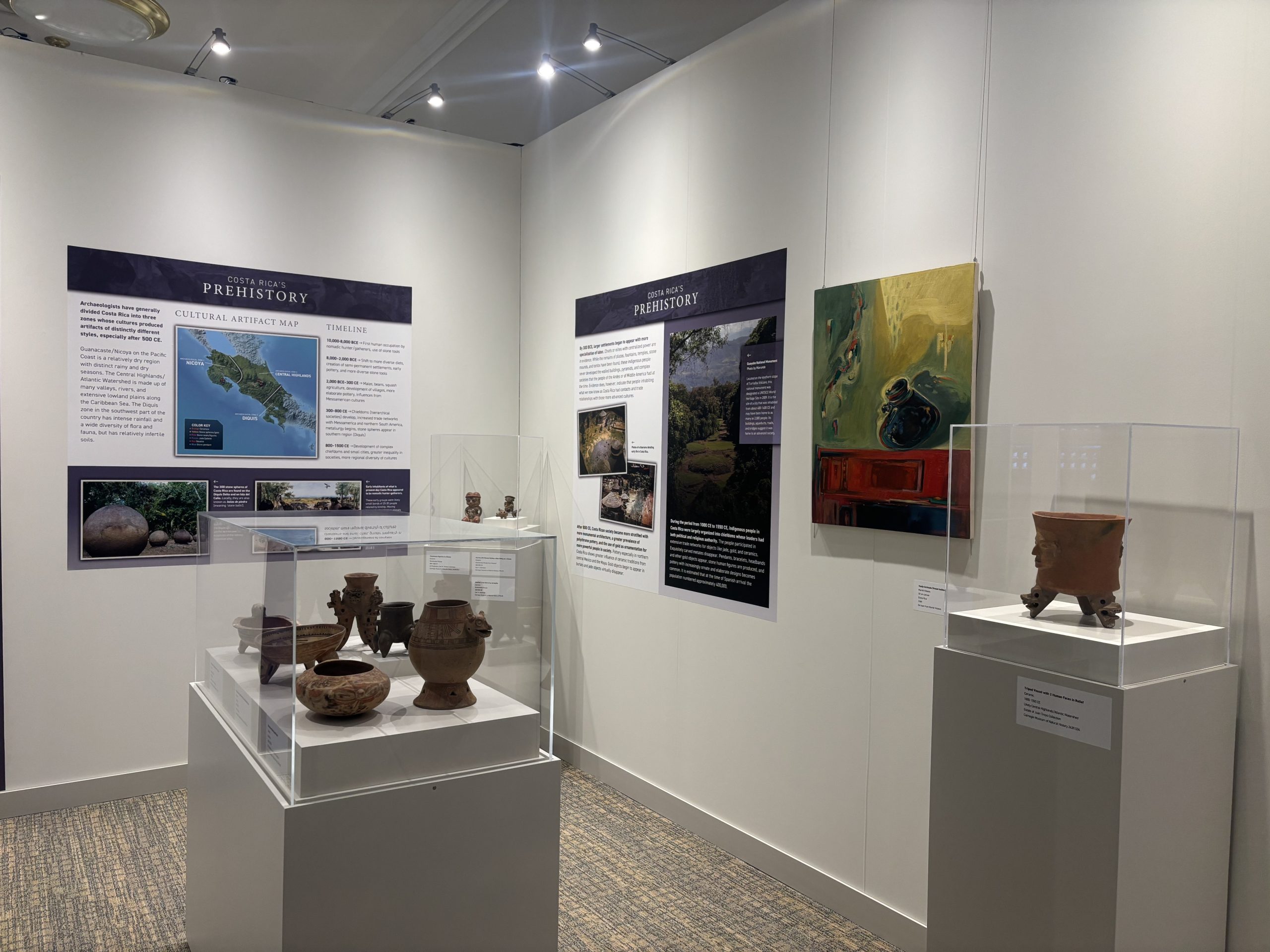
The exhibition of the Latin American Cultural Center of the Latin American Studies Association (LASA), in Pittsburgh, Pennsylvania, highlights the history, culture, and democratic vitality of Costa Rica, amidst masks, metates, and migrations.
A recent estimate indicates that 70% of the labor force of banana and pineapple growers in Costa Rica are migrants from Nicaragua. This striking and human statistic adorns one of the posters welcoming visitors to the Costa Rican cultural exhibition.
The exhibition, inaugurated on September 20, 2025, will remain open until June 28, 2026. Under the coordination of Dr. Manuel Román Lacayo, LASA’s deputy director and a Nicaraguan based in Pittsburgh, the project brings together archaeological pieces, contemporary works, and documents that narrate the history, identity, and challenges of this country.
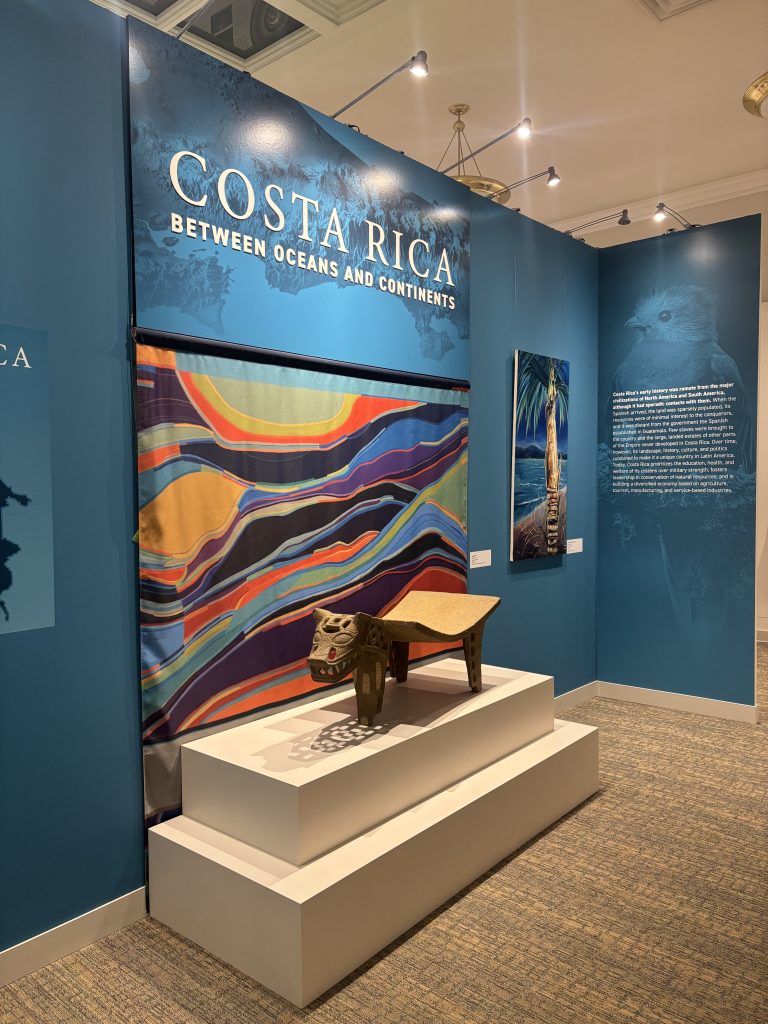
“The government of Costa Rica provided the Latin American Cultural Center with several objects that represent different moments in the history of the Central American nation,” the organizers explain. But beyond the objects, the exhibition aims to offer a comprehensive view of a country small in size, but enormous in regional symbolism: stable democracy, environmental awareness, and multicultural coexistence.
You may be interested in: Identity, Science, and Memories — The Life Archaeology of a Nicaraguan in Pittsburgh, United States
An idea kept for more than a century
«The idea arose from the possibility of loaning several objects from the pre-Columbian era that have been stored in the Carnegie Museum of Natural History’s warehouse (in Pittsburgh) since 1912, that is, they have been kept for 113 years without seeing the light,» Román recounted during an interview.
The deputy director recalled that when he arrived in Pittsburgh in 1999, some professors from the Department of Anthropology told him about that pre-Columbian collection originating from the territory now shared by Costa Rica and Nicaragua. «It was truly the same cultural zone as Nicaragua’s Pacific region, reaching beyond León,» he clarified.
Román, trained in the Anthropology PhD program at the University of Pittsburgh, explained that the proposal took shape in a particular context. “We wanted, especially in view of the socio-political change in the United States, to think about how to address this issue from the Latin American perspective without making a direct critique of this country’s government,” he said.
“So we came up with the idea of highlighting a Latin American country that has enjoyed strength in democratic institutions… that has known how to manage its natural resources, that has known how to improve the quality of life of its citizens, and that has maintained a democratic and peaceful succession after having removed the military from its budget. So, Costa Rica is that country,” Román stated.
Pieces from the Pre-Columbian Gold Museum in San José
The exhibition not only revives that democratic memory but also becomes a symbolic bridge between Nicaragua and Costa Rica. “For me, it has been like working at home,” said Román, who personally participated in the loans of pieces from the Pre-Columbian Gold Museum and the Numismatic Museum of San José.
In addition to the pre-Columbian collection of the Carnegie Museum, the exhibition is complemented with pieces from the Gold Museum, jade works, and a selection of metates and stone statues that had remained for decades in private collections or in storage. Costa Rican collectors and the visual artist Marité Vidales also participate, contributing graphic works that bring life to each space of the exhibition.
“We are going to have presentations on pre-Columbian archaeology, especially from the area where these pieces originate… and we will be discussing the crossroads in political terms and the current direction of Costa Rica,” Román announced. The parallel program will include film screenings, children’s activities, and discussions with specialists from the University of Costa Rica.
Among masks, legends, and work
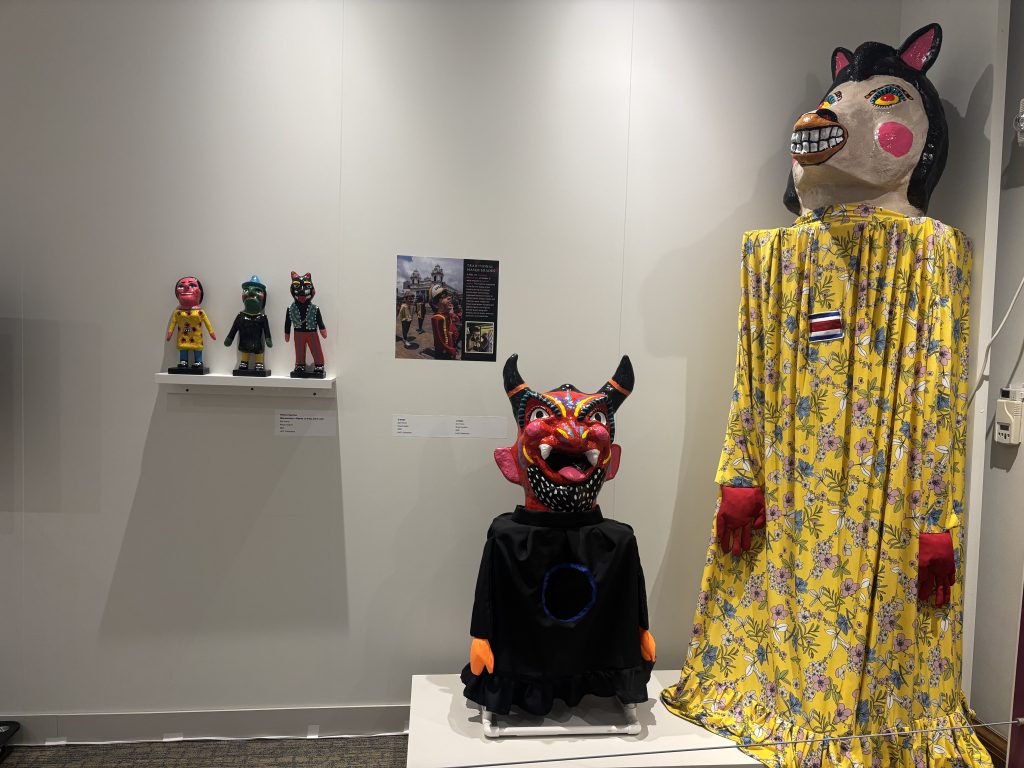
One of the most endearing sections is dedicated to the masks of Don Alfonso Vega Coto, artistically known as Pocho, a mask maker with over half a century of experience. In a video included in the exhibition, Pocho humorously and tenderly explains how his craft began: “Nowadays, I dedicate myself more to miniatures because I can no longer handle the big masks. I started with masks because my father had a Cimarrona; as a child I used to go around with my father, so I began making some masks to use here in the neighborhood, and to my surprise, it was such a success that after 15 days they were already being borrowed or rented for another event.”
La Cimarrona, the exhibit explains, is a small band of amateur musicians, typical of Costa Rican folklore, made up only of wind and percussion instruments. “I danced the Giganta, I always liked to go alongside the Cimarrona… La Cegua was a very elegant woman, she smoked and went out at night… then when she threw fire, that was the moment she transformed into the form of La Cegua,” remembers the mask wearer. With nostalgia, he adds: “Before, after meals, since there was nothing to do, they would sit and tell legends… today all of that has been lost.”
That popular sensitivity coexists with a more structural reading of the country. The exhibition posters show the complexity of the Costa Rican agricultural landscape, where bananas and pineapples continue to be export pillars, although increasingly dependent on migrant labor.
In 2023, 125,000 acres of bananas and 80,000 acres of pineapples were cultivated, representing 9% and 7.25% of total exports, respectively. Costa Rica is today the world’s leading exporter of pineapples, according to one of the posters at the cultural exhibition in Pittsburgh.
Coffee, another national symbol, maintains its historical prestige
Recent exports reached 432 million dollars, “a reputation for high quality, sustainable production, and fair trade practices.” But the country has focused on diversifying its economy: free trade zones attract tech and pharmaceutical companies such as Intel, HP, Bosch, and Bayer. Currently, only 5% of national production comes from agriculture, compared to 76% from the services sector.
On the political level, the cultural exhibition contextualizes the election of Rodrigo Chaves Robles as president in 2022, an economist with a long career at the World Bank. Despite the country’s institutional stability, voter abstention —above 43%— reveals latent discontent. The exhibition also addresses the growing migratory pressure: more than half a million legal immigrants and an unknown number of unregistered ones, mostly Nicaraguans, live in a country whose public services were already strained by the past pandemic and economic difficulties.
Nature, Heritage, and Resilience
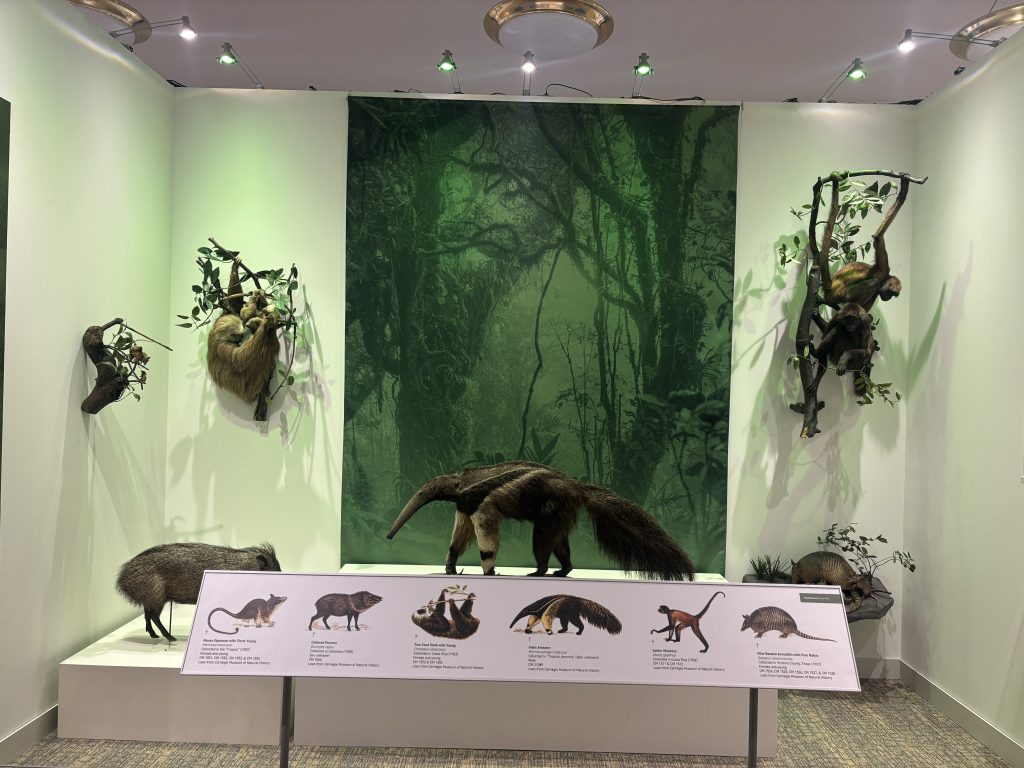
The exhibition dedicates a special space to environmental conservation, one of the greatest sources of national pride. With 27% of its territory protected and the goal of achieving net-zero carbon emissions by 2050, Costa Rica is a global benchmark in ecotourism.
In 2024, it received 2.6 million tourists, generating 190,000 jobs and nearly 5 billion dollars in revenue. The Traditional Masks of October 31, declared a national symbol in 2022, also have their space, celebrating the creativity and popular satire of the peoples of the Central Valley.
You may be interested in: Brayan Cabrera, the Nicaraguan competing for a chance to go to space
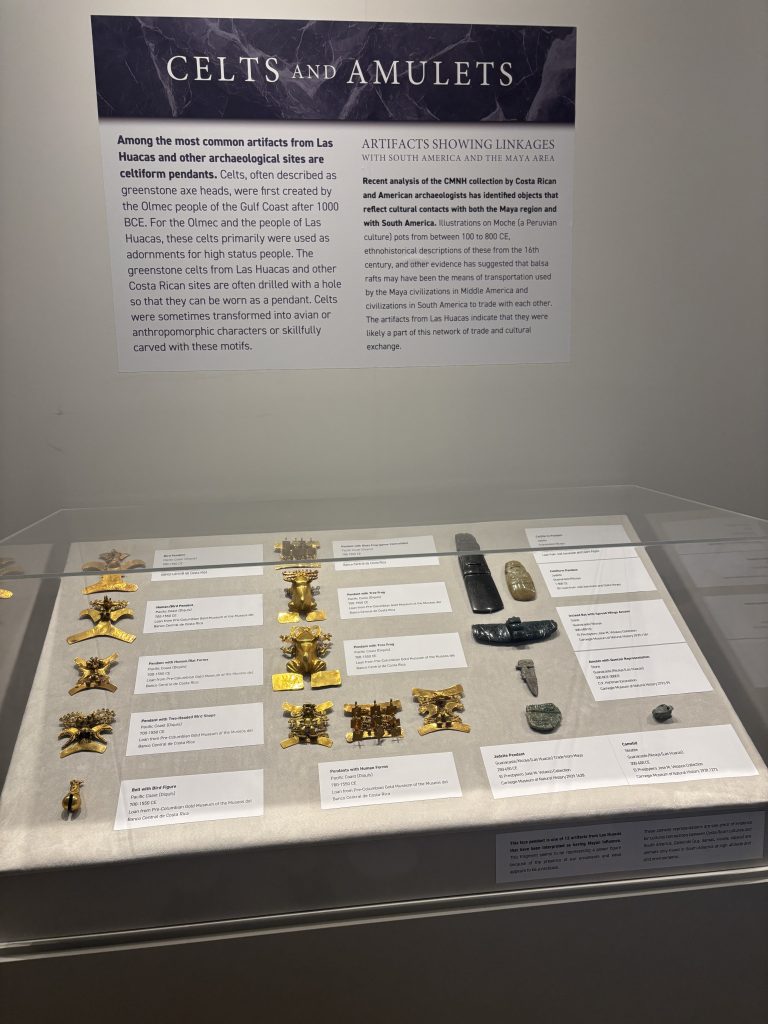
Visitors can admire the ceremonial metates, carved from volcanic stone, decorated with figures of jaguars, iguanas, or harpy eagles. These pieces, one of the panels notes, «were found in burials along with offerings of jade and gold, a testament to the art and spirituality of pre-Columbian peoples.» The amulets and celts in green stone complete the collection: «The celts of Las Huacas were used as adornments for people of high status and, on occasions, were transformed into avian or anthropomorphic figures,» reads the description.
Connections with the Mayan region and South America
A recent archaeological analysis, conducted by Costa Rican and American specialists, has identified objects that reflect cultural contacts both with the Mayan region and South America. The similarities between Moche pottery from Peru and artifacts found in Guanacaste suggest that reed rafts were the means of exchange between distant civilizations, a testament to a cultural network as ancient as the continent itself.
Also read: L.A. FRITANGA, the business of a woman from Corinto in Los Angeles
«We want to show how a country can maintain its balance between progress, culture, and nature,» summarizes Román. And they succeeded: between metates and integrated circuits, between marimbas and free trade zones, the Costa Rica of this exhibition beats like a metaphor of resilience and hope for all of Latin America.