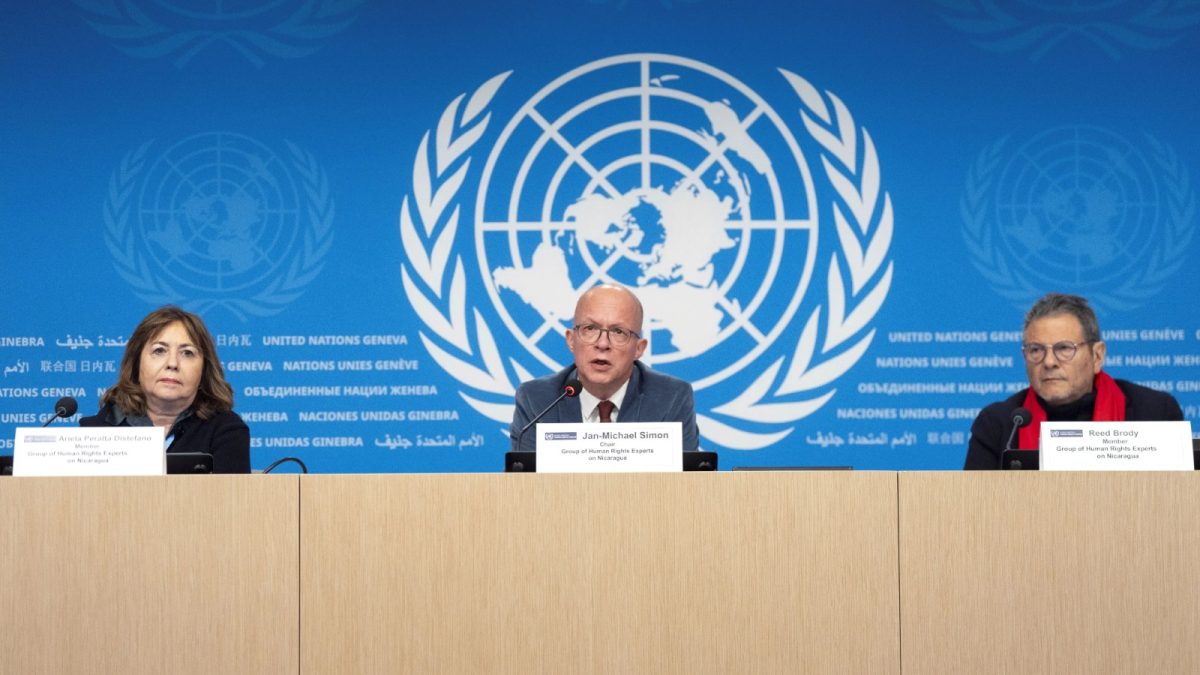
The United Nations’ Group of Human Rights Experts on Nicaragua (GHREN) reiterated on March 10 the key role played by Vice Foreign Minister Valdrack Jaentschke in a transnational repression network run by the regime of Daniel Ortega and Rosario Murillo, and denounced the existence of a spy apparatus operating in at least five countries.
According to Reed Brody, one of the GHREN experts—often dubbed the “dictator hunter” for his four decades defending human rights worldwide—exiled Nicaraguans are viewed by the regime as a potentially dissident group.
Since 2018, when the country’s political crisis erupted following a violent crackdown on protests, at least 800,000 Nicaraguans have fled the country to protect their safety, representing about 12 percent of the population.
Read also: UN Experts Accuse Ortega-Murillo Regime of Funding Transnational Repression and Global Spy Network
“That is why they have built an apparatus that pursues them wherever they are in the world. Their political intelligence identifies targets and operational units track them down,” Brody said during a conference call.
Without naming the countries involved, the expert said that “diplomatic missions in at least five countries host military intelligence personnel, and most ambassadors serve as political secretaries of the Sandinista National Liberation Front (FSLN), reporting directly to Rosario Murillo.”
Among the tools allegedly used are surveillance, doxing (the disclosure of personal information without consent), abuse of Interpol mechanisms and assassinations. For Brody, the “most disturbing” case is that of retired Major Roberto Samcam, who was killed on June 19, 2025, in his apartment in San José. Brody said investigations into the killing are already well advanced.
A dozen sources consulted by investigators confirmed the involvement of Vice Foreign Minister Jaentschke in this repressive network. According to the report, the official took part in the repression strategy and coordinated intelligence activities while serving as minister-counselor in Guatemala, Honduras and Costa Rica, as well as during his tenure as a presidential adviser.
Prior to the conference call, Ariela Peralta, another GHREN member, had stated that diplomatic and consular structures have been used to track, monitor and intimidate Nicaraguans living in exile.
A parallel network of repression
The experts also denounced the existence of a parallel FSLN network operating alongside formal authorities to carry out repression. They say it is also financed with public funds and represents another form of corruption—not aimed at personal enrichment, as in other cases, but rather at sustaining the repressive system.
This “organic structure of the FSLN” operates under the command of Rosario Murillo and was consolidated in 2018 when the state launched security and intelligence operations aimed at crushing citizen protests.
You may read also: Report Details Systematic Torture in Nicaragua: 250 Testimonies, 40 Methods Linked to Ortega Murillo Dictatorship
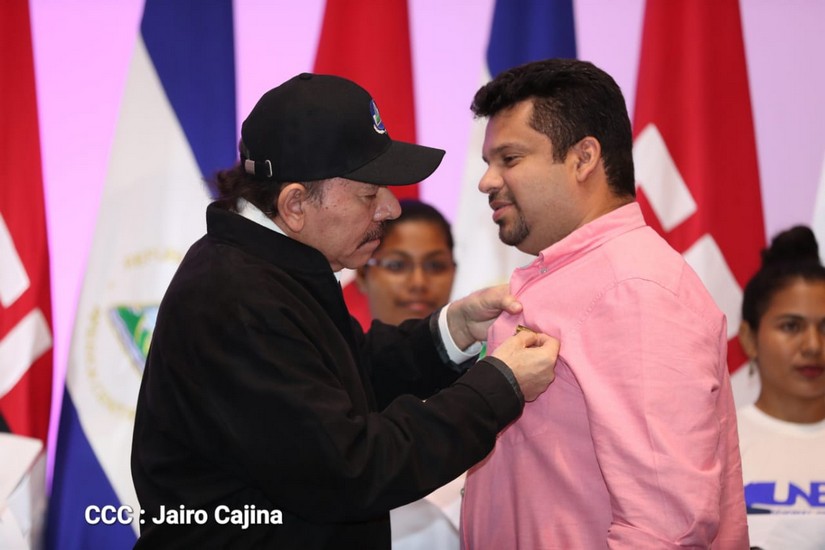
A key figure in this process is the FSLN’s organization secretary, Fidel Moreno Briones, Murillo’s right-hand man. According to the report, it was Moreno who relayed the order “Let’s go all in,” signaling the violent response against demonstrators that ended in a massacre.
Based on accounting documents, the experts revealed that the repression was financed with public funds through municipal budget allocations. Around $5 million was used to sustain the first two months of operations by the paramilitary groups that acted against the population.
“Part of this operation was financed through municipal budget lines formally assigned to short-term projects generally labeled ‘clean-up,’ ‘humanitarian assistance,’ or ‘public relations,’ or through operational expense items such as fuel, security and per diems,” the report states.
Simon: “State–Party–Family”
Jan-Michael Simon, president of GHREN, said Fidel Moreno helps explain how the system functions and described him as “a paradigmatic figure in all the webs”—the analytical schemes experts have used to map the regime’s repression.
Last year, the group presented a report identifying a chain of command behind the repression composed of 54 individuals, including Moreno. In the latest report, the list was narrowed to 26 as the experts focused on analyzing how transnational repression operates. This includes denying or refusing to renew passports, imposing exile and stripping individuals of their nationality, among other mechanisms.
The structure also involves directors of intelligence units from the army and the police, the attorney general, a team from the Public Prosecutor’s Office, and others.
“Moreno’s role shows how the party is the state, the state is the party, and both are the family in the figure of Rosario Murillo. It is the leadership of the party structure, parallel to state institutions, that exercises direct command,” Simon explained.
Stages of the attack on society
In their report, the experts outlined several stages of repression.
The first, from 2018 to 2020, involved a violent and disproportionate attack on protests. During the presidential election period, repression entered a second phase marked by targeted arrests of all potential political challengers to Ortega and Murillo. With no electoral competition, the two leaders secured their continued hold on power.
To instill fear in 2021, the government also jailed leaders from the private sector, civil society and opposition politics, while intensifying persecution of independent media in an effort to impose silence.
In 2022, the state turned the Catholic Church into its main target. From the following year onward, experts say the regime has sought to eliminate all forms of criticism to prevent any resistance movement, while Ortega and Murillo have strengthened their repressive apparatus and removed the independence of state institutions through the approval of a new Constitution.
You may be interested: Costa Rica to Denounce Illegal Gold Mining and Smuggling to Nicaragua in Talks With Trump
A new typology of victims
“The authorities have also expanded victimization within the state apparatus and the Sandinista ranks, increasingly targeting individuals perceived as a threat to the consolidation of Mrs. Murillo’s power—particularly in the event of Mr. Ortega’s incapacity—including members of the judiciary, public officials, and active and retired members of the armed forces,” the document states.
For Simon—who once described Nicaragua as a crime scene—the situation has evolved into what he calls a giant open-air prison. Meanwhile, Brody said the country has effectively become a place of silence.
The Nicaraguan government has not responded to any of the accusations so far. Over the past several years, UN experts have sent 21 letters requesting information from authorities.
The UN experts say they remain open to traveling to Nicaragua to monitor progress in implementing human rights reforms, if the government agrees to make changes.
However, they also stress the depth of impunity in the country. “Beyond the formal constitutional subordination of the judiciary to the presidency, the co-presidents have established tight control over the judicial system, particularly through the summary dismissal of more than 1,500 judges, legal clerks, public defenders and other staff since October 2023,” the report concludes.