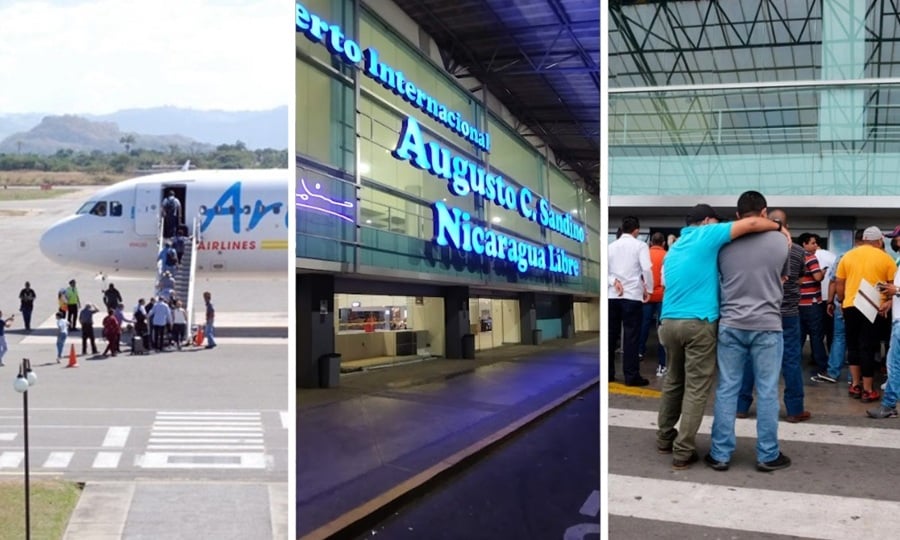
Just three days after the Ortega-Murillo dictatorship canceled visa-free travel for Cubans and ended its migrant smuggling operation, the Venezuelan airline Conviasa — its first ally in that strategy — canceled its flights between Havana and Managua. The measure comes after four years during which this business helped a large share of the 1.16 million migrants reach the United States. According to official statistics from Honduras, more than 240,000 of that total were Cubans, and until last week they were almost the only ones still using this route.
With the suspension of visa-free travel and the cancellation of flights between Managua and Havana — offered only by the Venezuelan airline — Cubans no longer have the opportunity to leave the island at a time of crisis that, according to some analysts, could trigger an exodus.
The migrant smuggling business, which analysts say was also used as a political weapon to intensify the migration crisis facing the United States at its southern border, began on November 21, 2021, when the Ortega-Murillo regime announced visa-free entry for Cuban citizens wishing to travel to Nicaragua.
Conviasa, the Major Ally in Migrant Smuggling
One month after that announcement, Conviasa resumed its direct flights between Havana and Managua. These flights, which had been operating since 2019, were suspended in 2020 due to pandemic-related closures caused by COVID-19. Before the pandemic, there were two weekly flights, mainly used by Cubans traveling to Managua to buy goods — primarily at the Mercado Oriental — and returning to the island three or four days later with those products.
Starting in 2021, however, the situation changed. The air bridge that the Ortega-Murillo regime offered Cubans through Managua’s international airport, with Conviasa’s support, shortened the journey and reduced risks. With this option, migrants no longer had to travel to Brazil or Ecuador — countries they could enter without a visa — and then continue by land toward the United States. That route forced them to cross the dangerous jungle between Colombia and Panama, known as the Darién Gap.
By the end of 2021, the business was firmly established, and its impact was immediate. The following year, Conviasa expanded its Havana–Managua flights to as many as four per day. Other airlines, including Aruba Airlines and Air Century, also began offering charter flights between the two cities.
Nicaragua Hides the Numbers, Honduras Publishes Them
The Nicaraguan Tourism Institute (Intur) stopped publishing its statistics to avoid revealing the nationalities of visitors arriving in the country. However, data from the Central Bank of Nicaragua showed that arrivals through Managua’s international airport skyrocketed, and about half of those who entered did not leave the country by air.
This was the first evidence that migrants were using Managua’s airport as a transit point before continuing overland to the United States. In 2022, 634,000 travelers entered Nicaragua by air, but only 312,400 departed the same way. That meant about 322,400 remained to continue their journey north by land.
These migrants joined others who were still making the overland journey through the Darién Gap. Most of them were Venezuelans, who were never granted visa-free entry to Nicaragua. Instead, they were charged between $150 and $200 for entering without a visa, which granted them 72 hours to cross the country and exit through the northern border.
Honduras Migration Statistics
Suspicion raised by the Central Bank’s airport data was confirmed by the Honduran National Migration Institute (INM), whose statistics also surged. In 2021, the INM reported 17,590 irregular migrants arriving from Nicaragua.
But in 2022, when the Ortega-Murillo business began operating, the number of irregular migrants entering Honduras from Nicaragua jumped to 188,858, of whom 73,804 were Cubans. The following year, when the business expanded globally and reached its peak, the INM recorded 545,043 irregular migrants from Nicaragua, including 85,969 Cubans. The rest were mainly citizens of Venezuela, Haiti, and Ecuador, along with migrants from a long list of other countries. This trend continued in subsequent years.
In 2024, U.S. sanctions and restrictions imposed on airlines transporting migrants to Managua via established routes — as well as on executives and employees of companies operating charter flights — reduced the flow. The INM reported 369,258 irregular migrants entering Honduras from Nicaragua, including 60,009 Cubans.
Trump’s Migration Policy Affected the Business
Then, in 2025, the tightening of immigration policy promoted by President Donald Trump after his return to the White House reduced the number of migrants entering Honduras from Nicaragua to 39,384, about half of whom were Cubans.
Between January 1 and February 5 of this year, according to INM reports, Cubans were almost the only ones still using the air bridge offered by the Ortega-Murillo business. Of the 1,759 people who crossed Nicaragua’s border into Honduras, 1,312 were Cuban nationals.
Read also: Nicaragua’s Top Foreign Investors Revealed — and China Isn’t Among Them
Thus, the cancellation of the visa-free policy ends a business that between 2022 and 2025 moved a large portion of the 1.16 million irregular migrants recorded by the INM as coming from Nicaragua. It particularly affects Cubans, who have few options for leaving their country.
It remains unclear whether the Ortega-Murillo regime will be flexible in granting visas to Cubans who had already purchased tickets to travel to Managua. According to a statement issued by Conviasa, for the remainder of February it will operate only one flight between Havana and Managua.
The company’s statement says only that, after learning of the “new migration requirements established by the Government” of Nicaragua, passengers must comply with them before purchasing tickets.
Conviasa has not said whether it will refund passengers who have already paid for tickets but do not receive a visa to enter Nicaragua. It is also unclear whether flights will resume later, as Cuba is facing a crisis that — due to pressure from the United States — has left it without external fuel supplies, including aviation fuel. As a result, other airlines are also suspending their flights to Cuba.