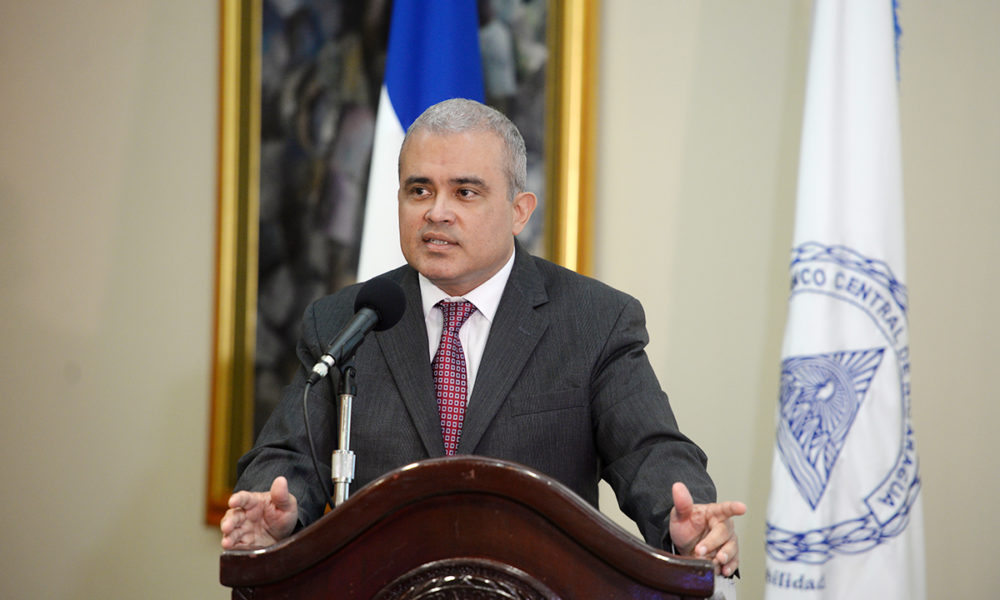
Within economic circles, few question Ovidio Reyes’s professional credentials. But they acknowledge that it is not technical expertise that keeps him at the helm of the Central Bank of Nicaragua (BCN), rather political loyalty. Following the disgrace of long-time Sandinista economic operators Álvaro Baltodano and Bayardo Arce, and the dismissal of other loyalists such as Iván Acosta and Bosco Castillo, Reyes now stands as the lone survivor of the team that consolidated the Ortega-Murillo regime.
Reyes’s authority—already as the most recognizable figure in the economic cabinet—has grown virtually unchecked. He substitutes for the finance minister to present the national budget, steps in for the agriculture minister to unveil production plans, inaugurates coffee harvests, and visits plantations. He replaces the minister of development, industry and trade to address supply shortages or oversee foreign purchases. He travels to China with Laureano Ortega Murillo to court investment. At times, he even fills in for Ortega himself to deliver presidential reports.
Although lawmaker Wálmaro Gutiérrez still formally chairs the National Assembly’s powerful Economic and Budget Commission, his public role has diminished sharply. Given the legislature’s subordination to the Ortega-Murillo family, his influence—both politically and publicly—has waned.
Read also: Nicaragua’s Top Foreign Investors Revealed — and China Isn’t Among Them
Reyes Wants No Shadows
Reyes has not only assumed the roles of purged or dismissed officials; he has also removed their allies from public posts and replaced them with Central Bank staff loyal to him.
That pattern is evident at the Ministry of Finance and Public Credit (MHCP), arguably the most important cabinet post, which has been without a minister since December—and appears likely to remain so. After the brief tenure of Óscar Danilo Mojica Aguirre, Reyes ally Nicolás Espinoza Rivera, a lawyer from the BCN’s legal team, took over as deputy minister.
Espinoza has been tasked with duties typically reserved for a minister: signing international loan agreements and representing Nicaragua before multilateral institutions and domestic bodies such as the Central Bank’s board. Under the Monetary and Financial System Administration Law (Law 1232), the minister is supposed to hold a permanent seat on the board; Espinoza occupies an alternate seat instead.
Yet despite more than two months in the role—and the ministry still lacking a minister—Espinoza has not appeared publicly. His ties to economic sectors appear virtually nonexistent. The only public image of him online is a photo posted by the Central Bank listing him among its board members.
A similar dynamic is playing out at the Ministry of Agriculture. Since Indiana Raquel Fuentes Ramírez replaced Sandinista Youth leader Bosco Castillo in August 2024, Reyes has been the public face of agricultural policy, while the minister herself remains largely unknown.
A Phantom at Industry and Trade
At the Ministry of Development, Industry and Trade (Mific), another low-profile figure took office in July 2025. Erwin Ramírez Colindres replaced José de Jesús Bermúdez Carvajal, who had also kept a low profile. Ramírez’s public appearances have been limited to occasional interviews with pro-government outlets on exports—statistics from Nicaragua’s Foreign Trade Single Window are no longer publicly available.
Until July 2024, when Iván Acosta left the Finance Ministry, the economic cabinet was dominated by allies of Bayardo Arce, the veteran Sandinista economic operator now imprisoned on charges of laundering more than $5 billion.
After Acosta’s departure, Arce loyalists still included Bruno Gallardo Pallavicini, who took control of the ministry in June 2024; Deputy Minister José Adrián Chavarría; and Treasury Secretary José Dolores Blanco, who had assumed many of Acosta’s duties after U.S. sanctions in 2021.
But by August 2025 Gallardo was retired, while Chavarría and Blanco were simply dismissed—replaced by Reyes allies. Mojica Aguirre briefly filled Gallardo’s post before stepping down in December, paving the way for Reyes to consolidate full control of the ministry through Espinoza. Carlos José Selva Hernández, a lower-ranking ministry official, was appointed treasury secretary.
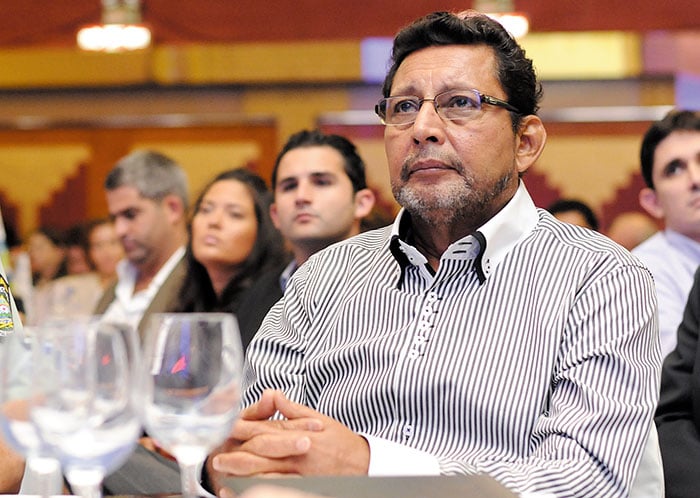
has been sentenced to prison for alleged corruption charges. Archivo/LA PRENSA.
Read also: U.S. Senate Bill Takes Aim at Illegal Gold Networks, Puts Nicaragua Under Sanctions Spotlight
Reyes recently marked 12 years as Central Bank president. Appointed in January 2014, he was sanctioned by the United States in June 2021 for collaborating with the Ortega-Murillo regime in human rights violations. Unlike other cabinet members who lost their posts due to complications stemming from sanctions, Reyes has only strengthened his position as the regime’s chief economic operator.
The one area where he has not achieved dominance is foreign investment, long overseen by retired General Álvaro Baltodano, now also imprisoned on money laundering charges. In that sphere, Reyes plays a subordinate role to Laureano Ortega Murillo, the dictators’ son, whom he reportedly advises and accompanies on trips to China. Because of U.S. sanctions, Reyes cannot travel to Washington for key meetings of institutions such as the International Monetary Fund and World Bank.
A Pawn on the Ortega-Murillo Board
Laureano’s influence also extends to the Ministry of Family, Community and Associative Economy, reshaped in August 2024. Although Fulvia Castro formally heads the ministry, Camila Ortega—another of the couple’s children—directs its initiatives, aligning it with her entrepreneurial projects. Control of the tourism institute (Intur) runs through Mara Stotti, wife of Daniel Edmundo Ortega Murillo, who was appointed co-director.
“Ovidio Reyes is a pawn on a chessboard where his priority has been preserving his position at any cost,” said a businessman who knows him and requested anonymity for fear of reprisals. “He will not defend an economic position against a political decision—especially if it risks his status quo.”
Economist Juan Sebastián Chamorro, however, does not view Reyes’s control as a threat in itself. Nicaragua’s economic policies, he argues, are heavily IMF-oriented: a balanced budget, a currency peg with a fixed exchange rate. The system does not hinge on one individual.
A financial adviser, also speaking anonymously, agreed that as long as remittances continue to flow, the macroeconomic picture will hold. Reyes, who once advised Bayardo Arce, is seen as technically capable. Much of today’s growth, analysts say, is the residual effect of policies implemented before 2017 in traditional sectors and free trade zones—underpinned by remittances, which are the real driver of Nicaragua’s growth figures.
The deeper concern, a business leader noted, is that the Ortega-Murillo regime has dismantled much of the institutional framework that once attracted domestic and foreign investment before the 2018 crisis. IMF warnings that the outlook could darken if conditions do not change underscore that risk.
No Option but China
In the investment arena, Reyes has limited room to maneuver. That role has been assumed by Laureano Ortega, and Nicaragua’s weak business climate and institutional fragility make it unattractive to investors.
The situation worsened after the United States imposed an 18 percent reciprocal tariff on Nicaraguan exports, along with additional measures by the Office of the U.S. Trade Representative following findings that human rights and labor abuses interfere with trade.
Under such pressure, advisers say, Nicaragua has little choice but to court Chinese investment—though they question its quality—and to await public investment financed by Beijing, which so far has produced few tangible results.
Read also: Is the IMF Reconsidering Ortega’s “Economic Paradise”? Analysts Point to a Shift on Nicaragua
Capable but Politicized
Economist Enrique Sáenz acknowledges Reyes’s long public career—dating back to 1990—and his deep experience at the Central Bank, describing him as one of the most qualified figures to manage the economy.
His problem, Sáenz argues, is political contamination. Reyes has aligned himself so closely with the Ortega-Murillo regime that he now serves as a loyal functionary—concealing information, manipulating data, and shielding official propaganda that portrays a country far removed from reality.