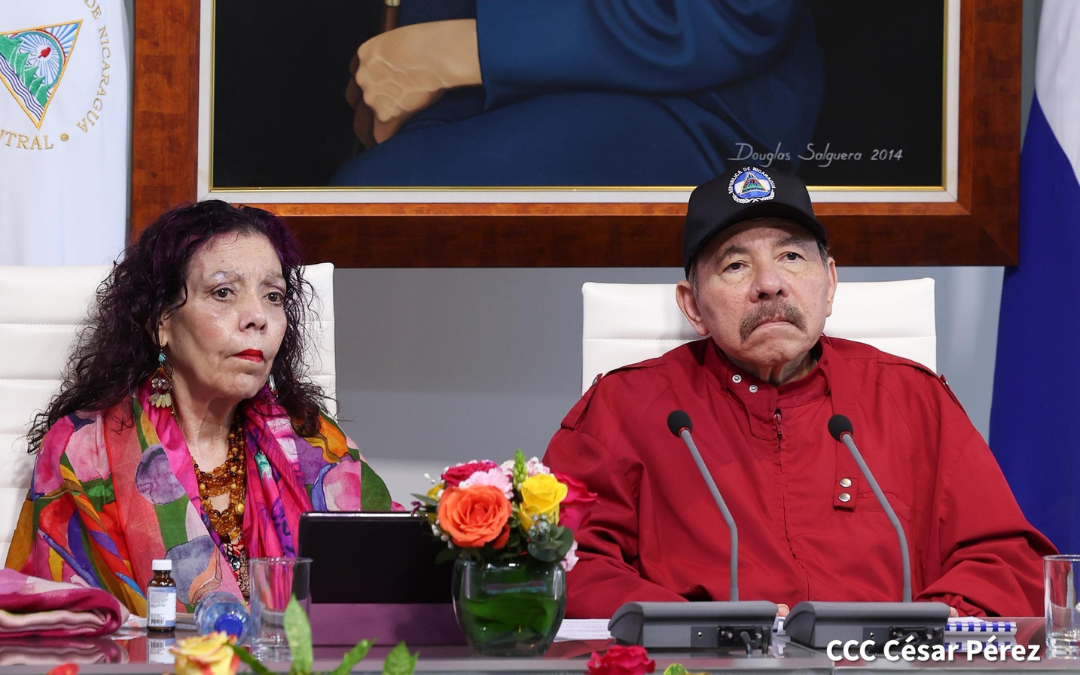
The proposed legislation, Senate Bill S. 3496 or the U.S. Legal Mining and Gold Companies Act, aims to establish a partnership strategy to combat illegal gold mining in the Western Hemisphere. The bill directly references Nicaragua, highlighting the possibility of further sanctions on the government of Daniel Ortega and Rosario Murillo, as well as their «associates.»
The legislation argues that both illegal mining and the trafficking of illicit gold in the region are negatively impacting the economy and social dynamics of the hemisphere. These activities are also said to «strengthen» transnational criminal organizations and «other international illicit actors.»
The bill is sponsored by Republican Senator John Cornyn, with support from fellow Republican Ted Cruz, and Democratic Senators Tim Kaine and Jacky Rosen.
Breaking Illicit Gold Trade
Section 4 of the bill outlines the intent to «completely sever ties with illicit actors exploiting territorial control and using violence to extort miners, pushing them into illegal agreements.»
This section also specifically targets the Ortega-Murillo regime, stating that the U.S. will disrupt the illicit gold trade in Nicaragua, including through sanctions similar to those imposed on the dictatorial family and its inner circle in October 2022. The bill references Executive Order 14088, which was issued on October 24, 2022, to address the national emergency in Nicaragua.
Also read: Sanctioned Nicaraguan Mining Company Transfers Gold Concession to Chinese Firm
In response to the bill, the Río Foundation issued a statement from its president, Amaru Ruiz, who noted that the legislation would increase scrutiny on the gold production chain. This, Ruiz argues, could reduce extractive activities in protected areas and indigenous and Afro-descendant territories.
Ruiz has repeatedly denounced illegal mining in protected areas like the Indio Maíz Reserve, and other regions, often involving indigenous and Afro-descendant lands. He adds that small-scale and artisanal mining is carried out with the support and approval of the Ortega-Murillo regime.
Chinese Companies Under Scrutiny
Ruiz also pointed out that at least one Chinese company operating in Nicaragua is already exporting gold to the U.S. through a scheme involving artisanal mining, processing plants, and companies dedicated to gold marketing and export.
Since 2022, approximately 14 Chinese companies have entered Nicaragua’s mining sector, alongside several Nicaraguan companies linked to the Ortega-Murillo regime. As with many government entities, these companies operate in near-complete opacity.
Most of these companies are unknown, lacking websites or social media presence, and their Nicaraguan offices remain a mystery. Legal representatives of these firms are often unknown, with only their names—usually of Chinese origin—appearing in public documents such as La Gaceta.
Two Mining Companies Tied to the Ortega-Murillo Regime
At least two mining companies are directly linked to the regime: Capital Mining Investment Nicaragua and Compañía Minera Internacional S.A. (Comintsa). Both were sanctioned in May 2024 by the U.S. Department of the Treasury for their affiliation with the Ortega-Murillo government and their role in generating revenue for the regime.
The Treasury Department has stated that Comintsa is «owned and managed» by the sanctioned Salvador Mansell Castrillo, Nicaragua’s Minister of Energy and Mines. The company has been transferring areas previously under concession to Chinese-controlled mining companies, a practice known as «concession laundering» aimed at evading U.S. sanctions, according to Amaru Ruiz.
More information: Chinese Mining Company Accused of Taking Farmers’ Land in Nicaragua’s Caribbean Region
As for Capital Mining, the Treasury confirmed that it is «controlled by Laureano Ortega Murillo,» the son of President Ortega and Vice President Murillo, and Mansell Castrillo, sanctioned by the Office of Foreign Assets Control (OFAC).
This bill comes amid growing pressure on the Ortega-Murillo dictatorship, following the fall of Nicolás Maduro’s government in Venezuela and the resumption of talks between the U.S. and Cuba.