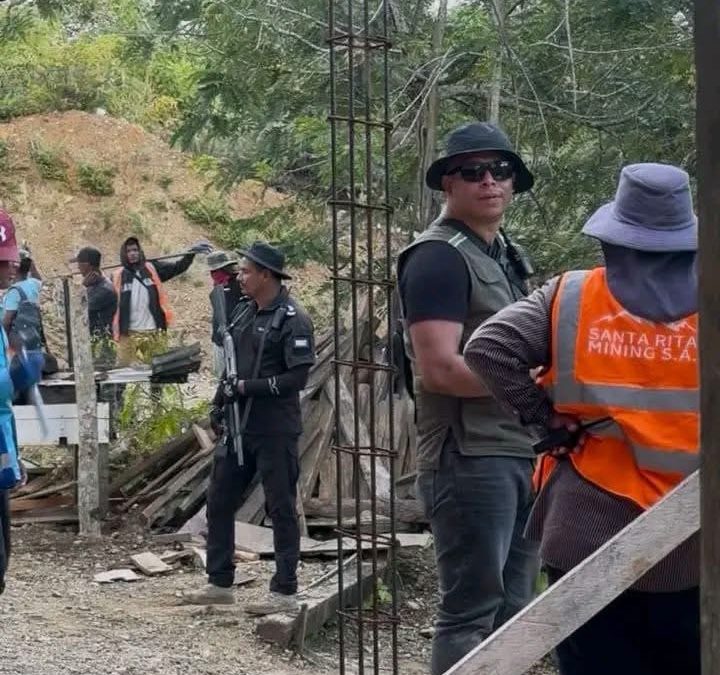
Over the past several weeks, men and women wearing orange vests and identified as workers of the Chinese mining firm Santa Rita Mining Company S.A. have entered the properties of small farmers to demarcate land in the mining town of Rosita, in Nicaragua’s North Caribbean Coast Autonomous Region, according to those affected.
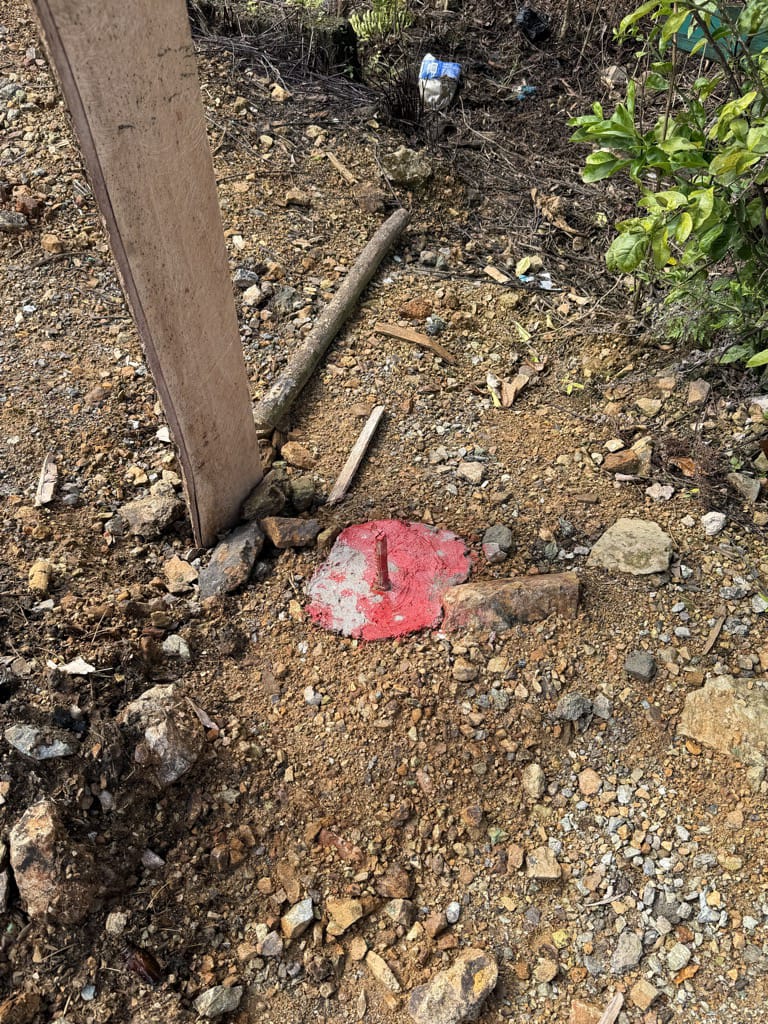
One of the victims, who agreed to speak under the pseudonym “Pedro,” said the workers tear down fences and place boundary markers indicating that the owners’ land has been reduced because “the rest” belongs to the company. Residents say the intruders arrive without providing information or presenting a court order. “This part belongs to the mining company,” they repeat—end of story.
Since March 5, 2019, Santa Rita Mining Company has held the concession for the Rosita D block, covering 3,356.90 hectares in the North Caribbean Coast Autonomous Region, according to an agreement by the Ministry of Energy and Mines published in La Gaceta.
Amaru Ruiz, president of Fundación del Río, said his contacts in the area confirmed that officials from the Rosita mayor’s office, together with government personnel, are allegedly stripping residents of their properties and then handing them over to the Chinese company.
Santa Rita Mining is also one of several Chinese firms that have benefited from concessions under the Ortega–Murillo regime. The gold-mining business in Nicaragua follows a familiar pattern: little-known companies with even less visible representatives, as is the case with Santa Rita Mining Company, which lists Chinese businessman Chunking Sun among its figures.
Translator and lawyer identified
The incursions have fueled tensions in this town of the so-called Mining Triangle. Victims have backed their complaints with photographs of those entering their land. They specifically point to translator Víctor Duarte—who communicates with the Chinese workers—and also mention a lawyer identified as Marlon Morales Baltodano. LA PRENSA attempted to contact him by phone, but he did not respond to calls or messages.
“If someone comes and shows documents proving ownership, they say those documents are not valid,” Pedro said. “And if they see someone with a phone or taking photos, there is fear that the Police could detain them to intimidate the rest of the people who are unhappy. We feel defenseless.”
The complaint spread quickly on social media. This latest case of evictions favoring a Chinese company recalls another reported in 2021, when there were also allegations of collusion between the Police, the Rosita mayor’s office, and the mining company. LA PRENSA attempted to speak with Rosita Mayor Ivania Colind, but she did not respond to any of three attempts.
Read also: Sanctioned Nicaraguan Mining Company Transfers Gold Concession to Chinese Firm
The affected neighborhood is 19 de Julio, though residents say similar actions are occurring in areas near the park, another area known as El Polvorín, and the community of Wasakin. Pedro says he has witnessed workers entering properties in groups and reiterates that residents feel unprotected. This time, he says, it is not the Police accompanying the alleged usurpers, but rather a private security force working directly for Santa Rita Mining.
“We know that mining concessions are a real right of an administrative nature, but they are separate from property ownership,” Pedro said. He also claimed that another person—whom he declined to identify—was forced to reach an agreement with the company after it showed interest in his land. The company allegedly offered just over $20,000.
Legal representative remains silent
In June 2021, LA PRENSA recorded the first complaint of land dispossession against the Chinese mining company, citing the neighborhoods of 19 de Julio and Los Ángeles and the community of Terciopelo as the most affected areas.
At the time, press reports identified the company’s lawyer as Aníbal Matus, who argued that the firm had legitimate rights because it had held ownership over land in the Bambana Kakamuslaya community for more than 40 years. LA PRENSA also attempted to contact him, but the conversation stalled once he realized which newspaper was calling.
“We have been able to verify this new complaint. This is an eviction like the one that occurred in 2021, but in the previous case, the Police carried out the process to favor the Chinese mining company. In this case, we are seeing the company’s own security forces acting,” environmentalist Ruiz said.
According to Ruiz, this pattern could unfortunately repeat itself in other parts of the country, as mining companies displace residents while advancing mineral extraction. Such situations are typically foreseeable through environmental impact studies, but community consultation processes are also not carried out. In practice, people only realize what is happening when the eviction occurs, Ruiz lamented.
“This kind of abuse can increase conflict and public anger. We don’t know whether the owners have land titles, but it is striking that company security forces are acting this way. Hopefully people continue to report these cases through the media or with organizations like ours that monitor these issues,” said Ruiz, who follows developments from exile with the help of local sources.
Read also: Nicaraguan Regime Transfers Gold Concessions to Unknown Chinese Companies to Evade U.S. Sanctions
The Ortega–Murillo grip
Nicaragua’s mining sector is under public scrutiny after the regime granted concessions over a significant portion of national territory to Chinese companies—a multimillion-dollar business.
According to Nicaragua’s Central Bank, preliminary gold exports last year totaled $1.8274 billion. Recently, LA PRENSA reported that mining companies sanctioned by the United States transferred their concessions to other, little-known firms—a process Ruiz describes as “whitewashing.”
In 2024, the U.S. Treasury Department sanctioned Compañía Minera Internacional (Comintsa) and Capital Mining Investment Company. The former was controlled by Energy and Mines Minister Salvador Mansell, and the latter by Laureano Ortega Murillo, son of the ruling couple.
Beyond these personal interests linked to Ortega and Murillo, LA PRENSA revealed in November 2025 that Grupo Minero Xiloá, S.A. (Grumixsa), which operates a plant in Villanueva, Chinandega, included among its partners another company from the Ortega–Murillo business consortium: Urbanizadora Industrial, S.A. (Urbisa).
Grumixsa operates out of the same Managua offices once used by the Nicaraguan Mining Company, which was sanctioned in 2022—evidence of the favoritism and corruption that often characterize business dealings between the Ortega–Murillo family and the state.
Another notable detail about Santa Rita Mining is its link to the Chinese chamber of commerce. Lawyer Vladimir Matus Buitrago also serves as a director of the Nicaragua–China Chamber of Industry and Commerce, a nonprofit founded on January 19, 2024. Several businesspeople representing companies with state-granted mining concessions participate in the chamber. Among the most prominent names is Feiwu Bian, representative of Zhong Fu Development, under the broader umbrella of Laureano Ortega Murillo, the regime’s main liaison with China, Russia, and Iran.
You may be interested: IMF Warns Trump’s Policies will Hit Nicaragua Remittances, but Regime is Braced for Impact