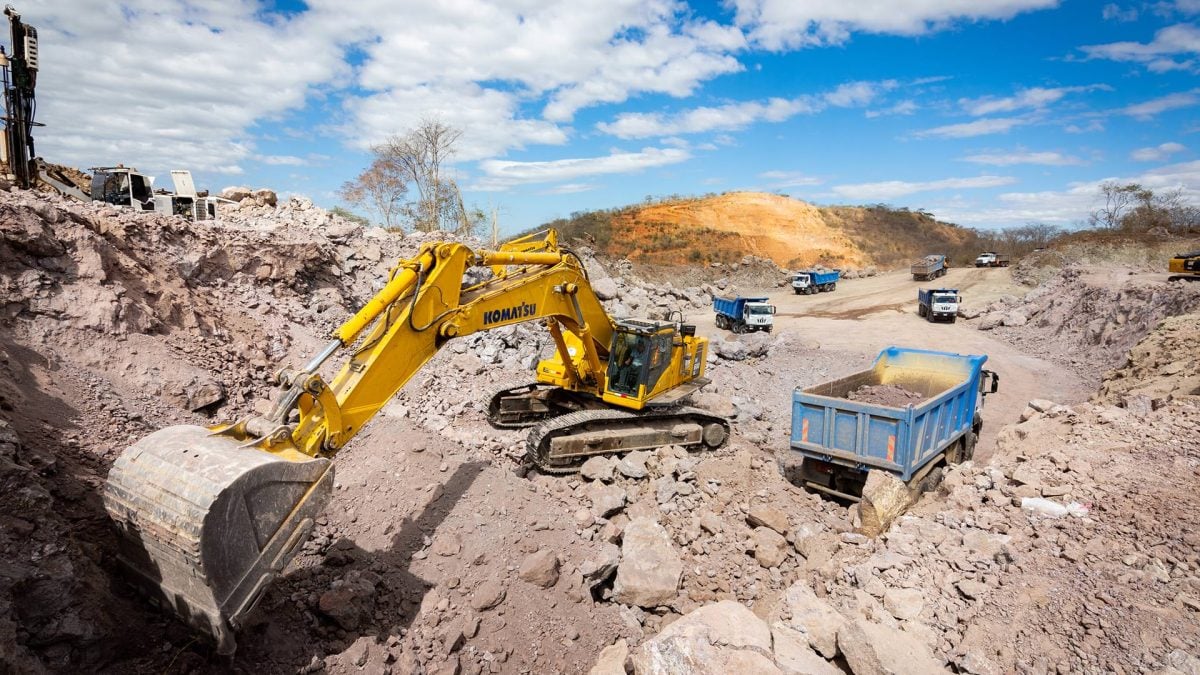
Over the past four years, the history of the Tutuwaka mining lot, located in El Rama in Nicaragua’s Southern Caribbean, has become a clear example of the country’s opaque gold business. The dictatorship has assigned its exploitation to little-known Chinese companies, just as obscure as their representatives. The only certainty is that they operate in a sector that generates millions of dollars and is under the direct control of Laureano Ortega Murillo, the regime’s chief investment promoter.
The mining concession covers 6,000 hectares. According to a resolution from the Ministry of Energy and Mines (MEM), the lot was transferred from Zhong Fu Development to Tutuwaka Mining Company S.A. While little can be found about the background of the new concession holder, even less is known about the track record of the businessmen who act as representatives of these companies before the state: Feiwu Bian and Kaiming Chen.
It is known that Bian serves as vice president of the Nicaragua–China Chamber of Commerce. “They try to hide who the real actors behind these concessions are,” said environmentalist, researcher, and director of Fundación del Río, Amaru Ruiz, describing what he considers a “laundering” of “sanctioned concessions.”
He is referring to the fact that the lot previously belonged to a company sanctioned by the United States. Records from the Ministry of Energy and Mines show that Zhong Fu Development S.A. acquired the Tutuwaka concession on February 26, 2024. Two years earlier, it had been in the hands of Compañía Minera Internacional S.A. (Comintsa), represented by Nicaraguan engineer Nelson Francisco Sobalvarro, according to Ministerial Agreement 023-DGM-016-2022 dated May 16, 2022.
On May 15, 2024—less than three months after the lot was transferred to Zhong Fu Development—Comintsa was sanctioned by the U.S. government. The Treasury Department described the company as “one of several regime-affiliated companies.” It was allegedly owned by Energy and Mines Minister Salvador Mansell, who had already been individually sanctioned by the Office of Foreign Assets Control (OFAC) since 2021.
In the same resolution, the mining company Capital Mining was also sanctioned. It is directly linked to Ortega Murillo—who was individually sanctioned in April 2019—and described as an intermediary. U.S. authorities noted that Mansell Castrillo “is known for charging some gold mining companies to do business in Nicaragua.”
The issue has resurfaced following new transfers by Zhong Fu to three companies that, until recently, were unknown. Environmentalist Amaru Ruiz insists that there is still no information about these companies, such as the projects they have participated in or the backgrounds of their representatives.
Zhong Fu transferred rights over more than 60,000 hectares
In addition to transferring the Tutuwaka lot in El Rama to Tutuwaka Mining Company, Zhong Fu Development also transferred, on January 15, the “El Muelle” lot, which covers 9,300 hectares and is located between the municipality of El Rama and Muelle de los Bueyes. Ministerial Agreement 156-SBT-M-151-2025 indicates that “El Muelle” was ceded to the Chinese company Southern Mining Company.
On January 14, Zhong Fu also transferred rights over the Siuna lot, with an area of 46,172.50 hectares located in Nicaragua’s Northern Caribbean, according to Ministerial Agreement 143-SBT-M-138-2025, to the Chinese company Y.M. Mining Company.
In total, Zhong Fu Development S.A. divested—within less than a week—61,472.5 hectares of mining concessions, transferring them to the new Chinese companies Y.M. Mining Company, Tutuwaka Mining Company S.A., and Southern Mining Company. As of the publication of this report, none of these companies have a website, an institutional online presence, or any traceable record of work in mining exploration or exploitation.
“They want to make them legal”
Amaru Ruiz, biologist, researcher, and director of Fundación del Río, said these changes—first involving the sanctioned Comintsa and more recently Zhong Fu—demonstrate “a way of laundering these concessions that have been sanctioned by the United States, in an attempt to give them a degree of legality and sidestep the actors who were or are in charge of that lot.”
“In the case of this new company, it is not known whether it has any partnership with the Ortega Murillo regime, but in general these Chinese companies are serving as intermediaries for other companies. That is, concessions are handed over to these firms, which then appear as new concession holders. This is either a form of business—because they find a buyer—or a way to hide who the real actors behind these concessions are,” Ruiz said.
He also stressed that these companies, which receive approval from the MEM—whose ministerial agreements state that they have “documents indicating technical and financial capacity to develop and complete mining activities within the concession”—are created “quickly, have no track record, no website, no record of exploration or exploitation projects, and there is an obvious lack of transparency surrounding them.”
“Nicaragua is vulnerable due to concessions”
Given the level of opacity, Ruiz warned that Nicaragua is increasingly vulnerable to environmental risks from the extractive activities of these companies.
“At the beginning of last year, the regime eliminated environmental impact studies as a requirement for mining projects. That makes it much more difficult to determine the real impacts of these mining concessions in those territories, because there is also no information on feasibility studies regarding extraction methods—whether they will use cyanide or mercury. In other words, there is no certainty about how they will operate, and therefore the risks and impacts are greater,” the Nicaraguan environmentalist said.
He added that, unfortunately, if “an accident, spill, or environmental or social impact occurs, we don’t know who will be responsible or what level of responsibility they will have, because the absence of these studies makes the country more vulnerable to these extractive concessions.”
Other lots granted to Comintsa—what happened to them?
The sanctioned Comintsa was granted the “La Reina II” lot in June 2022. The MEM had also awarded it the “El Ocote” lot in May 2021.
The “La Reina II” lot covered an area of 4,131.79 hectares, distributed across 3,781.49 hectares in the municipality of San Ramón and 350.30 hectares in the municipality of Matagalpa. The El Ocote lot, located in Waslala in Nicaragua’s Northern Caribbean, covered 1,368.56 hectares.
Regarding both lots—which together totaled more than 5,000 hectares—after Comintsa was sanctioned, it remains unknown whether they were reassigned by the MEM or transferred to another company.