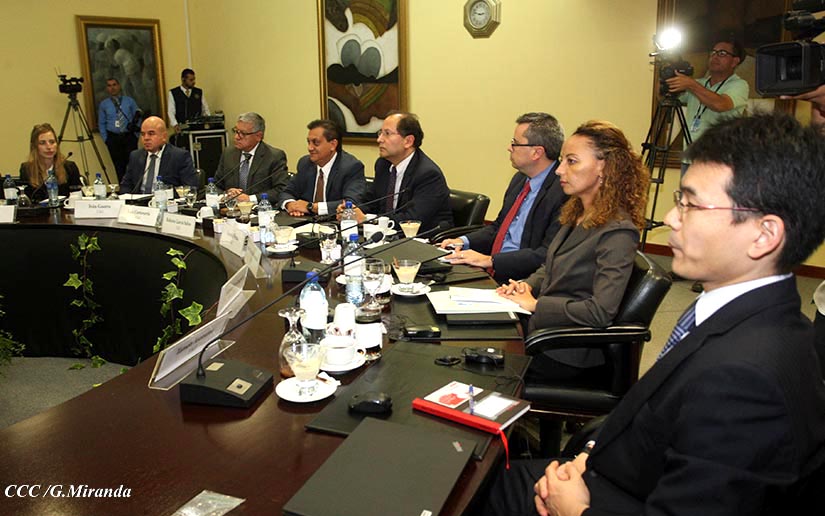
Since the onset of Nicaragua’s sociopolitical crisis, the International Monetary Fund (IMF) mission that visits the country annually to conduct the so-called Article IV consultation stopped meeting with private-sector representatives. Business leaders, together with opposition figures, began to label the Fund’s reports as complacent and detached from reality. These criticisms eventually became public denunciations and reached the IMF’s executive board.
After seven years of criticism, however, the IMF now appears to be sending signals of a change in tone.
Private-sector leaders say the most recent IMF report stemming from the 2025 Article IV consultation reflects a different approach to Nicaragua’s reality—still diplomatic in language, but noticeably more forceful.
They attribute this shift to repeated complaints from representatives of social, political, and business organizations, who used every available forum to denounce what they saw as the Fund’s complacency in the face of abuses and crimes against humanity committed by the Ortega-Murillo dictatorship, according to international human rights bodies.
They also point to the pressure facing the United Nations and its affiliated institutions—including the IMF—in the current global context, which they believe no longer allows them to remain indifferent to the realities in the countries with which they engage.
Business leaders further hope that the change will not be limited to rhetoric, but will extend to how the IMF treats the regime.
You may read: What lies behind the IMF’s complacent reports on Nicaragua’s dictatorship
What prompted the change in the IMF’s language?
“The shift may have been triggered by the constant appeals from the opposition and civil society to the IMF’s executive board regarding its complacent role toward the dictatorship,” said a business leader who requested anonymity for fear of reprisals. “It may also reflect the new global political context, which places greater pressure on these institutions not to remain indifferent to what is happening in the countries they engage with. This could even have influenced the positions of some countries’ representatives on the board.”
The business leader, who for years was part of the private sector’s representation in meetings with the IMF mission, does not rule out that the change in tone reflects resistance within the IMF board to continued manipulation by the Ortega-Murillo regime over the technical mission visiting the country.
“Perhaps they grew tired of seeing that instead of progress there has been backsliding, and of how the regime consistently took advantage of the accommodating language it managed to secure from the Fund’s technical team—especially since Alina Carare assumed its leadership,” said another business leader, who also requested anonymity.
Praise once abounded
Among the tone shifts identified by business leaders is that earlier reports were shorter and filled with praise for robust economic performance, an open and resilient economy, strong domestic demand, ample reserves, strong remittance inflows, and cautious private-sector investment decisions.
Those reports treated the rule of law as a potential factor that could raise economic costs, rather than acknowledging that its deterioration was already affecting the economy, increasing costs and harming society as a whole.
Risk assessments showed little concern, offered no special calls to prepare for future crises, and raised no major alarm bells. Recommendations were limited and described a private sector operating in a normal environment. The Fund advised close monitoring of consumer credit and called for efforts to improve the business climate, strengthen institutions, and enhance governance frameworks to boost private investment, while broadly advocating greater financial inclusion and depth.
Risks take center stage
Business leaders say that in the 2025 report the praise has disappeared. There is no longer talk of robustness or abundance. Instead, risks are magnified and problems are brought to the forefront. The new report highlights high uncertainty, weaker outcomes, scarce external financing, and persistent imbalances in the pension and social security system. It also stresses the importance of facilitation and the critical need to increase transparency.
“From the outset, the focus on robust economic performance has been replaced by an emphasis on a medium-term outlook marked by potentially weaker results and high uncertainty,” the business leader said. “The role of the private sector is prioritized through a series of recommendations throughout the document, and the rule of law is presented in a much clearer and different way.”
He added that the growth highlighted in 2024 has been replaced by a list of measures deemed necessary to ensure sustained medium-term growth. These include increasing public investment, human capital formation, and targeted social spending; diversifying exports; strengthening economic governance to combat corruption; improving the business climate; and significantly enhancing the rule of law.
Acknowledging pre-2018 gains
Business leaders also view it as significant that the new report acknowledges that post-2018 economic outcomes are not solely the result of recent macroeconomic policies, but also of reserves accumulated prior to the 2018 crisis and assistance from international financial institutions. They note as well that sanctions are now viewed through a broader and more specific lens.
“Overall, the language that once masked realities has disappeared, and the report makes clear that the IMF does not have full information,” said the business leader. “It repeatedly says ‘based on available information,’ lays out deterioration scenarios, and issues strong calls to step up efforts and prepare for crisis.”
For private-sector representatives, another sign of the shift is that where previous reports used broad and carefully controlled language, the 2025 report employs more direct and descriptive wording.
In one section, the IMF states: “Sustained medium-term growth requires not only prudent fiscal policy and correction of long-standing imbalances, but also greater public investment, human capital accumulation, and targeted social spending. Measures to diversify exports, support private investment, and improve the business climate and the rule of law are also essential.” In other words, these are no longer framed as suggestions, but as necessities to keep the economy afloat.
Rule of law as a pillar of growth
Elsewhere, the IMF tells the dictatorship: “Achieving higher medium-term growth will require increased public investment, human capital accumulation, and targeted social spending, alongside strengthened economic governance and anti-corruption frameworks, improved business climate, and a significant consolidation of the rule of law. Advancing structural reforms—particularly to increase resilience, diversify exports and trade, and raise labor force participation—will also be important.”
Gone are references to merely safeguarding macroeconomic stability or reinforcing buffers. The report now explicitly states that budget execution must be carried out cautiously and with risks in mind; that transfers to state-owned enterprises must be more precisely targeted; and that social spending must be better focused. In adverse scenarios, it recommends specific and temporary support for vulnerable groups.
It also calls for strengthening crisis-preparedness frameworks, reinforcing physical and human capital, diversifying exports, collaborating with exporting firms to develop skills for higher value-added production, and improving the business climate and economic governance—particularly through a substantial strengthening of the rule of law.
Has the regime lost control of the mission?
For business leaders, these tonal changes make it clear that, at least in this evaluation, the Ortega-Murillo regime has lost control over the language of the IMF mission that it had managed to shape in previous years.
Addressing the business climate, the Fund states: “Improving the business climate is essential to sustain higher growth. To ensure private-sector-led growth, enhancing financial inclusion would help channel remittances and small savings toward investment and support entrepreneurship.”
“Greater collaboration with the business community would help boost competitiveness and diversify exports by reducing the cost of doing business. Strengthening property rights protection and broader practices within the rule of law, tax administration, and regulatory frameworks would also help foster open competition and increase competitiveness,” the IMF emphasized.
Business leaders say it remains to be seen whether the IMF has truly awakened and put an end to the manipulation of technical language that the Ortega-Murillo regime achieved in recent years. They note that the report receives official approval, meaning the regime itself had to sign off on it.
They argue this underscores that the IMF is one of the institutions the regime cannot easily dispense with—even if it dislikes what the Fund has to say.