Amid the harassment, intimidation, and repression promoted by Havana’s Castro dictatorship against Mike Hammer, head of mission at the U.S. Embassy on the island, his recent visit to a Cuban Catholic priest underscored a stark contrast between the freedom of movement and thought still permitted by the Cuban regime and the radicalization of Nicaragua’s Ortega–Murillo leadership, which in recent years—over far less visible actions—has jailed and exiled priests.
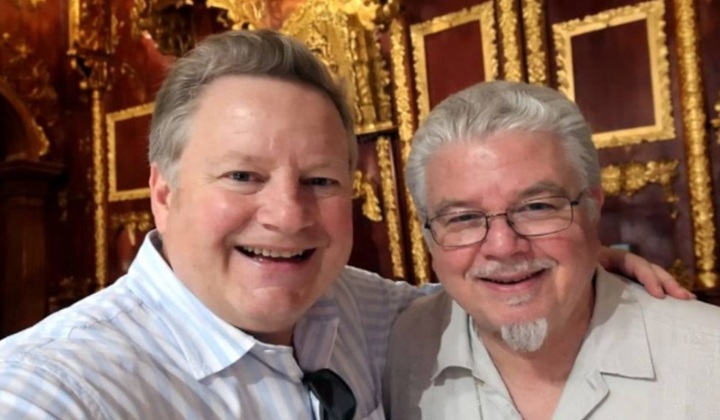
As part of his diplomatic duties, Hammer traveled to the province of Trinidad, where, in an act of political harassment, a mob attempted to prevent him from meeting with Catholic priest José Conrado Rodríguez. He was nonetheless able to do so.
Mob harassed him after the meeting
Hammer also reported that as he left the parish he was subjected to insults and shouting by a pro-government mob.
“When I left the parish, a few communists—surely frustrated by how badly the revolution is going—shouted obscenities at me,” the diplomat wrote on social media. Among the chants he reported were “murderer,” “genocidal,” and “Donald Trump’s puppet,” according to a post on the U.S. Embassy’s X account.
Read also: Chinese Mining Company Accused of Taking Farmers’ Land in Nicaragua’s Caribbean Region
Following the harassment, the U.S. State Department’s Bureau of Western Hemisphere Affairs issued a statement demanding that the Cuban regime halt its repressive actions.
“Our diplomats will continue to meet with the Cuban people, despite the regime’s failed tactics of intimidation,” the bureau said.
Nicaragua expels diplomats
Despite the act of intimidation and harassment, Hammer was not expelled from Cuba, nor were reprisals taken against the priest. This stands in contrast to the authoritarianism in Nicaragua, where Daniel Ortega and Rosario Murillo have responded with extreme measures to far less visible gestures.
A recent example is the expulsion of Spain’s ambassador in Managua, Sergio Farré Salvá, as well as the mission’s minister-counselor, Miguel Mahiques Núñez. Without offering any official public explanation, the regime expelled them before they had completed two months in the country, making their tenure exceptionally brief.
The European Union described the move as “unilateral, unjustified, and unacceptable,” urging the government to reverse the decision and allow diplomacy and dialogue to continue. But the dictators are not receptive to correction.
Clergy jailed and exiled
Similar cases have occurred with diplomatic representatives from the Organization of American States (OAS), the European Union (EU), and United Nations (UN) agencies, whose representatives have been expelled and forced to leave the country—sometimes for raising concerns about human rights violations, and in other cases for unknown reasons.
The persecution, however, is not limited to the diplomatic sphere. In Nicaragua, priests have been jailed and exiled for actions less visible than meeting with a diplomat or for expressing criticism of the regime—much like Father José Conrado Rodríguez has done in Cuba.
Read also: IMF Warns Trump’s Policies will Hit Nicaragua Remittances, but Regime is Braced for Impact
The most emblematic case is that of Bishop Rolando Álvarez, sentenced to 26 years in prison on charges of treason after refusing to leave the country on a flight that exiled 222 political prisoners in February 2023. A year later, Bishop Álvarez himself was exiled to the Vatican.
Journalists also persecuted
Álvarez is not the only one. In April 2024, the bishop of Siuna, Isidoro Mora, was also exiled after praying during Mass for Bishop Álvarez. The same fate befell the bishop of Jinotega, Carlos Herrera, who in November of that year was exiled to Guatemala along with his assistant after demanding that municipal officials show respect while conducting an event in the church atrium that prevented parishioners from hearing Mass.
These bishops join a long list of more than 300 priests who have been jailed or exiled. The same has happened to congregations of nuns who, in addition to being expelled from the country, have had their assets confiscated.
Even the practice of journalism marks another key difference. In Cuba, Hammer recently invited journalists to a diplomatic event, although they were denied access. In Nicaragua, simply practicing the profession has led to the detention, exile, forced displacement, and stripping of nationality of hundreds of journalists, as well as the confiscation of media outlets.