*The first of two articles LA PRENSA is presenting in partnership with Expediente Público
Amid escalating tensions between the United States and Iran — tensions that continue to fuel friction across multiple fronts of the international system — a less visible yet strategic dynamic is consolidating in Central America.
The relationship between Managua and Tehran has endured shifts in the global landscape, and today, the Nicaragua of dictators Daniel Ortega and Rosario Murillo provides Iran with access and presence in the Western Hemisphere.
Even in a scenario where Washington and Tehran explore avenues for de-escalation, Nicaragua’s value as a geopolitical asset remains intact.
The United States remains Nicaragua’s main export market and the primary source of remittances that sustain its economy. Despite this dependence, Ortega on April 21 called President Donald Trump “mentally deranged” over military actions against Iran.
Also read: Dictator Daniel Ortega Unleashes Another Fiery Verbal Tirade Against the U.S.
At the same time, Nicaragua offers territory, logistical facilities, and political backing to a regime regarded as one of the principal threats to U.S. national security. Yet relations between Managua and Washington show no proportional rupture.
Ortega Fills the Void Left by Maduro
Following the weakening of the Venezuelan axis, Nicaragua — alongside Cuba — has emerged as one of Iran’s few active allies in Latin America. Its positioning now goes beyond diplomatic gestures and is part of a broader strategy of political alignment at a time of heightened international tensions.
That alignment is reflected in concrete actions. On March 31 of this year, marking the anniversary of the Islamic Revolution, the Nicaraguan government issued an official statement that not only recognized the Iranian regime, but also praised its political model as a legitimate expression of self-determination.
For Félix Maradiaga — academic, former political prisoner, and Nicaraguan opposition figure in exile — these positions are not merely symbolic. Rather, they reflect a structural logic within the Ortega-Murillo regime’s foreign policy, one openly confrontational toward the United States.
“The relationship with Iran is consolidating as part of a broader strategic alignment, where the ideological component facilitates decisions that expand the access and presence of extra-regional actors in Nicaragua,” Maradiaga told Expediente Público.
Nicaragua has facilitated the Iranian presence in the Western Hemisphere
This alignment, however, goes beyond rhetoric. In practice, it has translated into concrete decisions facilitating the Iranian presence on Nicaraguan soil, at a time when Tehran’s officials face severe sanctions across much of the Western world.
“Managua granted major immigration privileges to Iranian officials who have naturally faced heavy restrictions over the past 30 years when traveling through the West, so the migration issue is significant,” Maradiaga said.
He emphasized that one of the most sensitive aspects of the relationship is the use of Nicaraguan territory as both a gateway and projection platform in the hemisphere.
Also read: Nicaragua Challenges U.S. as Ortega Regime Strengthens Russia Ties in Managua
Monkey Point: The Port That Was Never Built
The agreements and projects announced between Iran and Nicaragua since 2007 have included initiatives in infrastructure, energy, healthcare, technology, and institutional cooperation. On paper, they projected a large-scale partnership, but in practice they have yielded limited or difficult-to-verify results.
Examples of abandoned agreements include the deep-water port at Monkey Point and large-scale energy packages that never materialized.
The Monkey Point project was valued at more than US$350 million but was never built; and the energy package that included a power plant with a capacity exceeding 600 megawatts remains without clear evidence of implementation.
These initiatives were presented as transformative investments for Nicaragua’s economy. Yet the flood of announcements never translated into tangible outcomes. Most of the projects never came to fruition, while others stalled midway.
Even initiatives announced as part of cooperation packages worth more than US$1 billion lack publicly verifiable information regarding financing, progress, or results.
Agreements: Much Propaganda, Poor Execution
The agreements have focused on specific areas that rarely involved direct investment or measurable economic results. In fact, a significant portion of the cooperation promises have been institutional, cultural, or technical in nature — meaning they required neither large-scale investment nor short-term measurable outcomes.
Under this cooperation model, the think tank Expediente Abierto found that the Managua-Tehran relationship has operated through a logic of recurring announcements and selective implementation, rather than sustained economic development.
“Cooperation between the two countries has functioned as a mechanism for political visibility, propaganda, and strategic positioning,” the organization stated in a report.
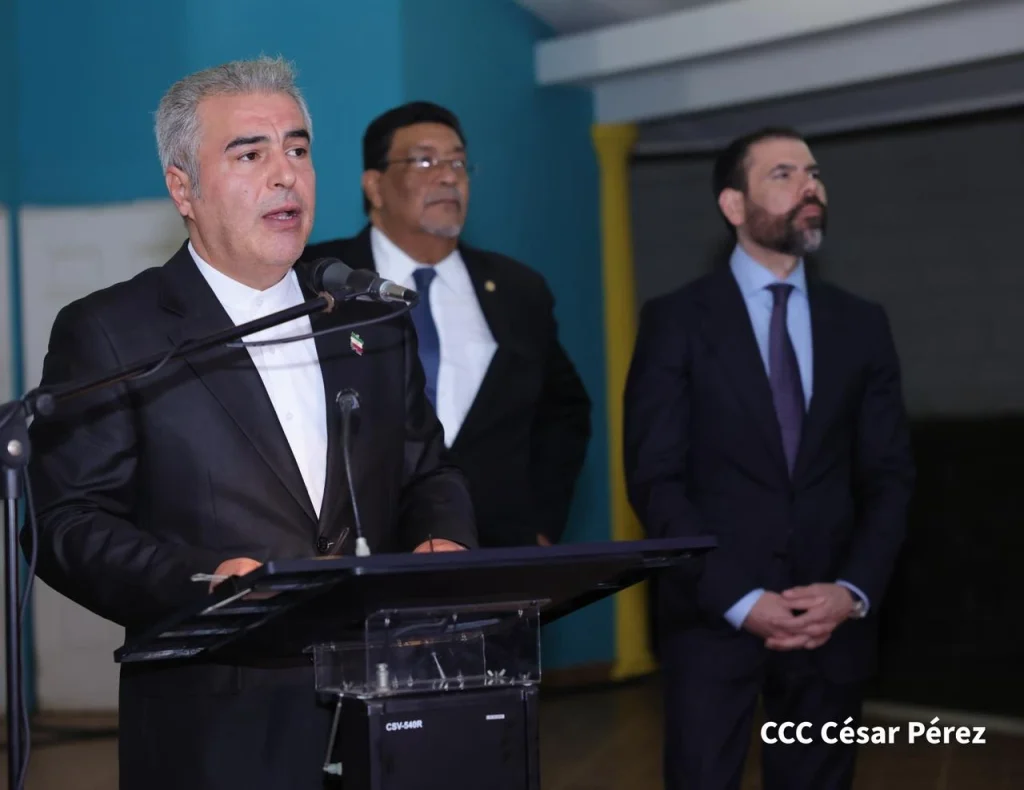
For Salvadoran political scientist Napoleón Campos, this pattern is not accidental. It reflects a logic in which Nicaragua positions itself as a platform for extra-regional actors such as Iran, Russia, and China.
“The value of the relationship does not lie in project execution or tangible economic benefits. In practice, cooperation functions as an instrument of geopolitical insertion,” Campos told Expediente Público.
According to Campos, the arrangement is functional for Iran: Managua offers territorial, political, and strategic access in exchange for limited but useful support for its anti-U.S. narrative.
The result, he argues, is a structurally asymmetric relationship that does little to promote internal development, while strengthening the projection of extra-regional interests in Central America.
You might be interested in: After more than 240,000 Cubans used it, Nicaragua shots down visa-free bridge to U.S.
An Active Ally of Iran’s Agenda
This strategic alignment extends beyond bilateral relations and cooperation agreements. It is also projected onto the international stage, where the Ortega-Murillo regime has taken active positions defending Tehran’s interests in multilateral forums.
One example occurred in November 2025, when Nicaragua joined Belarus, China, Cuba, Russia, and Zimbabwe in backing Iran’s nuclear program before the Board of Governors of the International Atomic Energy Agency.
During the session in Vienna, Nicaragua’s delegation defended Iran’s right to develop nuclear energy “for peaceful purposes,” a position that went beyond traditional diplomacy and reinforced its political alignment on a matter highly sensitive to global security and U.S. interests.
A Relationship of 46 Years
Far from being a recent or isolated development, this behavior reflects a relationship steadily built since the Sandinistas returned to power in 2007.
Ortega restored ties with Iran and has referred to the two movements as “twin revolutions,” noting that both the Sandinista rise to power and the ascent of the ayatollahs occurred in 1979.
Since then, Nicaragua has pursued a foreign policy aimed at counterbalancing U.S. influence in Central America.
A Pattern Beyond Nicaragua
A 2007 report by the Woodrow Wilson Center warned of “a profound gap between promises and the actual realization of productive and infrastructure investments by Iran,” highlighting the distance between cooperation announcements and effective implementation.
This dynamic has long been characterized by large-scale commitments that rarely produce concrete results in Latin America.
In Nicaragua, aside from isolated advances — such as the construction of a polyclinic — the overall balance confirms a relationship marked by repeated promises and marginal outcomes.
You might be interested in: U.S. says Nicaragua Serves as a Base for Russian Operations in the Western Hemisphere
The pattern identified by international analysts consulted is that the Nicaragua-Iran relationship cannot be understood in terms of conventional economic cooperation, but rather as an alliance of geopolitical convenience.
Rather than generating development or tangible benefits, it has functioned as a strategic projection platform for Tehran in the Western Hemisphere, sustained by ideological affinities, institutional opacity, and a shared logic of confrontation with the United States.
Ultimately, the value of this relationship lies not in what Nicaragua receives, but in what it offers: territorial access, political flexibility, and a foothold close to the United States — Iran’s principal adversary.