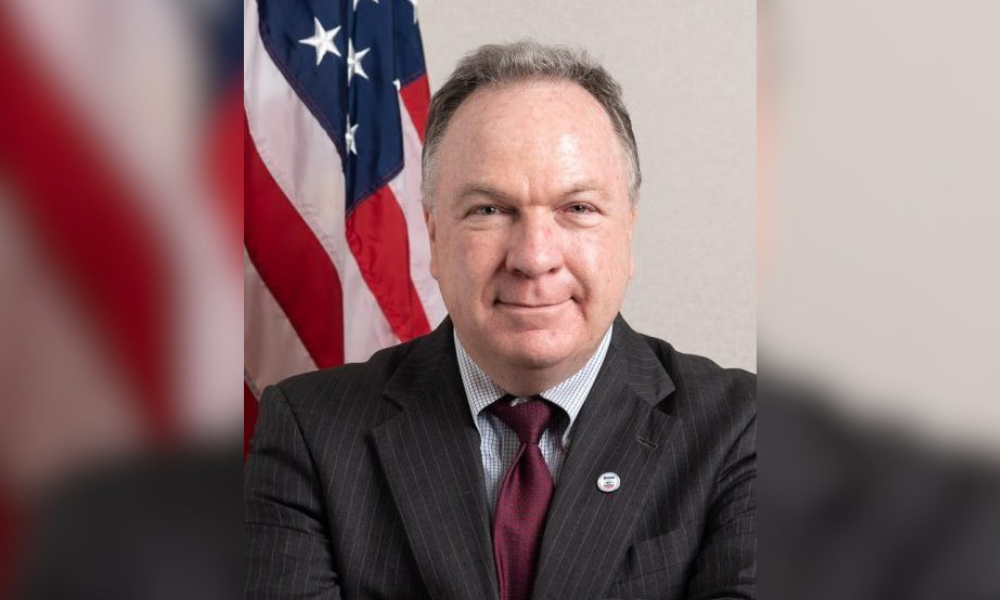
U.S. President Donald Trump has no real interest in forcing Daniel Ortega and Rosario Murillo from power in Nicaragua, according to former American diplomat Steven Hendrix. In an interview with LA PRENSA, the expert examined the foreign policy approach of the current U.S. administration, arguing that it is driven more by domestic political calculations and personal interests than by any coherent strategy toward Nicaragua, Cuba, or Venezuela.
With more than three decades of experience in democracy and governance programs across Latin America, Hendrix maintains that Trump would only move against the Nicaraguan regime if doing so offered political gain or international recognition.
“Trump would act if the situation benefited him politically, or if other forces were already moving to remove Ortega,” Hendrix said. “Then Trump would step in to claim the applause and the credit.”
The former USAID Democracy Director in Nicaragua also argues that Managua no longer carries the geopolitical weight it once did. In his view, neither Russia nor China sees Nicaragua as a genuine strategic priority, despite efforts by the Sandinista regime to portray itself as an ally of both powers. Hendrix went further, describing Ortega as a “sellout” because of his close relationship with China — a stance he says contradicts the historical ideals of Sandinismo.
Read also: Raúl Castro Indictment Raises Questions About Possible U.S. Cases Against Ortega and Murillo
Trump Focused on Domestic Politics
According to Hendrix, Trump is “simply not interested” in Nicaragua because he is preoccupied with domestic pressures such as inflation and the upcoming November elections.
“Besides, he loves playing golf,” Hendrix added sarcastically.
The former diplomat said the Ortega-Murillo regime has built a political system designed solely to preserve its grip on power, despite the existence of capable sectors within Nicaragua that could lead change.
“We have a country with no shortage of brilliant Nicaraguans who could lead the nation,” he said. “But the de facto government of the Ortega-Murillo family has moved all the chess pieces to ensure it always remains in control.”
Hendrix also argued that the Sandinista government has deliberately dismantled independent sectors of society.
“It has isolated the Church, effectively eliminated the independent press, and destroyed civil society,” he said. “To practice a profession now means either aligning yourself with the dictator or leaving the country.”
He added pointedly: “Not to mention the impossibility of even buying my book The New Nicaragua,” referring to restrictions on the entry of critical literature into the country.
When Ortega returned to the presidency in 2007, Hendrix was in Nicaragua working for the United States Agency for International Development (USAID). His book, The New Nicaragua: Lessons in Development, Democracy, and Nation-Building for the United States, chronicles the transformations taking place in the country during that period.
Hendrix described Ortega and Murillo as leaders of a dictatorship skilled in political survival, arguing that the regime bears no resemblance to the people-centered revolutionary government promoted during the 1980s.
“It is a government loyal only to itself and to its own endless continuation,” he lamented.
Opposition Should Seek International Support Beyond Washington
Hendrix believes Nicaraguan opposition sectors should look beyond the United States for international backing.
“If I were Nicaraguan, I would try to influence events in Nicaragua from abroad,” he said. “Today I would think more about the European Union, about Mexico, neighboring countries, friendly nations.”
He also pointed to Costa Rica as a country that could wield greater influence under current circumstances.
Unlikely U.S. Push for Justice in Eddy Montes Case
Asked whether the Trump administration could pursue justice against Ortega over the killing of Nicaraguan-American citizen Eddy Antonio Montes Praslin inside Nicaragua’s prison system, Hendrix considered such a move unlikely.
He argued that Trump “has freed drug traffickers from Honduras and other countries and has shown no consistency in his policies regarding organized crime, narcotrafficking, or human rights.”
You may be interested: U.S. Family Considers Lawsuit After American Mother Dies in Crash at Nicaragua Luxury Resort
Hendrix also noted Trump’s history of maintaining close ties with authoritarian governments, insisting that Nicaragua should not expect decisive action from Washington if a direct political interest from the White House is absent.
“I believe this is a moment for all of us not to expect salvation from the White House,” he said. “It will not come unless it serves the interests of its occupant.”
On May 16, six years passed since the killing of Montes, widely considered the first political prisoner to die inside a Nicaraguan prison under the current Ortega-Murillo government.
Montes, a 57-year-old lawyer known among fellow prisoners as “The Pastor” for his religious guidance to younger detainees, was shot by a prison guard with a military-grade weapon at La Modelo prison in Tipitapa.
Trump’s Style and Midterm Elections
When asked whether Trump might allow Nicaragua’s political situation to continue unchanged while focusing on geopolitical negotiations involving Ukraine, Russia, Taiwan, or China, Hendrix said the U.S. president is primarily focused on consolidating power at home.
“Trump reached the height of his power,” Hendrix said. “He began governing by decree, above everyone else, including the Federal Reserve, Congress, and the judiciary.”
He added that Trump removed career officials and installed loyalists throughout the federal government.
“He carried out mass dismissals of public-sector employees and career diplomats, replacing them with people aligned with his political agenda,” Hendrix said.
According to Hendrix, the greatest limits on Trump’s power could emerge from the midterm elections and potential congressional investigations.
“It is likely Trump will lose control of the House in the midterms,” he said. “During his first presidency, when that happened, he was impeached twice.”
Losing legislative control, he argued, would weaken Trump’s ability to govern.
“That paralyzed his legislative agenda,” Hendrix explained. “Instead of governing offensively, he had to defend himself. He made little progress during the final two years of his first presidency.”
He also warned that a Republican loss in Congress could trigger investigations into political appointments and the handling of public funds.
“All that backroom political maneuvering — putting loyalists in government — and any misuse of funds would come into public view,” he said. “That would slowly begin to curb Trump’s power.”
Hendrix believes the Republican Party is already entering a post-Trump succession battle because the president cannot seek another reelection.
“He has no possibility of running again,” Hendrix said. “Potential rivals are already emerging, positioning themselves to take control of the party after Trump.”
Nicaragua Not a Priority for Russia or China
Within that context, Hendrix argued that statements from some Republican figures regarding Nicaragua may reflect personal political ambitions rather than official White House strategy.
“If Marco Rubio says those things about toppling dictatorships, it is hard to know whether he is speaking for the president or positioning himself as a future candidate,” Hendrix explained.
Read also: KFC’s Arrival in Nicaragua Does Not Signal a Strong Investment Climate, Economists Say
For Hendrix, Nicaragua lacks sufficient geopolitical importance to become a true priority for either Russia or China, despite Ortega’s attempts to portray the country as a strategic ally of both powers.
“Ortega wants to elevate Nicaragua to that level, but Russia already has its hands tied with Ukraine,” Hendrix said. “They are losing the war.”
He also argued that recent signals from Moscow indicate a practical distancing from Managua.
“Ortega no longer has the global importance he once did,” he said.
“Ortega Turned Out to Be the Real Sellout”
Regarding Nicaragua’s relationship with China, Hendrix argued that Beijing has grown weary of extending loans to countries like Venezuela and Nicaragua.
“China is tired of lending money to Venezuela,” he said. “It wants repayment, not more investments. The same applies to Nicaragua. The Chinese are essentially asking: ‘You owe us a great deal of money — how are we going to resolve this?’ They are tired of lending.”
Referring to mining concessions granted by Ortega’s government to Chinese companies, Hendrix argued that the environmental and political consequences of the relationship have not yet been fully understood.
“The ecological damage must also be measured,” he said. “China has invaded without sending troops.”
In Hendrix’s view, Ortega’s alliance with Beijing contradicts the nationalist principles historically associated with Sandinismo.
“Ironically, Ortega turned out to be the real sellout, which is completely contrary to Sandino’s vision,” he said. “It is incredible how Ortega is selling out the country simply to keep himself and his family in power, without thinking about the future or about history.”
Trump, Latin America, and Nicaragua
Hendrix believes the Trump administration lacks a coherent strategy toward Cuba and that Washington’s decisions are driven more by short-term reactions than by any clearly defined regional policy.
“Removing one government and installing another is not just about security,” he said. “It is about responding to economic crises, energy crises, even famine. No one really knows Trump’s motivations.”
According to Hendrix, that uncertainty extends even to figures close to the president.
“Even the Cubans do not know,” he said. “And I honestly do not think Marco Rubio knows either. I do not believe Donald Trump himself knows, because he has not decided. He is creating chaos to see what happens.”
Hendrix argued that the same inconsistency is evident in U.S. policy toward Venezuela and ultimately affects Nicaragua as well.
“During Trump’s previous administration, he opened the door to temporary protected status for Venezuelans in the United States,” Hendrix noted. “Now he is closing the door to migrants and refugees.”
“It is curious,” he concluded. “He is not even consistent with himself. He takes advantage of the moment, and when the politics change, he changes his position too.”
Our editorial: Nicaragua’s Military Deal With Russia Risks Sovereignty and Deeper Isolation
Steven Hendrix: Career and Experience in Nicaragua
Steven Hendrix is an American jurist and former diplomat with more than 30 years of experience in democracy, governance, and human rights programs across Latin America, Africa, Asia, and the Middle East. Throughout his career, he held senior positions at the U.S. Agency for International Development (USAID) and the U.S. State Department, working on issues related to foreign policy, institutional transparency, justice, security, and democratic strengthening.
Between 2005 and 2007, Hendrix served as USAID Democracy Director in Nicaragua, where he led programs aimed at improving government accountability and public services. During that time, he worked with Indigenous representatives, community leaders, mayors, members of the National Assembly, and executive branch officials, while also representing his organization before the White House, the U.S. Congress, and the media.
He later held senior USAID positions in Paraguay, Ghana, Nigeria, Iraq, and Guatemala, and coordinated regional programs for Latin America and the Caribbean focused on democracy, security, justice, and governance. Hendrix also participated in negotiations linked to peace agreements in Colombia, El Salvador, and Guatemala, as well as broader international security and regional cooperation initiatives.