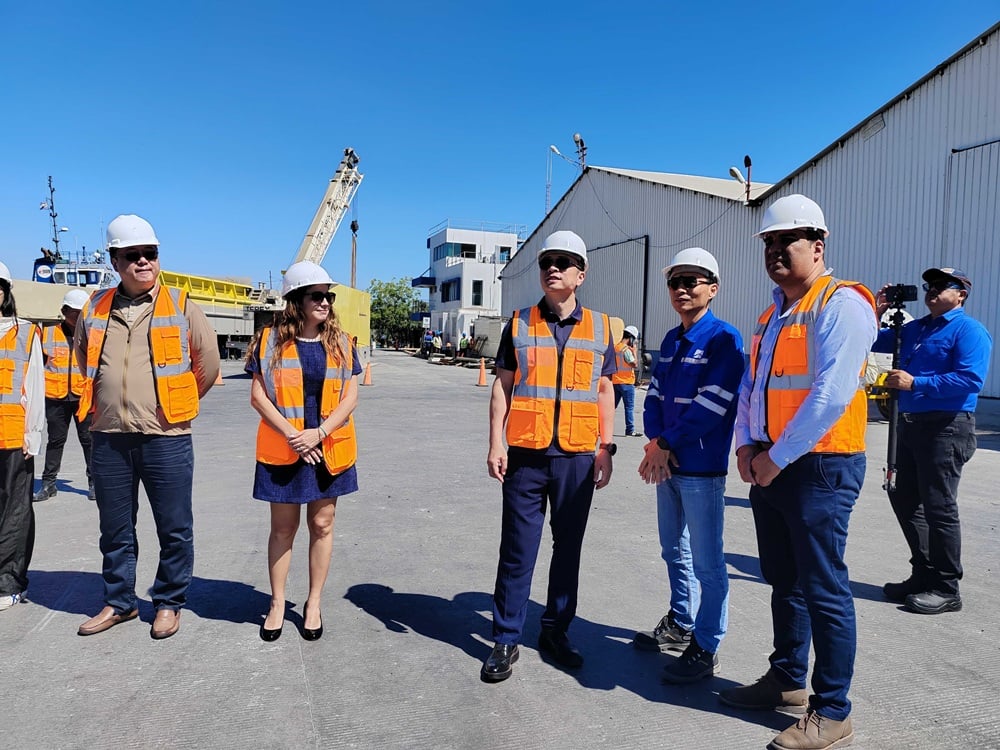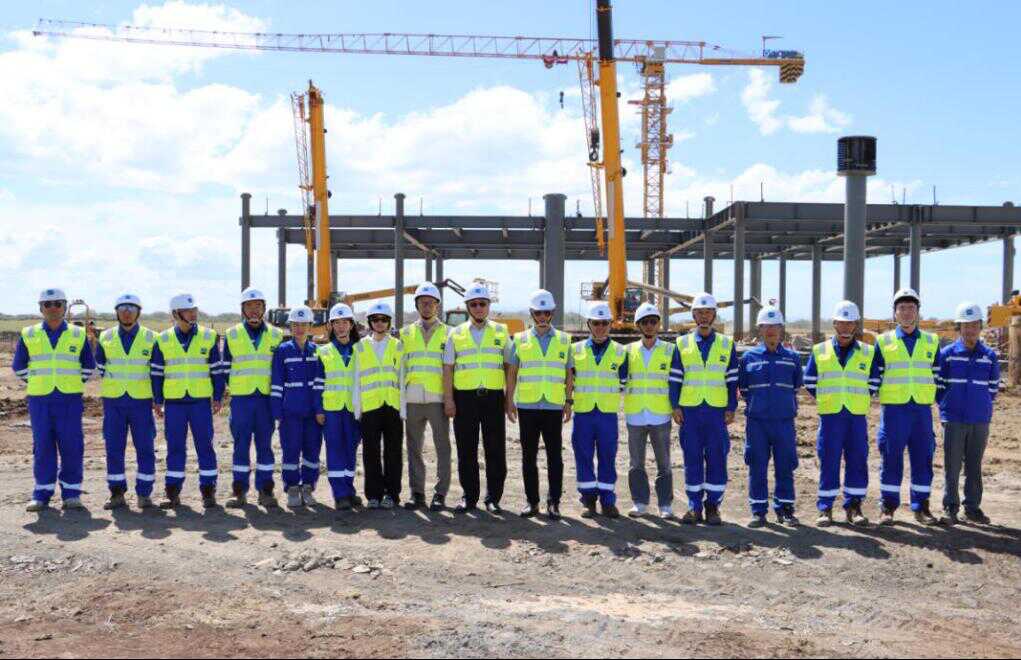
Photos released by the Chinese Embassy in Nicaragua following a recent visit by Ambassador Qu Yuhui have drawn renewed attention to delays in two major Chinese-financed infrastructure projects, particularly the stalled reconstruction of the Punta Huete International Airport.
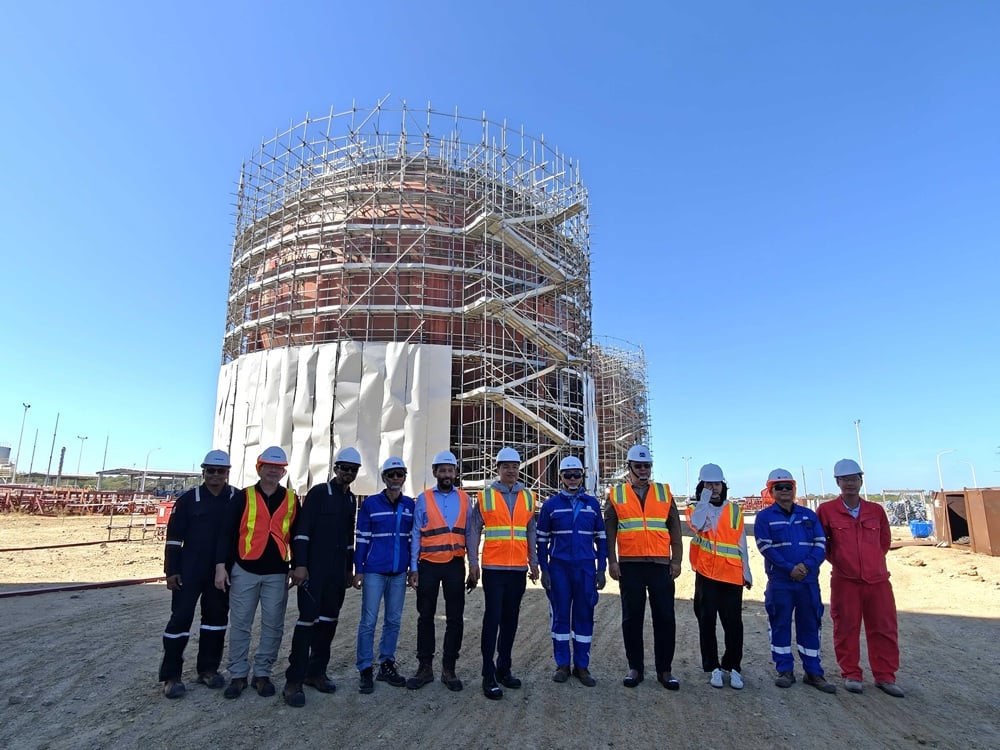
The embassy published images from the ambassador’s visits to Punta Huete, in the municipality of San Francisco Libre, and to Puerto Sandino, where China is financing the construction of liquefied petroleum gas (LPG) storage facilities. While the images from Puerto Sandino show visible construction progress, the single photograph from Punta Huete shows little more than a crane, construction equipment, and the ambassador posing with officials.
The brief embassy statements—each fewer than 40 words—were posted in early and mid-January and noted that Qu was accompanied by China’s economic counselor Zhao Chunjiang and representatives of China CAMC Engineering Co., Ltd. (CAMCE), the state-linked firm financing and executing both projects. CAMCE is covering 80 percent of the total cost, with the Nicaraguan government responsible for the remaining 20 percent.
More than 18 months after the airport project was formally launched, there are still no visible signs of substantial construction at Punta Huete. The reasons for the delay have not been publicly explained, despite the fact that Nicaragua paid its required 20 percent counterpart in 2024—an explicit contractual condition for the start of works.
Read also: Is the IMF Reconsidering Ortega’s “Economic Paradise”? Analysts Point to a Shift on Nicaragua
Budget Execution Lags Behind Allocations
Budget data reinforce concerns about the project’s slow progress. Nicaragua’s 2025 budget allocated 3.57 billion córdobas (approximately US$97.5 million) for work at Punta Huete. However, according to the government’s January–September 2025 budget execution report, only 569 million córdobas (about US$15.5 million) were spent during that period.
The report indicates that the funds were used for preliminary activities such as demolition, runway expansion, and construction of an access road. Of the amount executed, US$2.27 million came from public funds, while the remainder was drawn from CAMCE’s loan.
For 2026, the government nearly doubled the airport’s budget allocation to 7.29 billion córdobas (about US$199 million), rolling over unspent funds from previous years. Whether this increase will translate into tangible progress remains uncertain.
A Project Years in the Making
Official government communications say the new international airport terminal is scheduled for completion in October 2028—four years after the public groundbreaking ceremony led by Laureano Ortega Murillo, son of President Daniel Ortega and Vice President Rosario Murillo.
Documents published by Nicaragua’s National Assembly show the airport’s total cost was revised upward to US$517.6 million, well above initial estimates of around US$400 million. As a result, Nicaragua paid CAMCE US$103.5 million in 2024 for its 20 percent share, rather than the US$80 million originally projected.
The remaining US$414 million will be financed by CAMCE through two loan tranches of roughly equal size. The credit agreement was signed in December 2023 and ratified by Nicaragua’s legislature in early 2024.
Read also: China’s Investment Strategy in Nicaragua: Low Capital, High Economic Presence
Contrasting Progress at Puerto Sandino
In contrast to Punta Huete, the images from Puerto Sandino show visible advances in the construction of three LPG storage spheres. Ambassador Qu was photographed in front of large cylindrical structures under construction, along with other industrial facilities and heavy machinery.
Still, official budget data reveal inconsistencies. Despite a 2025 budget allocation of 487.7 million córdobas (about US$13.3 million) for the LPG project—funds linked to CAMCE’s loan—no money was executed during the January–September period, according to the same budget execution report.
For 2026, the allocation for the LPG storage project was reduced to 405 million córdobas (about US$11 million), even as funding for the airport project increased.
The government says the LPG project will expand Nicaragua’s storage capacity from 5 million to 8 million gallons, allowing it to meet domestic demand and maintain reserves. The stored gas, marketed under the Petrogas brand, is intended to supply roughly 300,000 households per month with 25-pound cooking gas cylinders.