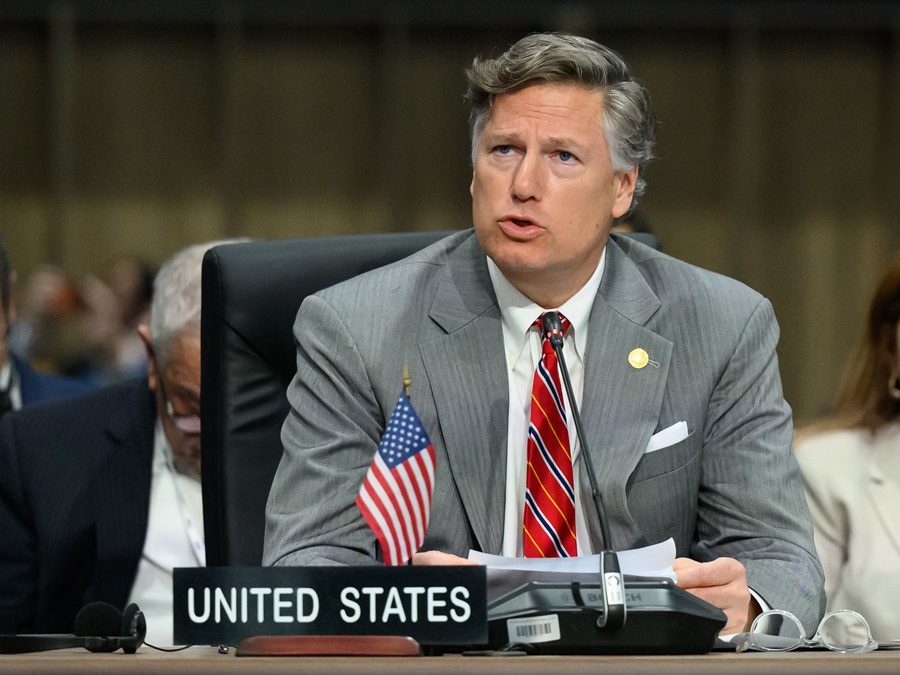
The United States thanks Dominica and Ecuador for their efforts as co-chairs of the OAS Permanent Council to shepherd the process leading to this historic session. We also extend our gratitude to Paraguay for chairing this ministerial.
We especially commend the co-sponsors of this resolution, and all delegations present, for keeping the spotlight on the dictatorship of Nicaragua’s co-presidents, Rosario Murillo and Daniel Otega. This summer, with overwhelming support, this organization adopted a resolution condemning Ortega’s announcement that there would be no more elections in Nicaragua. We meet today because the countries represented around this table reject this anti-democratic behavior.
Now is the time for this organization to take action that sends a clear message. Murillo and Ortega’s dictatorship has no place in our hemisphere.
Also read: A Major OAS Defeat for Ortega-Murillo Regime Gives Nicaragua’s Opposition New Hope
As Secretary Rubio has said, the recent illegitimate constitutional changes enacted by the regime’s rubber stamp Parliament exposed the fiction of democracy in Nicaragua.
This is just the latest action from Murillo and Ortega to deprive Nicaraguans of their liberties. For too long, these co-dictators have silenced, exiled, and jailed thousands whom they’ve labeled political opponents, including American citizens and legal permanent residents.
The recent death of Brooklyn Rivera was a horrific tragedy, and, furthermore, Mr. Rivera’s grieving family members and associates should be free, not sitting in jail because they asked for the return of his body.
Murillo and Ortega also continued to escalate religious repression. Half the country’s Catholic bishops live in exile. We must remember the unjust and arbitrary detention of bishops Alvarez and Mora, and we can’t forget the horrific reports of the torture through which they greatly suffered. It’s a shame and an outrage that a country that is home to one of the deepest faith traditions in our hemisphere, and home to the grand cathedrals at Granada and Leon, won’t let believers convene in procession during Lent.
It hasn’t been safe for the opposition to participate in Nicaraguan politics for a long time, especially since the violent crackdown in 2018. The illegitimate changes to the Constitution labeled the opposition as traitors and prohibit them from participating in the Democratic process.
Murillo and Ortega have transformed the beautiful country of Nicaragua into a police state aimed at perpetuating their dynastic rule. As you may recall, this isn’t their first attempt to rewrite the Constitution to entrench themselves in power. In 2025, they illegally changed the Constitution to elevate Murillo to co-president without even the pretense of an election, because they know Murillo can’t win a fair election.
If you’re not afraid of your people, why are you afraid of elections? The answer is simple. The dictators are afraid of the freely expressed will of the Nicaraguan people. Nicaragua should have held elections this year. Yet no one has any illusion that any elections, much less free and fair elections, will occur in Nicaragua so long as the Murillo Ortega Dynasty rules.
You might be interested in: Law as the foundation of OAS collective action in Nicaragua
We all understand that the Democratic crisis in Nicaragua isn’t solely an internal matter to the contrary. The dictatorship endangers the peace and security of our hemisphere. The dictatorship destabilizes Central America and our broader hemisphere by facilitating illegal immigration and embracing non hemispheric security services, which support the repression.
These non-hemispheric security services train Nicaragua’s National Police and share intelligence with the regime’s machinery of repression. These actors aren’t only propping up a dictatorship. They’re using Nicaragua as a springboard into our region, threatening the peace and security of Central America and our hemisphere.
This status quo in Nicaragua is intolerable. The resolution put forward today demands that the dictatorship release unjustly held prisoners, protect religious freedoms, return, confiscated property, and reverse the constitutional changes that fly in the face of democracy.
What’s the point of this organization if we can’t speak firmly and loudly to defend democracy, the very principles that are set forth in this booklet that is before each and every one of us? And we’re delighted that this body has expressed a willingness and a “compromiso” to do so.
To ensure that the demands of this resolution do not fall on deaf ears, we propose sending a high-level group, chosen by foreign ministers, to Managua, to deliver these demands. The United States looks forward to working with the chair and other member states to assemble that high level group from across the hemisphere to carry our collective message directly to the regime.
We must carefully consider who should form part of this delegation, and the same is true for developing the collective action set forth in our resolution, in this resolution. These steps will follow once the high-level delegation reports back to this meeting of foreign ministers. We’re asking today to keep our options open, to decide next steps after that delegation has done its job. Passing this resolution today by consensus illustrates our resolve to tell this dictatorship, we, all of us, we see you.
We will continue to apply pressure until we see change. Murillo and Ortega have consistently closed the door on productive dialogue. Just yesterday, they rejected Agrément for our highly qualified ambassador, illustrating their unwillingness to accept professional diplomatic engagement.
From our newsroom: Nicaragua’s Military Holds the Key to Post-Ortega Succession, International Analysts Say
As always, the Trump administration is committed to constructive engagement with the chair and the member states to drive forward with our collective efforts to support meaningful democratic change in Nicaragua.
Thank you, muchas gracias. Thank you very much. Thank you.
*The author is deputy Secretary of State of the United States, this was his speech during the meeting of Foreign Ministers of the OAS on the situation of Nicaragua last Friday in Washinton D.C.