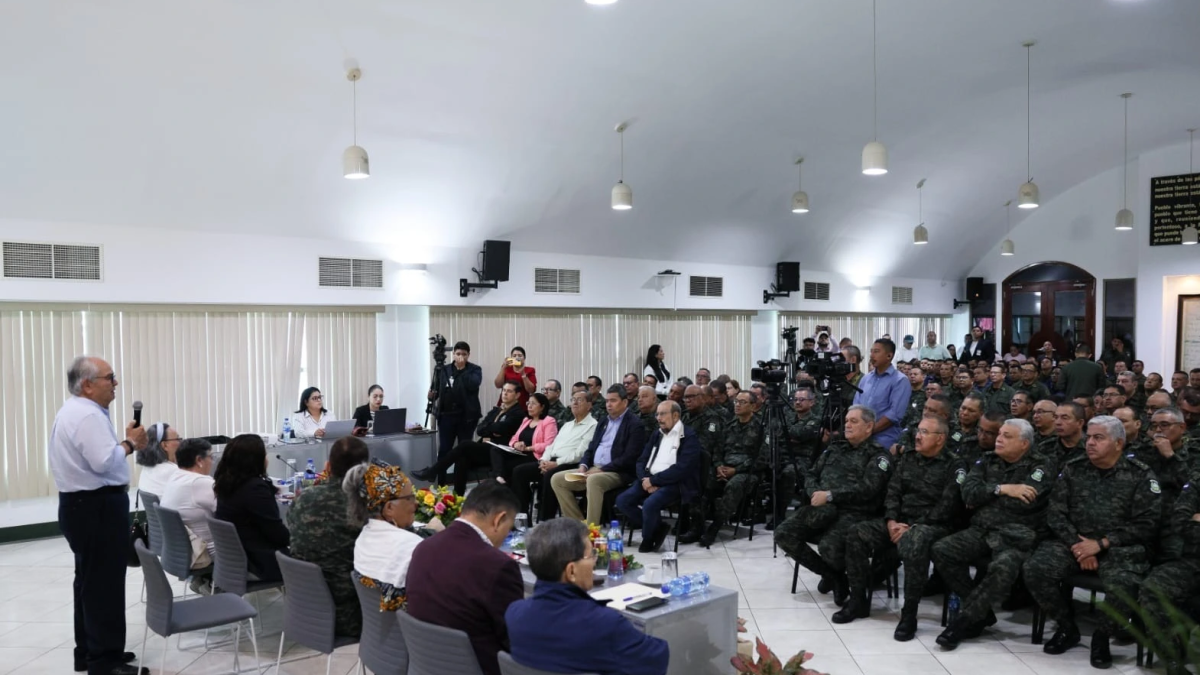
On July 29, Gen. Julio César Avilés arrived at the National Assembly to back constitutional reforms promoted by dictators Daniel Ortega and Rosario Murillo. This made the Nicaraguan Armed Forces the first institution summoned by lawmakers to deliver a formal stance on the overhaul. That day, Avilés spoke on behalf of the High Command, the Military Council, and the ground, naval, air, and reserve forces.
Although Avilés claimed in 2021 that the military would respect the will of Nicaraguan voters, the top commander endorsed a drastically different constitutional model this time. The changes extend elected terms to seven years, authorize stripping legal status from political parties that accept foreign funding or support sanctions against Nicaragua, and declare foreign court rulings null and void within national territory.
According to Orlando J. Pérez, a political science professor at the University of North Texas at Dallas, and Randy Pestana, associate director at Florida International University’s Jack D. Gordon Institute for Public Policy, this move carries consequences extending far beyond legal text: the military has endorsed dismantling the electoral foundation of the civilian authority to which it is constitutionally subordinate.
Once Ortega and Murillo are gone, the authors argue, no other institution will possess comparable capacity comparable to that of the Army to keep the state apparatus running. Consequently, anyone seeking to succeed them will, in one way or another, require the consent of the armed forces.
The Military and Political Succession
The critical question is not merely who formally assumes the presidency, but who maintains the functional capacity to guarantee effective control of the state, Pérez and Pestana noted in an analysis published September 8 in War on the Rocks.
The reformed constitution mandates that if one co-president dies, the survivor assumes the presidency for the remainder of the term. Under that framework, Murillo would be Ortega’s legal successor. However, Pérez and Pestana raise a distinct issue: would the military remain obedient to Murillo once Ortega is gone?
Ortega built his relationship with the armed forces over decades. Murillo, by contrast, exercised direct authority over the National Police. While 2025 reforms formally placed Murillo in the military chain of command, significant doubt remains regarding how the institution would respond during an actual succession.
This uncertainty is vital because the military maintains a unified command structure, and the analysis highlights that no other armed body in the country can challenge its dominance. Nor can any civilian force, given that most organized opposition leaders remain in exile.
Unwavering Backing for Ortega and Murillo
Since Ortega returned to power in 2007, the armed forces have stood by him. The military actively assisted government repression during the 2018 civil uprising.
In April 2025, the United Nations Group of Human Rights Experts on Nicaragua (GHREN) named 54 officials responsible for state violence following the protests. Eleven were military officers—six generals and five colonels—including Avilés.
That allegiance was reaffirmed in 2026 when the top general endorsed constitutional amendments extending term limits and restricting participation for parties associated with foreign funding or international sanctions.
Analysts observe that the military transitioned from safeguarding democratic elections under the pretext of civilian subordination to actively endorsing measures that undermine electoral competition.
Entrenched Economic Interests
The military leadership’s posture is deeply tied to its financial stakes.
The Military Social Security Institute (IPSM), tasked with managing pension funds for military officers, has evolved into a vast commercial conglomerate. It holds substantial investments across construction, retail, pharmaceuticals, higher education, and real estate.
Pérez and Pestana point out that no military chief has published an audit of the pension fund since 1995. This commercial footprint means any political transition poses direct financial risks to military assets and retirement payouts for high-ranking officers.
The mistrustful Ortega and Murillo
Firm backing from the military does not indicate complete trust from Ortega and Murillo.
Reforms to the Military Code in March 2025 granted the presidency explicit power to appoint and dismiss the commander-in-chief. Two months later, retired Gen. Álvaro Baltodano and retired Capt. Aníbal Rivas Reed were arrested.
This suspicion extends to lower ranks. Avilés has remained head of the armed forces since 2010, and senior commanders have held their posts for years. The analysts describe this bottleneck as an «institutional logjam» that blocks mid-level officers from advancing to top command positions.
The cases of Roberto Samcam and Víctor Boitano illustrate the dangers facing retired officers who criticize the regime. Samcam was assassinated in Costa Rica in 2025, while Boitano was arrested in Managua in 2024.
Why Nicaragua Is Not Venezuela
Pérez argues that a transition model similar to Venezuela’s—where Nicolas Maduro was removed and replaced by Vice President Delcy Rodríguez, would fail in Nicaragua.
Venezuela possesses massive oil reserves, a significantly larger and faction-riddled military, a clear constitutional successor in Rodríguez, and a protracted preparation period by the United States for potential contingency operations.
Nicaragua lacks these features. Its military totals roughly 14,500 personnel under a unified hierarchy, with no rival armed force capable of contesting power.
Consequently, if Ortega and Murillo suddenly depart from power, the military will stand as the sole institution equipped to maintain state continuity.
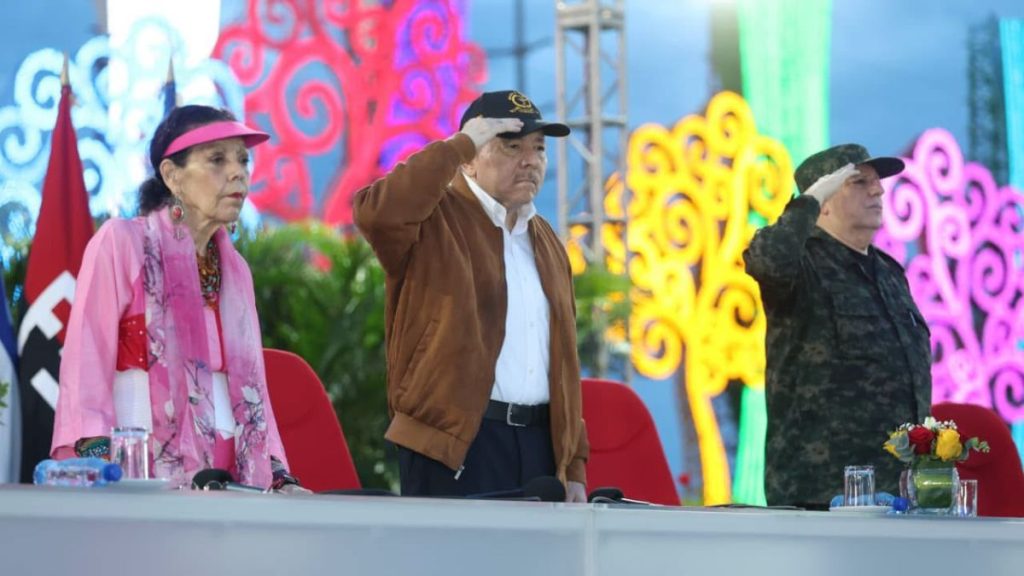
United States, Russia, and China
Direct military cooperation between the United States and Nicaragua ended years ago. However, contact between military officials continues through international summits.
In March 2026, Nicaraguan officers attended a summit in Lima alongside U.S. representatives and international delegations. Nicaraguan officers also took part in other multilateral defense forums attended by U.S. personnel.
While Washington does not seek to grant legitimacy to the current military high command, Pérez and Pestana suggest that maintaining open communication channels could prove vital during a future transition.
Concurrently, Nicaragua has deepened defense ties with Russia while securing economic and equipment deals with China. Avilés visited Moscow and Beijing in 2025, leading to the ratification of a bilateral defense agreement with Russia covering joint training, intelligence sharing, and electronic warfare.
The analysis concludes that while Washington cannot dictate when or how the Ortega-Murillo regime ends, it can establish conditions for future relations with the military post-transition.
Ultimately, the choice rests with the military leadership: maintain dependence on Russia or pursue renewed ties with the United States and the inter-American system.
While constitutional mechanisms outline the succession of Ortega and Murillo, effective control of the state will belong to the Nicaraguan Armed Forces—an institution already positioning itself for what comes next.