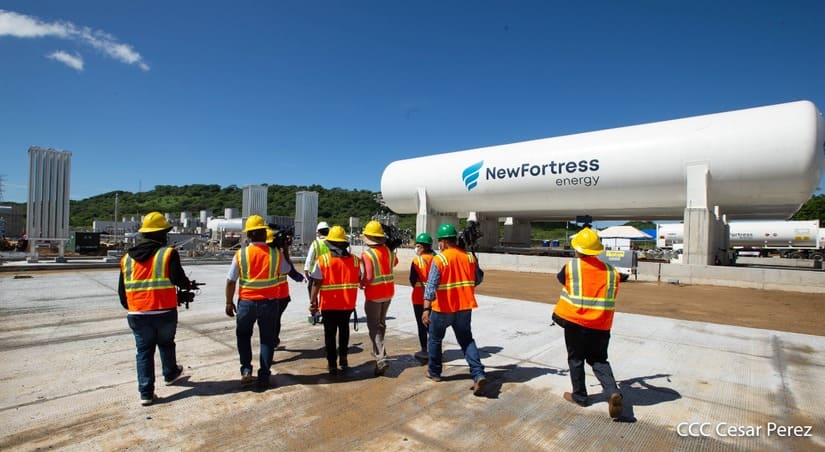
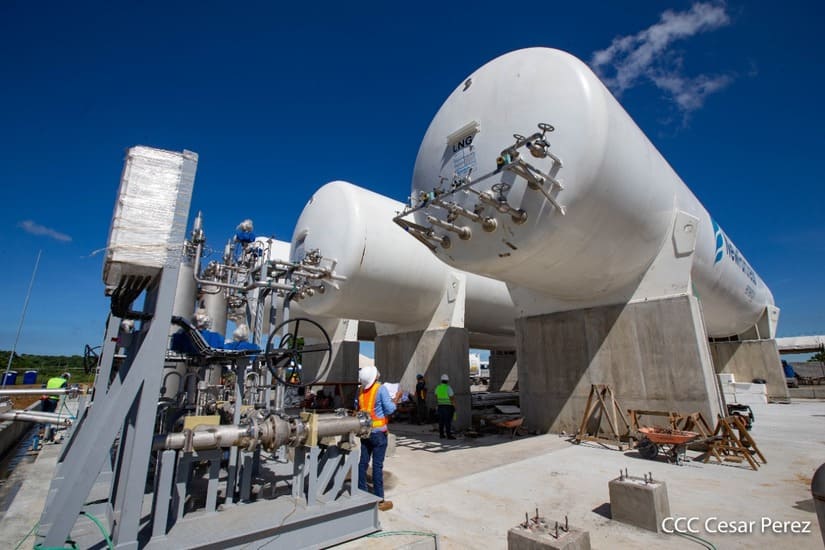
New Fortress Energy is on the verge of bankruptcy. The U.S.-based company arrived in Nicaragua in 2020 with a $700 million investment and built a plant designed to generate 300 megawatts of electricity using natural gas. Four years after construction was completed, however, the plant remains idle. Now the company is scrambling to avoid an imminent bankruptcy filing that would allow it to restructure debts totaling approximately $8.9 billion.
The situation raises questions about how the Ortega-Murillo regime will respond. For months, industry insiders have speculated that the Nicaraguan state could attempt to seize the plant, arguing that the company failed to meet various commitments. Such a move, critics warn, would amount to outright confiscation.
In December 2023, when Mercon Coffee Group sought protection under Chapter 11 of the U.S. Bankruptcy Code amid financial troubles, Nicaragua’s tax authority, the Dirección General de Ingresos (DGI, the tax office), moved to collect a disputed $30 million tax debt. Instead of accepting a payment plan later proposed by the company to avoid intervention, the Ortega-Murillo government confiscated Cisa Exportadora and Mercapital, Mercon’s two Nicaraguan subsidiaries.
What will the Ortega-Murillo regime do with New Fortress?
Economists described that earlier confiscation—carried out under the guise of state intervention—as a move with severe economic consequences. That year, coffee exports dropped by more than 500,000 quintals. Cisa had been responsible for producing, collecting, processing, and exporting roughly half of the nearly three million quintals Nicaragua typically ships abroad each harvest season. Other companies were unable to absorb its operations.
“It’s unclear whether they want to create more problems—especially with the United States—given that they appear to be trying to avoid further tensions,” said an energy sector specialist who doubts the government will move to confiscate the New Fortress plant, given its U.S. ownership.
The expert noted that bankruptcy proceedings are designed to restructure debt through court-approved plans, often allowing companies to continue operating. Asset liquidation is one possible mechanism to meet creditor obligations.
Promised generation in 2021
“In a liquidation, the company is sold off in parts—that’s another possibility—but we’ll have to see how the process unfolds. They’re certainly not in a strong position. They’ve suffered setbacks, sold some assets, and continue to face difficulties,” the specialist said.
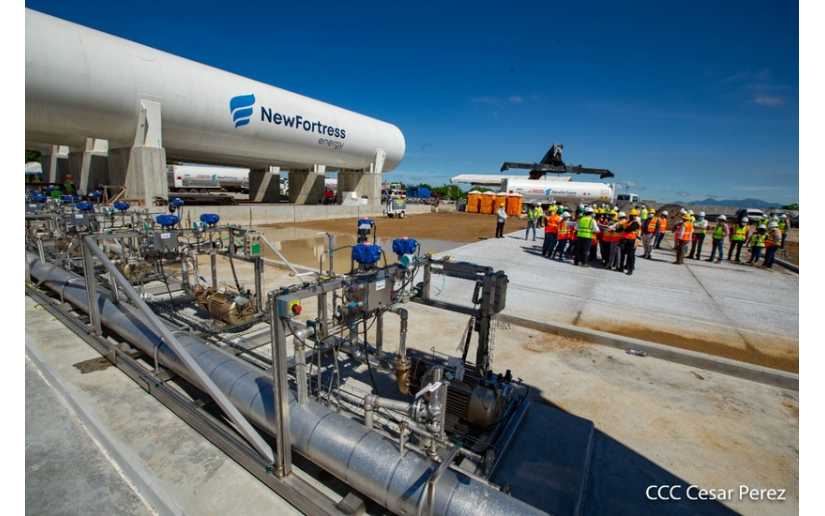
In October 2021, project manager Winnie Irizarry told pro-government media during a tour of the Puerto Sandino plant that construction was 85% complete and that electricity generation would begin by the end of November that year. The company had already secured contracts to sell power to the national distributor.
Yet official documents indicate that after selling its Jamaica plant in 2025, the company’s main assets are now a facility in Altamira, Mexico; a power plant in Puerto Rico; installations in Brazil; and the still-unfinished project in Nicaragua. The company acknowledges that delays in managing stalled projects—including in Nicaragua—have strained cash flow and increased pressure on its debt burden.
Two possible bankruptcy paths
According to Bloomberg, New Fortress Energy is attempting to resolve its financial crisis through a reorganization plan in the United Kingdom known as a “scheme of arrangement.” The plan would convert part of its debt into equity, reduce interest payments, and allow the company to continue operating. If creditors reject the proposal, the company would likely file for Chapter 11 bankruptcy in the United States.
The UK proposal reportedly envisions bondholders taking control of the company’s Brazilian assets. Long-term creditors would recover investments through the Altamira, Mexico assets and the Puerto Rico terminal. The company is also negotiating restructuring support agreements under which creditors would receive company shares.
In November, New Fortress announced it had reached a forbearance agreement with holders of its 2029 bonds, extending by one month the deadline for interest payments originally due November 17. In December, the deadline was extended again by another month—an extension that has since expired.
$8.9 billion in debt
A recent Bloomberg analysis warned that without another extension, bondholders could accelerate repayment of principal, forcing the company into bankruptcy, as regulatory filings show that all its debt would effectively come due.
In its third-quarter 2025 financial report (July–September), New Fortress disclosed total debt of $8.9 billion. Of that amount, $6.6 billion was classified as the current portion of long-term debt.
Amid the deteriorating outlook, creditor groups have formed and hired investment banking advisory firms specializing in mergers and restructuring.
Bondholders sell at a loss
On January 21, holders of $2.7 billion in 12% bonds due in 2029 sold them at just 31 cents on the dollar—a steep loss from the 94 cents they fetched in March of the previous year.
Over the past year, New Fortress Energy’s share price has plummeted by more than 80%. Although a late-January cold snap in the United States briefly boosted natural gas prices and prompted a modest rebound, the increase amounted to just 0.6%.
When New Fortress Energy arrived in Nicaragua with its $700 million pledge, the Ortega-Murillo government hailed the investment as proof of confidence from U.S. investors. The announcement came amid international condemnation of the government’s crackdown on social protests, which human rights groups say left more than 350 people dead, thousands injured or imprisoned, and drove nearly one million Nicaraguans into exile.
A company long in crisis
Since 2021—when pro-government journalists toured the Puerto Sandino site to showcase what was billed as a pioneering project that would make Nicaragua the first country in the region to generate electricity with natural gas—authorities have largely stopped mentioning the initiative. No official explanation has been offered for the continued delay, nor is it clear how much of the promised $700 million investment actually materialized.
The Nicaragua project is not alone in its troubles. The Altamira terminal in Mexico ultimately cost $3.5 billion—more than triple the initial estimate—and was completed more than a year late. Similar setbacks plagued the Brazil plant, while planned projects in Angola and Mauritania never materialized.
For these reasons, critics argue that both the Nicaragua plant and New Fortress Energy—led by billionaire investor Wes Edens—represent yet another failed megaproject in a country that has repeatedly attracted investors burdened by heavy debt.
Another failed mega-investment
Edens is the second high-profile investor to promise the Ortega-Murillo government a transformative mega-project, only to later collapse financially. A decade earlier, Chinese businessman Wang Jing pledged to build a $50 billion interoceanic canal through Nicaragua. Years later, his business empire unraveled amid allegations of fraud.
In June 2021, the Shanghai Stock Exchange suspended trading of Xinwei Group, the company Wang headed, amid accusations of a $31 billion fraud and concealed debts. In April 2024, Xinwei Group was declared bankrupt.
Bloomberg has described New Fortress Energy as a dream that crashed against the rocks. Two-thirds of its workforce has reportedly left, either voluntarily or through layoffs. The company, once fueled by ambitious expansion plans, is now portrayed as being in perpetual crisis—“led by a talented salesman more adept at raising capital and securing contracts than at delivering on them.”