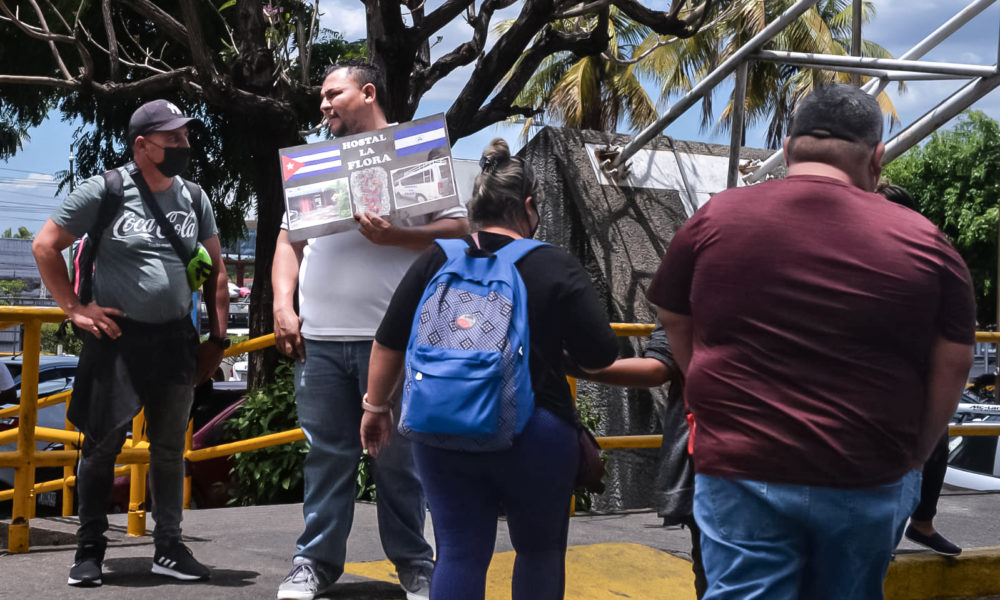
As the United States increases its threats in an attempt to curb the flow of irregular migrants reaching its southern border, the Ortega-Murillo dictatorship continues to profit from the air bridge established for citizens from around the world to use Augusto C. Sandino International Airport in Managua as a springboard to shorten their journey to U.S. soil.
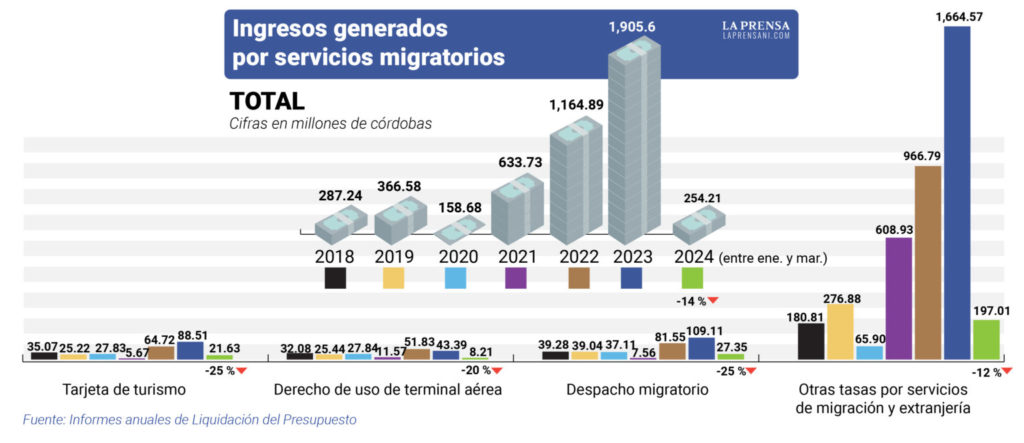
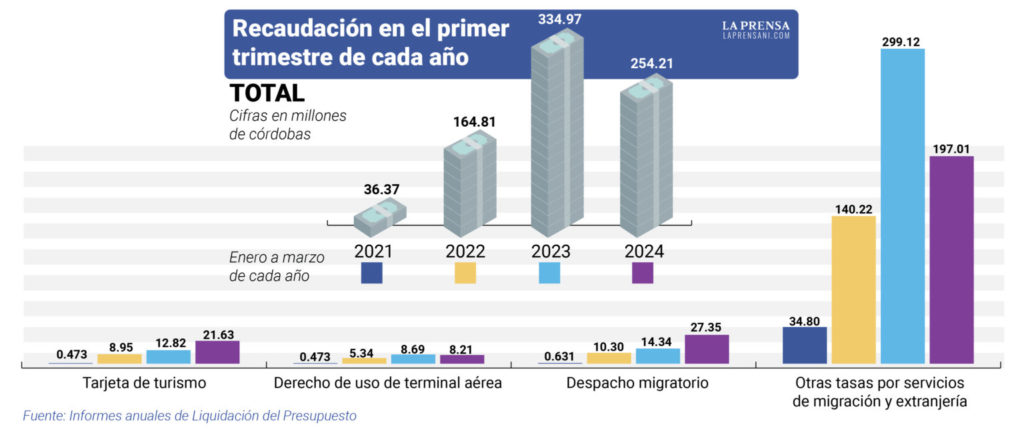
In the first quarter of 2024, these travelers generated revenue over 6.9 million dollars. This figure is high compared to the years before this business began, but it represents a 24 percent decrease compared to 2023.
This political strategy, which exacerbates the migration crisis the United States faces at its southern border, was implemented in November 2021 when Daniel Ortega suspended the visa requirement for Cubans. A month later, the Venezuelan airline Conviasa launched a route between Havana and Managua.
The mechanism was completed with the establishment of a logistical network that facilitates migrants entering through Managua Airport to travel northward, cross the border, enter Honduras, and continue their journey by land through Guatemala and Mexico until reaching the U.S. border.
Revenue of over US$6.9 million in three months
The rest is history. Cubans were soon joined by Haitians and citizens from other South American countries, followed by Europeans, Asians, and Africans. The growing demand for this route spurred the arrival of dozens of charter flights, and for the first time in its history, Managua’s airport received direct flights from Europe, Asia, and Africa. This strategy, in addition to affecting his «political adversary,» has allowed Ortega to revitalize and bring the airport’s finances, which had been accumulating losses for years, back into the black, starting to accumulate substantial profits that continue to grow.
Reports on the Settlement of the nation´s General Budget published by the Ministry of Finance and Public Credit detail that in 2021, the arrival of air travelers generated US$17.6 million. The following year, when the migrant traffic boom began, the figure rose to US$ 32.3 million, and in 2023 it increased to US$ 52.9 million.
In the first quarter of this year, the activity generated over US$ 6.9 million, a 24 percent decrease compared what the airport collected in the first three months of 2023. Despite this reduction, this amount is 54 percent higher than the US$ 4.8 million collected in 2021, indicating that the regime’s immigration policy continues to yield benefits despite pressure from Washington.
The services charged to migrants
These resources are primarily obtained through four charges associated with the arrival of flights and travelers. The most significant revenue comes from a category reported by the Ministry of Finance called «Other Fees for Immigration and Foreign Services.»
Law 1033, Law of Reform and Addition to Law 761, General Law of Migration and Foreign Affairs, includes in this item «charges for immigration services that are exclusive to foreigners.» Among them are the border visa, which costs US$50, and the transit visa, valued at US$25. Both apply to migrants using national territory to advance towards the U.S. border.
Additionally, it is possible that this segment includes fines ranging from US$150 to US$200 per person. Since the implementation of this strategy, irregular migrants passing through the country on their way north have reported being charged by immigration authorities to be allowed to leave the country. This fine is charged to migrants entering by air, as well as those arriving by land. If they do not pay, they are sent back to Costa Rica.
Airport maintains passenger flow
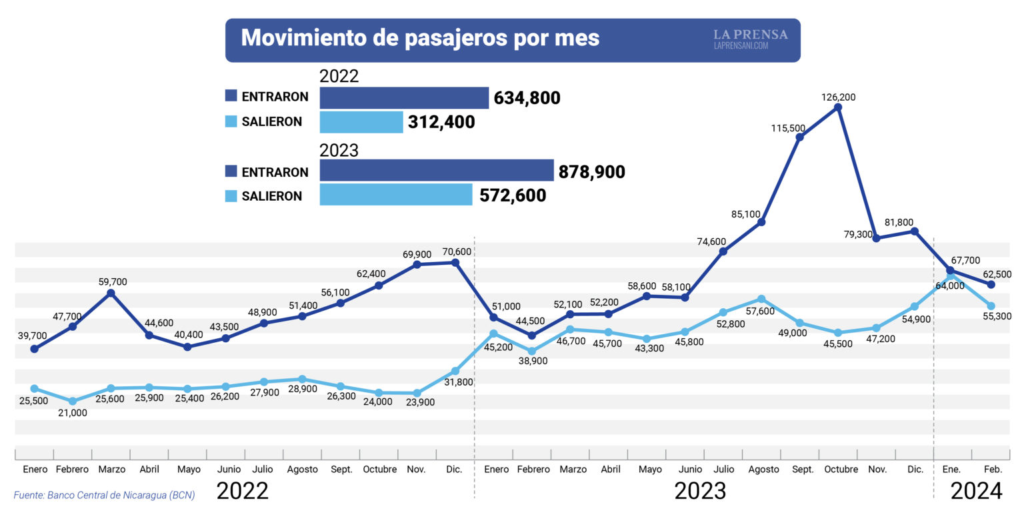
Central Bank of Nicaragua (BCN) statistics show that between January and February of this year, 129,500 people entered through the airport, a figure higher than the 95,600 who arrived during the same months in 2023.
The second highest revenue-generating charge was the Migratory Clearance, which brought in US$ 758,000, nearly double the amount received from the first quarter of 2023. According to Law 1033, all non-resident foreigners entering or leaving the country, except for nationals of the CA-4 countries (Guatemala, Honduras, El Salvador and Nicaragua), pay 3 dollars for migratory clearance. This tax is also paid by transportation means; foreign-flagged aircraft and ships pay 60 dollars to enter and 60 dollars to leave the country.
Some other charges to migrants
Due to the visa restrictions that the United States began imposing in November 2023 on those involved in charter flights bringing migrants to Nicaragua, the arrival of up to 15 small planes per day from various Caribbean islands decreased. However, larger aircraft carrying up to four hundred passengers from Asia and Africa are now arriving. Additionally, some airlines with established routes, including the Venezuelan airline Conviasa, increased their flight frequencies.
The third highest revenue-generating charge was the Tourism or Immigration Card, generating US$600,000, nearly doubling the first three months of 2023. According to Law 495, General Tourism Law and its reforms, citizens of countries with which Nicaragua has not signed visa waiver agreements must pay $10 or its equivalent in national currency to enter the country.
Finally, the charge for the Right of Use of the Airport Terminal generated US$ 228,000 generated in the first three months of 2024. Of the four charges, this is the one that generates the least revenue, and it is collected from passengers through airlines, which include it in the ticket price. The last time this fee was updated was on February 25, 2016, when it was increased by $5. Since that date, all passengers entering and leaving through the Augusto C. Sandino International Airport in Managua have paid $44.23 for this service.