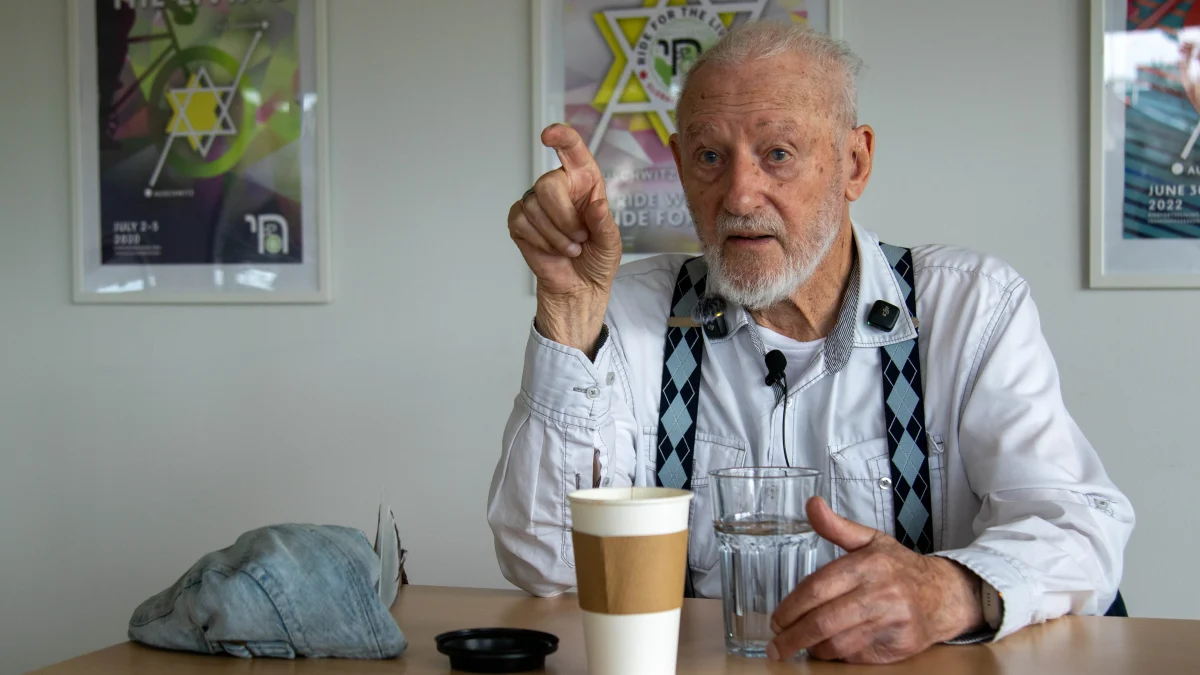
Bernard Offen is one of 196,000 people left to recall the horrors he witnessed as a survivor of the Holocaust. At 97, he’s been telling his story for decades now, but it still brings him to tears.
“I cannot put the past aside,” he said. “It’s about being here and now being here in the present moment.”
Before the war Bernard said he believed in God. After surviving five concentration camps, including Auschwitz, and losing most of his family, his opinions on God have changed.
“He had a big beard, but now I’m thinking that he does not have a beard,” he said. “It’s about looking at God in a different way. In many ways it is us, human beings who are part of God.”
Also read: Holocaust Survivors Fear History Is Repeating as Antisemitism Spreads Worldwide
Bernard’s childhood in prewar Kraków
Bernard was born in the Krakow area, Poland in 1929 to an orthodox Jewish family of six. He grew up in a predominantly Jewish community and would visit their local synagogue regularly.
His family didn’t have much, but his fondest memories were living right next to a five-story chocolate factory.
“I call myself a chocoholic,» he said.
As a child he would run up to the factory gates and beg for chocolate. An employee at the factory would hand a piece to him, he would then run off and share with his friends.
“When I close my eyes, I can still feel it,” he said. “The aroma of chocolate.”
While Bernard was eating chocolate with his friends, his father, Jakub, was working as a traveling salesman selling a wide range of products like toothpicks and billiard tables.
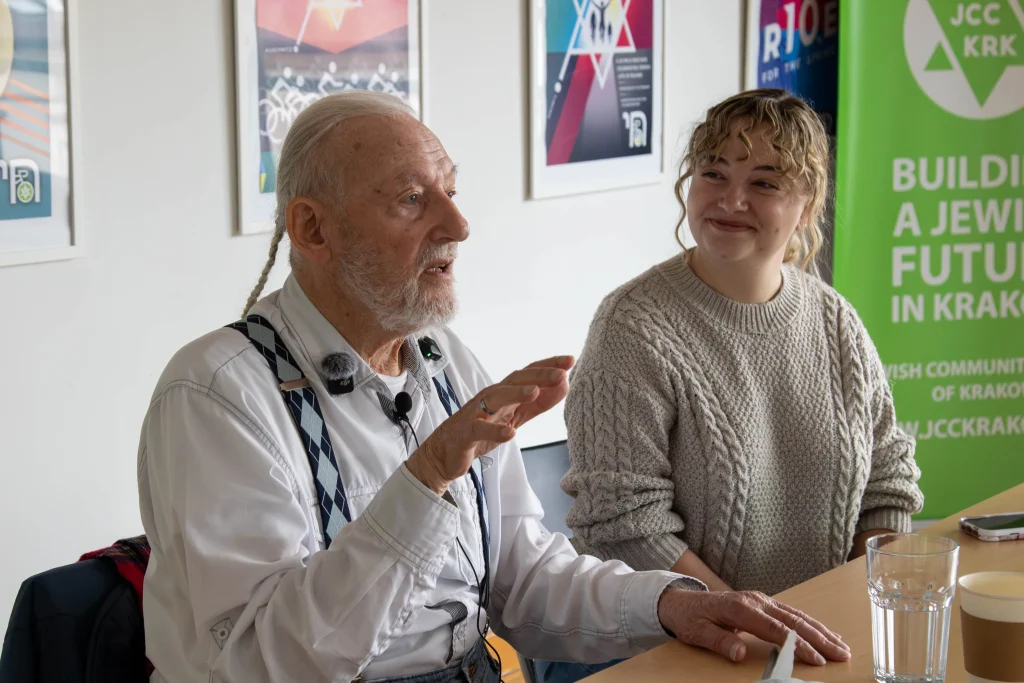
“He went around to different communities around the Krakow area, but he was always back for Shabbat,” he said.
However, Bernard’s fond childhood memories were cut short when his family were forced to move to the Krakow ghetto.
From the Kraków ghetto to Auschwitz: Surviving five Nazi camps
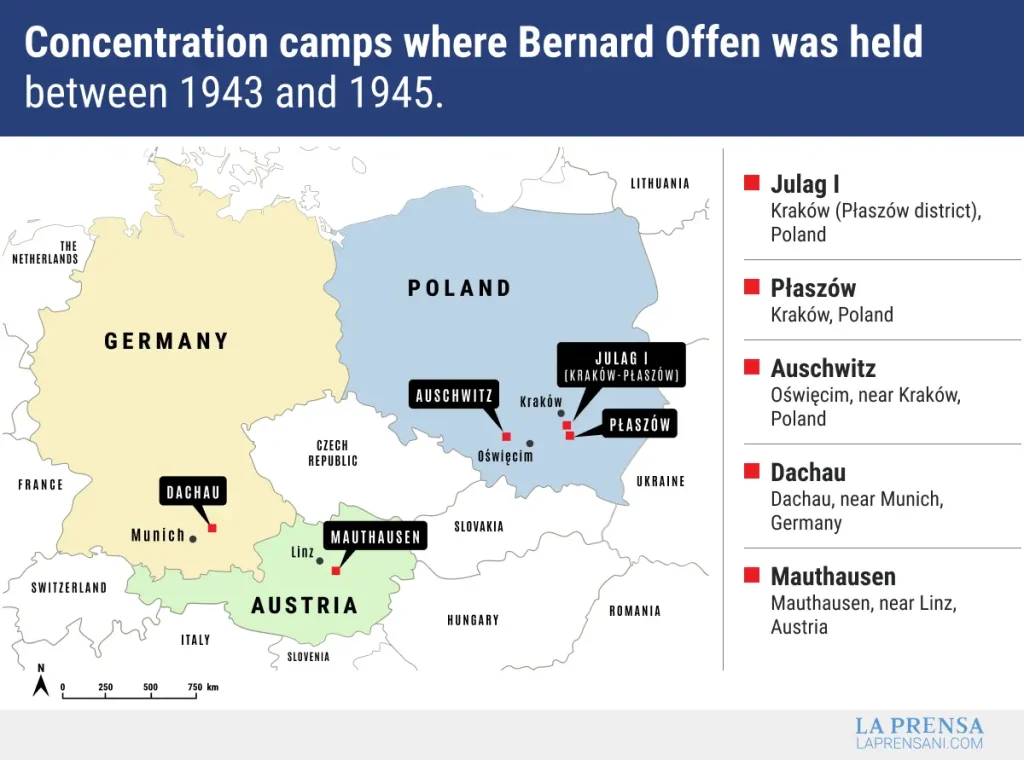
After living in the Krakow ghetto for some time, Bernard’s family and him were sent to a concentration camp called Julag I. According to Bernard, there is little known about this camp.
Then they were sent to Płaszów, a forced labor concentration camp in a southern suburb of Krakow. Then his father, him and his two brothers were separated from the rest of his family and sent to Mauthausen, a concentration camp in Austria.
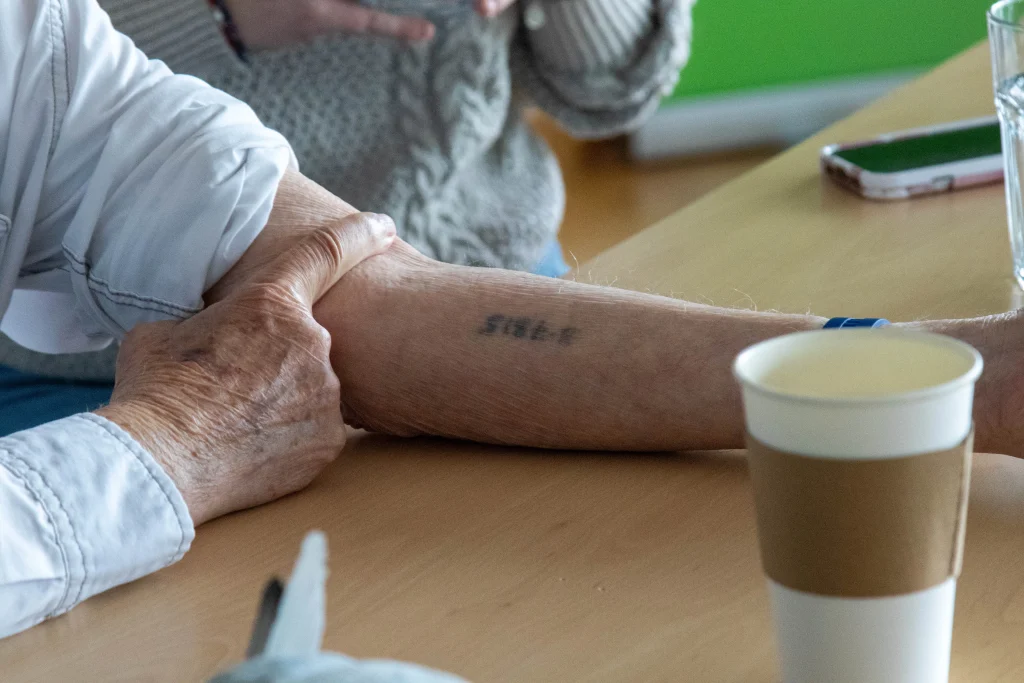
However, he and his father were only in Mauthausen for about a week before they were sent to Auschwitz. When Jews arrived at Auschwitz, they were inspected by doctors and separated into two groups. His father belonged to the group going directly into the gas chambers and Bernard was sent to work in horrible conditions.
Read further: 81 Years After the Holocaust, Jewish Students Fear Rising Antisemitism in America
The last time Bernard saw his father at Auschwitz
“He went one way,” he said. “I went the other way.”
On August 22, 1944, Bernard’s father, Jakub, was murdered.
Bernard’s father was one of 1.1 million people (that we know of) who lost their lives in Auschwitz, which is known as the largest concentration and extermination camp under the Nazi regime.
Bernard was only 15 when his father was murdered.
“At the time of the selection and separation we were… distance was maybe here from that building across the street,” Bernard said as he pointed his finger towards the window with a shaky hand.
Even though they were far from each other, Bernard still recalls seeing and feeling his father’s eye contact.
“We knew that was the end for us,” he said. “We didn’t know what, but we knew that this is the last time we would see each other.”
He survived three months in Auschwitz before he was sent to Dachau, near Munich. He was there for about six months until he was liberated by the American army while participating in a death march.
According to the Holocaust Encyclopedia, towards the end of the war, the Nazi’s forced prisoners to march long distances in brutal weather with little food or water. Those who could not keep up were shot.
“I had many– an angel who kept me going,” he said. “Otherwise, I’d get shot.”
He said they marched for about five days in the backroads of Munich and on the final day those who survived the marches were put in what looked like an abandoned camp. Exhausted from the march, he fell asleep, when Bernard woke up, the Nazi soldiers were gone.
Since Bernard was one of the stronger survivors being only 16, he was sent to go get help.
“They said don’t go forward in the direction we were marching in, let’s go back because we know where we came from, but we don’t know what’s ahead,” he said.
So Bernard goes back and as he is walking, he hears heavy machinery and bombs. He ends up hiding in an abandoned farmhouse, but as he looks outside, he doesn’t see German tanks with the Nazi insignia. Instead, he sees tanks with stars embellished on them.
“So, I decided to come out of the farmhouse, raised my hands and started shouting so I would be seen and a couple of American soldiers came to me,” he said.
He ended up taking a few soldiers back with him to help the others. Bernard and others were liberated on May 2, 1945.
Searching for his brothers across postwar Europe
Initially, Bernard spent the first few months after the war with the American army.
“They let me play with their guns and they took care of me,” he said.
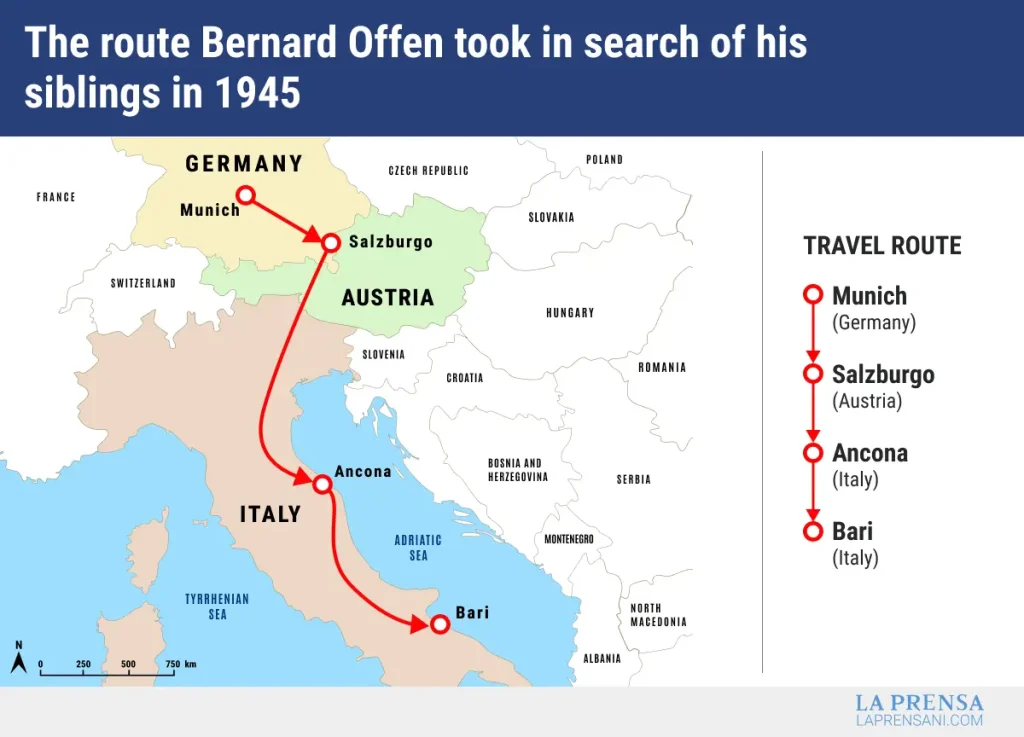
But after some time, he began to wonder about what happened to his family. So, he hitchhiked to a refugee camp in Munich for some answers. There he met a man who had a book that contained names of survivors.
“I found out both of my brothers survived,” he said.
But his siblings, Salomon and Natan, had left for Italy.
With limited access to trains due to war destruction, Bernard ended up securing a spot on a coal train to Salzburg, Austria. Once he gets to Salzburg, he heads the refugee office and inquires about his brothers. They tell him they left for Italy, but there is one problem.
“‘You cannot travel,’” Bernard was told. “‘You don’t have any documents that you even exist. You understand? There is nothing showing that you are alive.’”
So, Bernard said he was stuck in Salzburg for a few weeks while all his identification paperwork was figured out. Once he gets his paperwork, he is sent on a truck nearly 500 miles through the Swiss Alps with Italian refugees to a city called Ancona.
“‘Are my brothers here?’” he asks someone within the Ancona refugee camp. “‘They were here, but they are no longer here.’”
A reunion with his brothers in Bari, Italy
Bernard’s brothers ended up meeting some Polish soldiers and joining their nation’s army. Apparently, his brothers were sent to a hospital after joining the Polish military since they were in bad physical condition. Bernard is back to hitchhiking trucks to find his brothers.
“There was no way in which I could stop from trying to find my brothers,” he said.
When he gets to the hospital, he finds out his brothers are no longer there and instead at training camp. He hitchhikes to the training camp only to find his brothers were on leave to a town named Bari for a Jewish holiday.
So Bernard hitchhikes to Bari, an Italian port city on the Adriatic Sea, where he finds out that his brothers are walking on the beach after talking to some hotel staff at a nearby resort.
“I get closer and it turns out to be my brothers,” he pauses, trying to hold back his tears. “And after long hugs and crying, I am the bearer of the news of what happened to our father.”
Bernard’s brothers then told him what happened to his mother, Guta, and sister, Miriam. They were sent to Bełżec, where they died in October of 1942
“Bernard’s extended family was 59 people,” said Neely Kasanoff, director of external relations at Krakow’s Jewish Community Center. “And of the whole family, Bernardand his two older brothers were the only survivors.”
Eventually he and his brothers immigrated to the United States in 1951 and within a year of moving, Bernard was drafted into the Korean war. He spent 18 months in Korea.
“I was still feeling grateful to the American army for liberation, and I wanted to be just like my American soldiers who liberated me,” he said.
Bernard lived in the U.S. for about 70 years before he moved back to Poland in 2022 at the age of 93. While in Michigan, he began to share his story. His reason for sharing and then eventually moving back to his home country was because it was necessary for his journey of healing.
You may also read: How Social Media Is Transforming the Fight Against Antisemitism
Returning to Kraków: Healing through Holocaust remembrance
“It’s a healing time for me to be here,” Bernard said. “And this self-confrontation in the process of healing is an ongoing process.”
He says he walks through places here in Krakow that still trigger unpleasant memories. But he knows that this is a part of the healing process and with “connecting back to humanity.”
Bernard said telling his story is also a part of this process.
“I’m one of the last ones to be able to tell that story,” he said.
Also read: The Jewish cemeteries that survived the Holocaust but are in danger of disappearing in Poland
The impact of survivors’ accounts
According to Jolanta Gumula, deputy director for programming at the POLIN Museum, preserving stories like Bernard’s is vital to make sure the Holocaust is never forgotten.
At 50 years old, she remembers growing up in the “shadow of the Second World War.” However, newer generations don’t share the same experience, she says, and it’s important that they also learned what happened.
“We still have their testimonies, and thanks for that, we can remember,” she said. “We can spread that knowledge, that information, not to forget.”
She said the other day her 16-year-old daughter asked her if in 30 years from now if people will still remember the Holocaust and the atrocities that were committed. Gumula said it made her think about the First World War and how she remembers learning how it was terrible, but that’s it.
“I cannot feel it because I don’t know anybody who could tell me about it,” she said. “Yes, so that’s why it is so important.”
She said preserving these stories is also important for combating antisemitism, especially within Poland.
“To combat antisemitism and other discriminations, it is crucial to remember what happened,” she said.
Bartosz Heksel, branch manager of the Oskar Schindler’s Enamel Factory Museum, said without survivors sharing their stories there would be no museum today.
“For me without survivors, without people who were telling the story, who were remembering and were really active to honor Oscar Schindler, there would be no movie (Schindler’s List, 1993),” he said. “There would be no museum.”
You may also read: After Hamas Killed His Parents on October 7th, Maoz Inon Chose Peace Over Revenge
He also said that for Holocaust survivors, the war never really ended in 1945.
“So for the survivors, for those who lost most of families, most of members of the families, the war did not end in 1945,” Heksel said.
Bernard said after all these years, he still believes in forgiveness.
“I forgive and it’s in that process of forgiveness that healing can happen,” he said.
Bernard knows this doesn’t happen overnight, but what he does know is that every time he shares his story, he is one step closer to healing.
“It’s never comfortable to tell the story,” he said and then paused. He tries to collect himself as his eyes begin to water. “Some old emotions and memories come up which happened so long ago.”
…
“But in some ways they are alive within me and it’s a burden.”
This article is published in alliance with Fuente Latina