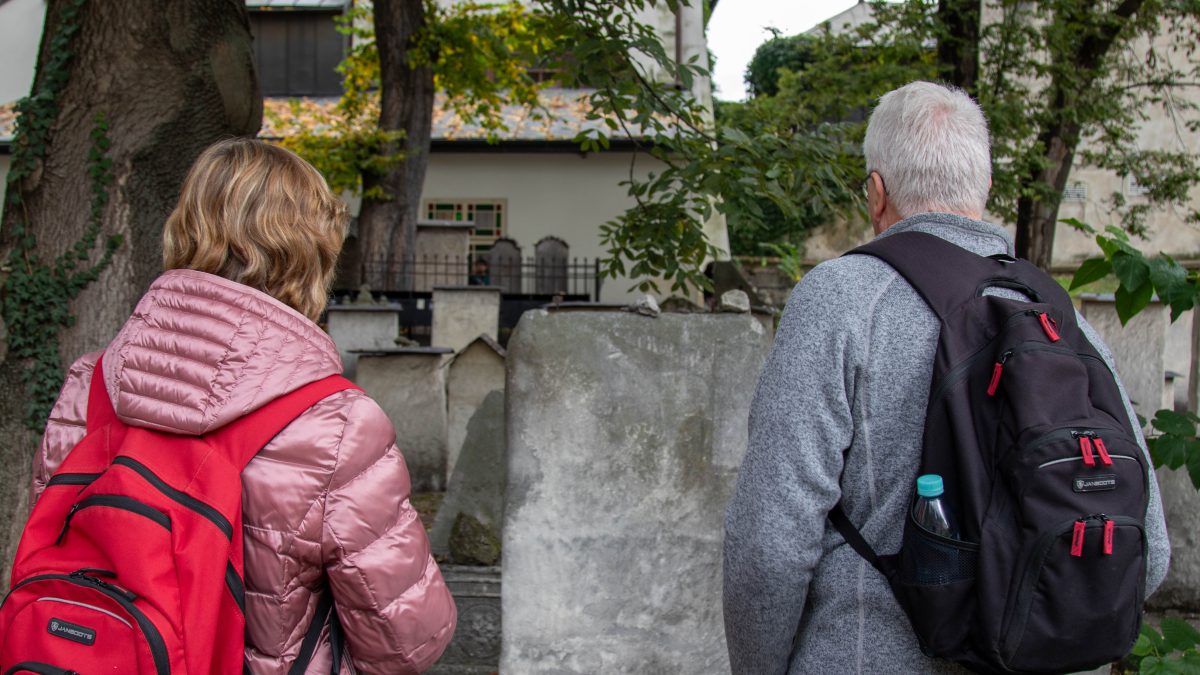
In 1993, Dan Oren ventured into a small town with his mother in Poland to see what traces of Jewish life were left. This town is where his grandfather was originally from before he and his family left Poland before World War II broke out.
“The only surviving trace of Jewish life was the devastated Jewish cemetery,” Oren said.
Oren and his mother were met with a cemetery that looked like it had been erased off a map. He said there were only a handful of tombstones left, but he thinks there once would have been over 1,500 there.
“It turned out that one of them happened to belong to my great great grandmother, my grandmother’s grandmother,” he said. “Somehow it survived the devastation.”
It took him 20 years to figure out that the tombstone belonged to his great great grandmother.
Oren said this was before the internet existed and he did admit that now with a simple Google search his two decades of discovery probably would have been minimized to one hour. But back then, his journey of founding Friends of Jewish Heritage in Poland had just begun.
Since 2016 he has taken other Jewish Polish descendants from the United States to Poland to restore ancestral cemeteries. They are now at 40 restored cemeteries. There are over 1,200 Jewish cemeteries that are known and confirmed in Poland.
How a visit to Jewish cemeteries became a preservation mission
In 2005 Krzysztof Bielawski needed a break. He describes this time as being “very busy and tired of my work,” so he decided to go on a vacation. Instead of a possible trip to the Swiss Alps or even the South of France, Bielawski chose to visit Jewish cemeteries in his home country.
“So as you know, like most tourists, I also took pictures, and after a few months, I decided to create my own website with these dozens of photos from various Jewish cemeteries,” he said.
He only expected maybe one or two people to visit the site, but instead he had many visitors clicking, asking questions and even uploading their own pictures of Jewish cemeteries in Poland.
Now over twenty years later Bielawski has made the restoration and preservation of Jewish cemeteries his life’s work, even publishing a book about it in 2024.
Bielawski is a project coordinator at the Foundation for the Preservation of Jewish Heritage in Poland (FODZ).
“The truth is the Germans destroyed many cemeteries during the war, but we should also note many Polish residents took part in this, let’s say ‘destruction,’ and this process also continued after the war,” he said.
According to the POLIN Museum of the History of Polish Jews, the destruction of Jewish Cemeteries began at an “unprecedented scale” during World War II. Matzevot, which is Hebrew for gravestone, etched with elaborate inscriptions and art, were used to pave roads and used as building material for concentration camps, storage yards and more. Then after the war matzevot (¿matzeva?) were used for reconstructing houses, farm buildings, stairs, grinding wheels, and more.
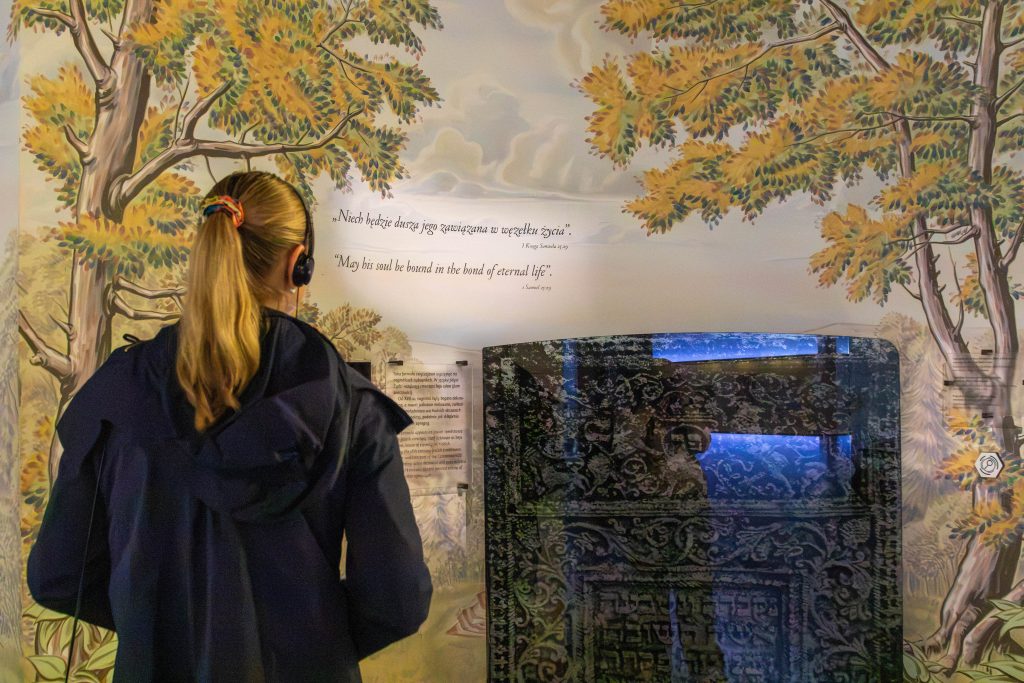
Bielawski says FODZ owns and cares for about 300 of the 1,200 Jewish cemeteries and synagogues in Poland. Restoration is not a full-scale effort, he said. Sometimes it is rebuilding a fence or even picking up fallen leaves. He knows it will be impossible for the organization to care for all of the cemeteries as they struggle to keep up with the ones they have now. So, who is responsible for restoring Jewish cemeteries in Poland?
“Some can say that Jewish communities are responsible for that, but Jewish communities are very small in Poland,” said Jolanta Gumula, deputy director for programming at the Polin Museum. “Even if they want to take care about it, that group is too small.”
According to the last census, Bielawski says, there are only about 17,000 Jews living in Poland. In some of the towns with destroyed cemeteries there are no Jews present.
In 1997, the Polish state adopted an act that allowed Jewish communities to become the owners of these cemeteries and Bielawski said about 5,500 claims were made. However, in order to obtain this newfound ownership, Jews had to show records that these cemeteries were once owned by a Jewish community. Bielawski said these documents were often lost or destroyed after World War II.
“We have more and more cases when local non-Jewish residents take care of Jewish cemeteries because they find these burial places of, let’s say their former residents, also something which is a part of the local heritage of this town,” he said.
Gumula said the majority of cases are Polish people stepping up to take care of these cemeteries like teachers working with their students to take care of these sacred spaces. Oren has seen the local Catholic Church look after them.
Antisemitism and funding threaten Poland’s Jewish cemeteries
“We have been and we are an antisemetic country,” Gumula said.
Despite some motivation by locals, Bielawski said antisemitism is still prevalent when it comes to people’s involvement in restoration of these sacred spaces.
“The biggest challenge is that in many cases, local residents or local authorities treat these cemeteries as, let’s say, ‘strange cemeteries,’ which are not their own,” he said.
He said antisemitism has only been amplified with the war in Israel and Gaza. He says it has stopped local involvement, and he has been concerned about monuments in cemeteries FODZ has established being vandalized.
Gumula said one of the museum’s main missions is to combat antisemitism, but the fight has felt more apparent since Oct. 7. She said they have a team running training and workshops daily to educate the Polish community to minimize this form of discrimination.
Also read: How Social Media Is Transforming the Fight Against Antisemitism
Besides antisemitism, Bielawski said the biggest hurdle is funding.
Not only does the start up to restore cemeteries and synagogues come with a hefty price, but the maintenance can also be expensive.
Recently, Bielawski got an estimate on how much it would cost to restore a synagogue and the number totalled to almost $5 million.
“Restoring a synagogue is only the first step,” he said. “I think an even bigger challenge is to maintain the building in the future.”
He especially emphasized how some local communities might not want to invest in decrepit synagogues, because if there are no Jews to use them then they don’t see the value.
Because maintenance is so costly, Bielawski said that their main focus is the 300 cemeteries and synagogues they already own. However, this has brought a financial strain to FODZ.
“The state is ready to give us many cemeteries that require maintenance, which require giant funds to fence them, to maintain them, and so on,” he said. “But they don’t want to give us back any properties which could be sold or rented. So that’s why, for the last year, we see that our financial situation is getting more and more difficult.
This has also taken away from community engagement and education.
Polish communities begin reclaiming Jewish heritage
Gumula said that education is key to this journey of cemetery and synagogue restoration.
The POLIN museum has a program where they collaborate with synagogues and cemeteries within small towns about Poland’s dark past in relation to their involvement in destroying cemeteries.
She said people in these small towns are starting to realize how they might have Matzevot as a step on their staircase or on their floor.
“A guy from the village, he opened his car and he said, ‘Look what I have! I had it in my yard, yes, in my backyard, and it was matzevot, wow! Now I realize what it is.’”
The man, Gumula said, brought it to the cemetery in the village and knew it belonged there.
“Something has changed, and it is wonderful that in a country with a really difficult story with a lot of shadows, as you saw in our exhibition, the third generation, my generation, are starting to feel that something is wrong,” she said.
Also read: Holocaust Survivors Fear History Is Repeating as Antisemitism Spreads Worldwide
Oren said support from the local community is key to making a cemetery last not just for today, but also tomorrow.
“If the local community doesn’t care about the cemetery, they will ignore it and they will neglect it,” he said. “They won’t teach people that you have to respect that cemetery, and it will fall into disrepair once again.”
Bielawski said when they restore cemeteries, they will place information boards so that people walking by can read the history and significance of the burial ground.
“It’s also important for us to do something to cooperate with the local population, with the local community, to change their minds,” he said.
“This future is not pink,” why the future of Poland’s Jewish cemeteries remains uncertain
“First of all, I’m an optimist, but not in this case,” Bielawski said.
For Bielawski the future is not black and white, but pink. He said he doesn’t think Poland will get to a point where every Jewish cemetery is adequately taken care of.
“These cemeteries are still in danger, and we should think about the condition of the Jewish people in Poland in the future,” he said. “I think this future is not pink; rather I would say gray or even black.”
With the rise of antisemitism, lack of funding and time causing the cemeteries to naturally age, Bielawski said there is no way for FODZ to get to every burial site and maintain the ones they have now.
“In most cases, this destruction was giant and so giant that it is impossible to restore them, never,” he said.
“So why should people care, Jews or Poles?”
“We lose burial places of people, but of course we also lose a part of the memory, a part of the memory about Polish Jewish history,” he said.
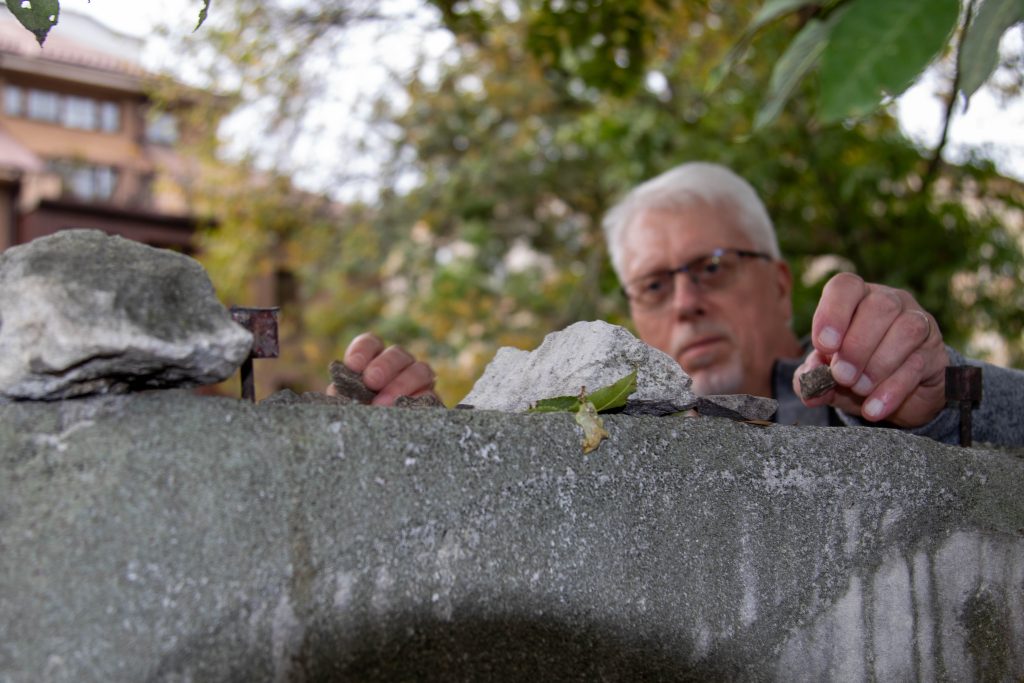
Oren said in Jewish tradition, cemeteries are places of great respect, but over 90 per cent of them are in rough shape. Visitors leave a rock instead of flowers to jewish gravestones as a sign of visitation to show that the deceased’s memory will never be forgotten.
“Go to any Catholic cemetery in Poland, it is pristine,” Oren said. “It is beautifully decorated, but the Jewish cemetery, because 90 per cent of Jews in Poland were murdered, after the war there was nobody to take care of it.”
Also read: How One Gen Z Creator Turned A Family Discovery Into A Mission Against Antisemitism
He remembers when he finally found out that the gravestone he visited years ago was in fact his great great grandmother and instead of feeling a sense of joy, he said he was filled with sadness. Sadness to see his ancestor’s burial site unkept, slowly deteriorating as time and weather chipped her headstone away.
This article is posted in alliance with Fuente Latina