WARSAW, Poland — As millions of young adults scroll through social media every day, Samantha Rodríguez hopes they will pause for a moment and engage with a story from the past.
Rodriguez utilizes social media as a teaching tool, whether she is uploading videos from a former Nazi concentration camp, describing the history of a now-extinct Jewish community, or publishing snippets from conversations with Holocaust survivors. The 25-year-old Mexican communicator has amassed over 45,000 followers on Facebook, Instagram, and TikTok through her project, The Voice of the Silence.
Today, Rodríguez’s work focuses on preserving memory and helping young people engage with questions of identity, history and belonging, online. Yet, a decade ago, she knew little about the story that would eventually reshape her life.
“Before that, I simply said I was Mexican,” affirmed the communicator originally from Cuernavaca, Mexico.
That changed in 2015 when her mother, aunt and uncle began researching their family history through genealogy websites, immigration records and archival documents. What they uncovered surprised everyone: the great-grandfather they believed was Russian had actually been born in what is now Poland.
As they dug deeper, the family discovered something even more significant. Their ancestors were Polish Jews. According to this website, 3.3 million Jews lived in Poland before the war, and of those, at least 1,500 migrated to Mexico after the war, according to Jewish Gen a site that investigates about Jewish genealogy.
For Rodríguez—who was 15 at the time and had been raised in a Christian family—this revelation filled her head with questions.
She traveled to Poland in search of her roots
The following year, she traveled to Poland with her family searching for answers and visited the towns connected to their ancestors. Working alongside researchers, museums and archives, they began piecing together a family history that had been lost across generations.
They uncovered names, addresses and historical records. They learned where relatives had lived before World War II and what happened to many of them during the Holocaust.
“My grandmother never even knew who her grandparents were,” Rodríguez stated.
Before learning about her family’s Jewish roots, she primarily defined herself through the experiences she had always known.
“If we talked about religion, I was Christian. Professionally, I was a communicator,” she said. “But this part of my family history and Judaism completed that identity for me and changed it completely.”
A second trip to Poland in 2017 deepened that journey.
At a gathering for descendants of Jews from the Lublin region, Rodríguez met people from around the world who were also reconnecting with histories disrupted by war, migration and genocide. Some had grown up knowing their family stories. Others, like her, were only beginning to uncover them.
The experience left a lasting impression.
“That changed my life,” Rodríguez said.
Also read: After Hamas Killed His Parents on October 7th, Maoz Inon Chose Peace Over Revenge
As she learned more about her family’s past, Rodríguez began looking for ways to share those stories with others. Having studied communications, she understood the power of storytelling and the growing role digital platforms play in how young people learn about the world.
She founded The Voice of the Silence in 2020
When the COVID-19 pandemic began in 2020, she launched The Voice of the Silence, a project dedicated to preserving stories connected to Holocaust history and Jewish memory.
The name reflects her own family’s experience.
For decades, much of that history remained unknown. Her grandmother spent most of her life not knowing what had become of her relatives in Poland; in some cases, she didn’t even know who some of them were.
“There was a silence,” Rodríguez shared. “Now we can give a voice to those stories.”
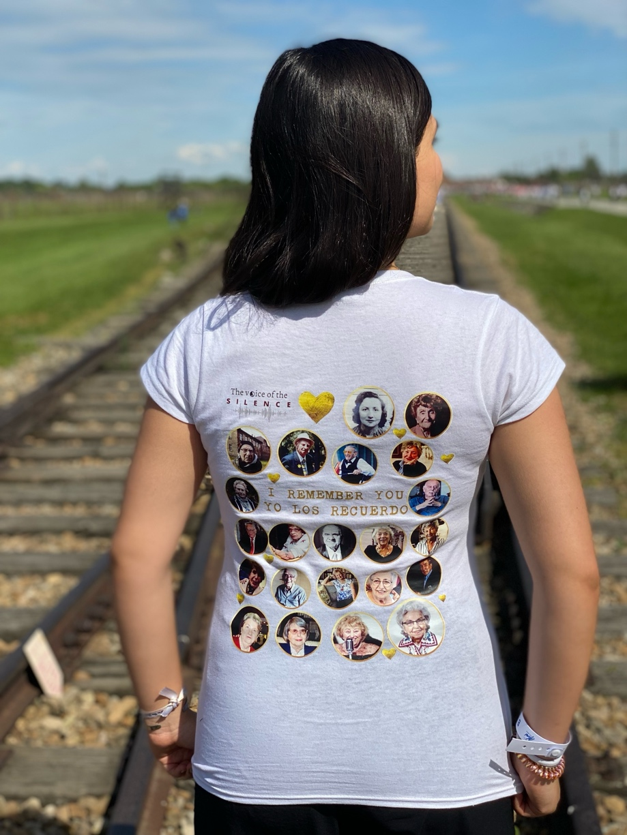
Photo: Samantha Rodríguez
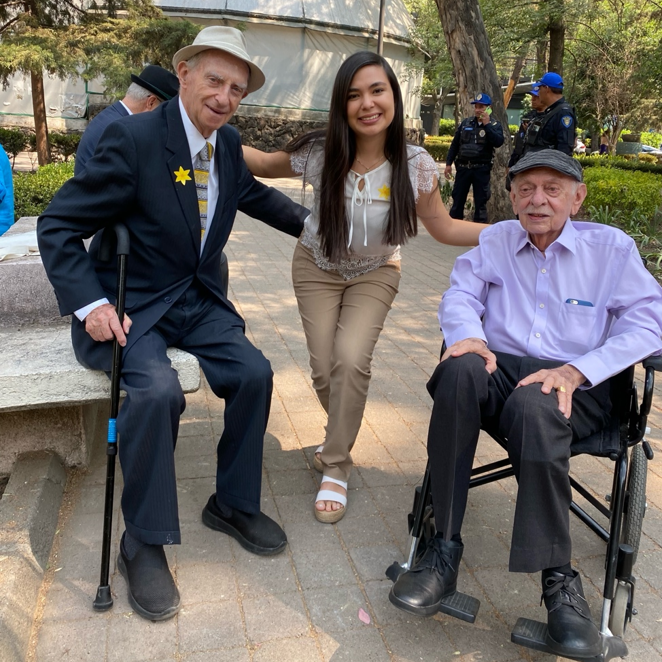
Using social media and online interviews, Rodríguez began documenting conversations with Holocaust survivors, descendants, historians and educators. One of the first people to respond to her outreach was a Holocaust survivor in his 90s.
Five years later, she has conducted more than 100 interviews.
A project to reach young audiences
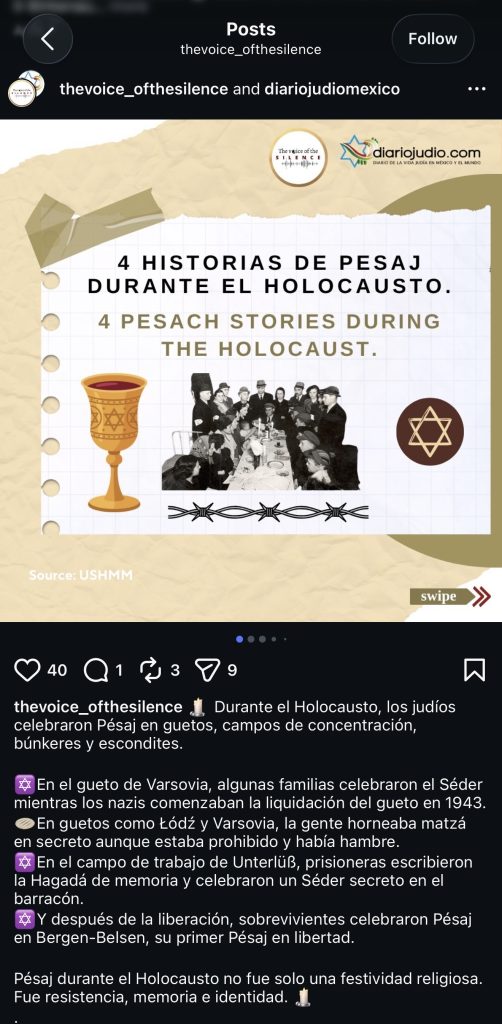
Today, Rodríguez shares those stories through Reels, TikToks and short-form videos. Some content feature museums, former ghettos and concentration camps she visits across Poland. Others include clips from conversations with Holocaust survivors whose firsthand accounts are becoming increasingly rare.
“I show people the places and explain what they are seeing,” Rodríguez said. “The more people who see it, the more people can learn what happened.”
Read another story: 81 Years After the Holocaust, Jewish Students Fear Rising Antisemitism in America
What began as a personal search for answers gradually evolved into a platform that now reaches people all around the world.
Technology played an imperative role at every stage of that transformation. Digital archives helped Rodríguez uncover her family’s past. Social media connected her with experts, survivors and descendants from around the world. Those same platforms allow her to share stories with audiences who may never encounter them in a classroom.
“The younger generations spend so much time on Instagram and TikTok,” she claimed. “Even if they learn something about this history there, it is a very good way to teach it.”
Samantha moved to Poland
Today, she lives in Poland, where she works in Holocaust and Jewish memory education and serves as a Spanish-language guide at sites connected to Jewish history, including Majdanek concentration camp and the former Jewish quarter of Lublin.
Many people ask why she chose to build a life in a country so closely tied to her family’s tragedy.
For Rodríguez, the answer lies in the same search for identity that began a decade ago.
“It is very beautiful to walk here and think that my family was here,” she said. “Even though the ending was tragic, being able to be here now is very important.”