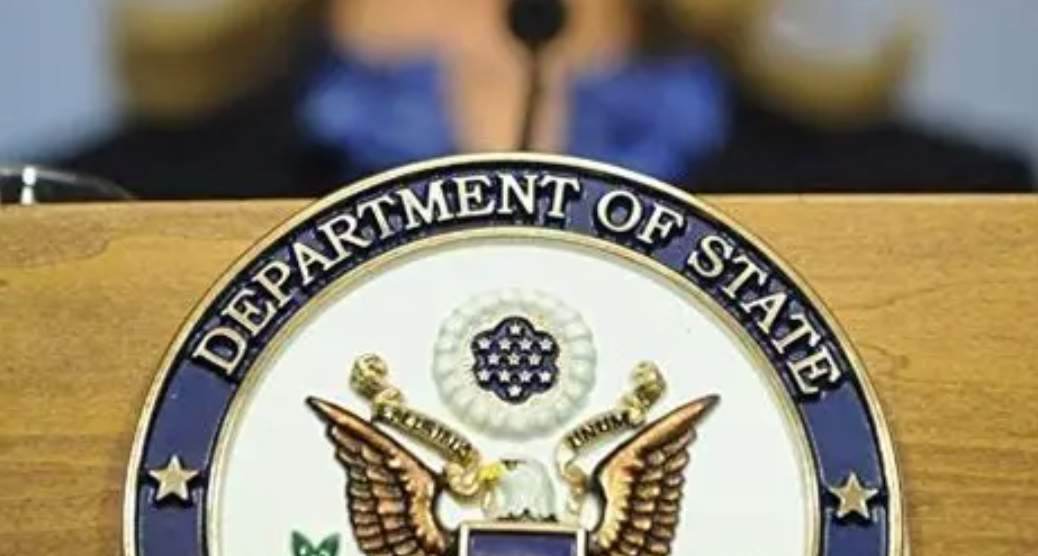
The U.S. Department of State on June 8 imposed visa restrictions on more than 100 officials and their family members, whom it holds responsible for the death of Indigenous leader Brooklyn Rivera, according to sources within the Trump administration. Rivera, a former YATAMA lawmaker, died in custody under the dictatorship of Daniel Ortega and Rosario Murillo on May 30. He had been unjustly detained since September 2023.
According to the sources, the latest action brings the total number of Nicaraguan officials and relatives targeted by similar U.S. measures to 2,350 for their alleged complicity with the Nicaraguan regime. The decision was formalized in a State Department statement titled “Continuing to Promote Accountability for the Murillo-Ortega Dictatorship.”
“The United States will not overlook the Murillo-Ortega dictatorship’s responsibility for the horrific death of political prisoner Brooklyn Rivera,” the statement said. “U.S.-sanctioned Lumberto Campbell Hooker was directly involved in denying medical care to Brooklyn Rivera and prevented his family from burying him. Today, the Trump administration took decisive action by imposing additional visa restrictions on more than 100 regime officials and their family members.”
Read also: Ukraine: Nicaragua’s Alliance with Russia Threatens International Stability
Secretary of State Marco Rubio described Nicaragua’s government as “an enemy of humanity” in a post on X and reiterated that the Trump administration would not ignore its crimes.
Under U.S. federal law, authorities are prohibited from publicly disclosing the identities of those affected by the sanctions. The move comes one week after Deputy Secretary of State Christopher Landau blamed the Nicaraguan dictatorship on social media for Rivera’s death while he was being held under conditions amounting to enforced disappearance.
Campbell Accused of Role in Denying Medical Care
As administration sources had previously indicated, the State Department specifically named electoral magistrate Lumberto Campbell, a prominent Sandinista figure on Nicaragua’s Caribbean Coast.
According to the statement, Campbell played a key role in denying Rivera medical treatment and in preventing his family from carrying out his burial. Campbell has been under U.S. sanctions since November 7, 2019, when he served as acting president of Nicaragua’s Supreme Electoral Council.
Campbell also participated in the funeral arrangements organized by the regime in Managua, despite repeated requests from Rivera’s family to have his body returned for burial in his native community. The electoral magistrate has long been considered a close political ally of Ortega and Murillo in the Caribbean region.
Murillo herself mentioned Campbell in a statement dated May 31, one day after Rivera’s death. According to the vice president, the regime had been attentive to “Brother Brooklyn” and claimed he was accompanied until the end by Nancy Elizabeth Henríquez, his son Wailan Rivera, his sister Alda López Bryan, Reverend Adela Martínez of the Moravian Church, and Campbell.
That portrayal, however, contrasts sharply with reports of repression against Rivera’s relatives. His sister remains detained, while his son Wailan reportedly escaped arrest. The information was previously disclosed by Tininiska Rivera, the Indigenous leader’s daughter. Three nephews and two close associates of Rivera are reportedly in similar circumstances.
You may be interested: Nicaragua’s Rulers Double Down on Putin Alliance as Washington Tightens Scrutiny
Nancy Elizabeth Henríquez, a former YATAMA legislator and close friend of Rivera, was herself imprisoned from October 1, 2023, until March 21, 2026. Her detention appears at odds with Murillo’s assertion that Rivera “was accompanied with affection and faith.”
The international community has widely condemned Rivera’s death. The United Nations and the Organization of American States have called for an independent investigation, while 29 former Latin American presidents have urged the application of “universal jurisdiction” against Nicaragua’s ruling authorities.
Representative Salazar: “This Is Only the Beginning”
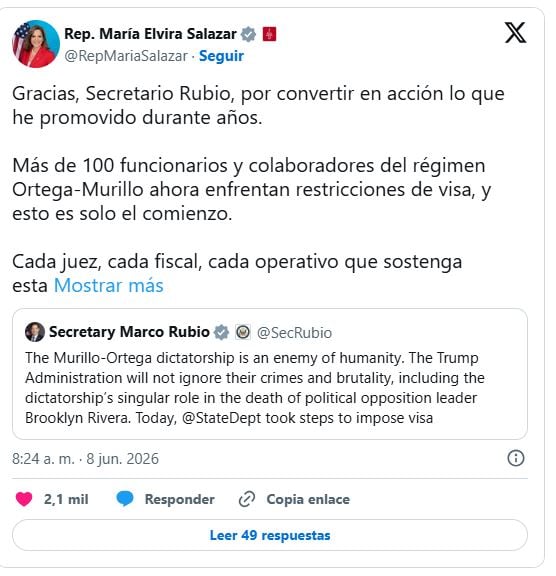
Republican Representative María Elvira Salazar thanked Rubio for the decision and warned on social media that further actions could follow.
“More than 100 officials and collaborators of the Ortega-Murillo regime now face visa restrictions, and this is only the beginning,” Salazar wrote. “Every judge, every prosecutor, every operative who sustains this dictatorship must understand clearly: no one who enables tyranny will escape the consequences. Nicaragua will be free, and we will not stop until that day comes.”
Republican Congressman Carlos Giménez also condemned the Nicaraguan leadership on social media, describing regime officials as “criminals” and “terrorists.”
“They have no forgiveness from God,” he wrote in one post.
In a second message, Giménez added: “Maduro captured, Raúl Castro prosecuted, and the Ortega-Murillo enforcers are next. Our hemisphere must be a hemisphere of freedom and democracy—tyranny has no place here.”
Republican Representative Brian Mast, chairman of the House Foreign Affairs Committee, also expressed support for the State Department’s action.
The sanctions come amid growing scrutiny in Washington over Nicaragua’s deepening ties with China and Russia. Last Friday, a congressional hearing titled “Confronting the Ortega-Murillo Totalitarian Regime” was postponed for the second time. Deputy Assistant Secretary for Central America Ana Quintana-Lovett had been scheduled to testify.
The hearing was first canceled on May 20, when the U.S. Department of Justice filed criminal charges against former Cuban leader Raúl Castro.
According to Nicaragua’s Mechanism for the Recognition of Political Prisoners, there were 47 political prisoners in the country as of March 2026. Eleven of them were classified as “disappeared,” meaning their relatives had no verifiable information regarding their whereabouts or physical condition. Rivera remained in that situation until his death.
Read also: These Are the Eight Political Prisoners Who Died in the Custody of the Ortega-Murillo Dictatorship
Murillo Responds Without Directly Addressing the Announcement?
During her midday address, Vice President Rosario Murillo made no direct reference to the State Department’s announcement. Instead, she returned to her recurring rhetoric on sovereignty, which her government has often invoked in response to accusations of human rights abuses.
“For us, this is another world, and united, the peoples of the world prevail and will prevail,” she said.
Just days earlier, the Nicaraguan government reaffirmed its alliance with Russian President Vladimir Putin, at a time when Washington is closely examining relations between Managua and the Kremlin.
“Beyond those voices that believe themselves to be giants, beyond those loud mouths who think they can govern through insults, malice, and disrespect—it is simply not possible,” Murillo said, without naming anyone directly.
This version preserves the tone, structure, and attribution style commonly used in English-language news reporting while remaining faithful to the original text. Translated with ChatGPT.