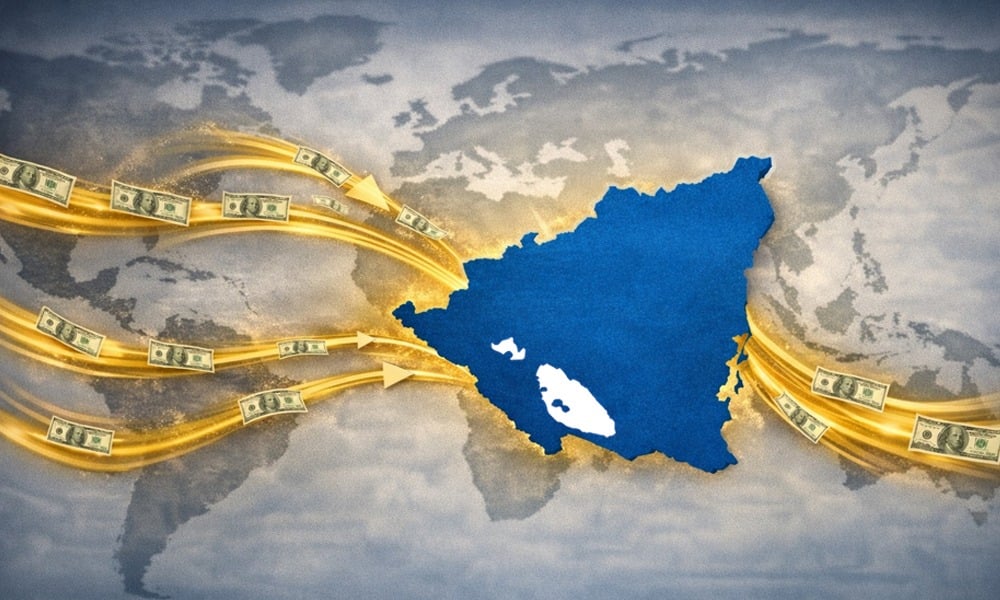
While local authorities have kept remittance reports under wraps for much of 2025, the Inter-American Development Bank (IDB) estimates that remittance inflows to Nicaragua reached a new all-time high of $6.199 billion, an 18.2% increase over 2024.
Given that about 80% of remittances sent to Nicaragua originate in the United States, the rise underscores the exceptional efforts of migrants at a time when they face increasingly hostile policies.
This growth contrasts sharply with a 4.5% decline in remittances to Mexico, the region’s largest recipient. According to the IDB, its estimate is based on information available through the third quarter of the year. Meanwhile, at the domestic level, Nicaragua’s Central Bank (BCN) has suspended the publication of monthly remittance reports since April of last year.
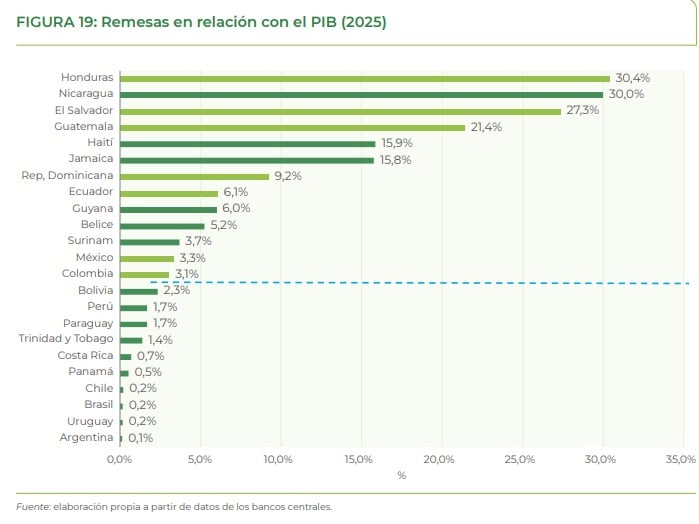
The $6.199 billion in remittances received by Nicaragua in 2025 is equivalent to 30% of the country’s Gross Domestic Product (GDP), making it the second most remittance-dependent country in Latin America and the Caribbean. Only Honduras ranks slightly higher, having received $11.983 billion last year—30.4% of its GDP.
Remittances Grow Across Central America
The surge in remittances to Nicaragua helped Central America once again post a record total of $55.395 billion in 2025, a 20.4% increase over the $46.026 billion received in 2024. The result reflects sustained resilience amid uncertainty. According to the IDB, growth in Honduras, Guatemala, and El Salvador—each posting expansions of around 20%—also fueled the regional increase.
“This increase reflects migrants’ response to the uncertainty they face in the main country of origin of these flows. During the first months of the year, many drew on their savings to send more money to their families and in higher average amounts,” states the technical note Remittances to Latin America and the Caribbean in 2025: Adaptations in a Context of Uncertainty, prepared by the IDB.
The report adds that part of the growth in 2025 stems from exceptional migrant behavior in response to uncertainty, similar to patterns seen during the 2008 financial crisis and the COVID-19 pandemic in 2020.
Migrants Face Uncertainty
The document does not explicitly mention the migration policies promoted by the Trump administration. However, the uncertainty it references is driven by the persecution migrants face in the United States, including President Donald Trump’s decision to deport thousands of undocumented migrants, as well as the cancellation of migration benefits such as Temporary Protected Status (TPS) and humanitarian parole, which had allowed migrants to live and work legally in the country.
The IDB highlights as “exceptional behaviors” the use of accumulated savings to make extraordinary transfers and the increase in working hours to boost income and build precautionary funds to sustain remittance flows. These strategies helped keep remittances at high levels throughout 2025, the report notes.
However, the analysis warns that such strategies are difficult to sustain and that the capacity for remittance growth appears to be approaching its limit, as savings are depleted, employment stabilizes, and migration flows decline sharply.
Remittances Grow Faster Than Per Capita GDP
The U.S. Customs and Border Protection agency (CBP) reports a dramatic drop in irregular migrant entries. In January 2024, 9,791 Nicaraguans entered the United States without visas; in January of the following year, that figure fell to 402, and in recent months, fewer than 100.
According to the IDB’s technical note, the growth rate of remittances to Central America in 2025 exceeded projected per capita GDP growth across the region. It also notes that most remittance-receiving households are not poor, and that in 2025, households receiving remittances increased their incomes by 17.7% compared with those that did not benefit from these flows.
Still, the social impact of remittances is undeniable. “In the northern countries of Central America, between 5% and 7% of the population would improve their poverty status thanks to these incomes,” the report states. Although most remittances go to non-poor households, many families depend on these transfers to avoid falling into poverty.
Uncertainty Threatens Future Remittance Growth
Overall, the 2025 results portray sustained resilience amid uncertainty. Remittances remain a critical economic and social pillar for millions of families, even as their room for growth narrows. If current conditions persist, the region may be entering a new phase—not of decline, but of transition toward a new environment in which remittance flows grow more slowly and reflect less expansion and more resistance.
The IDB reiterates that while remittances continue to underpin household economies, their growth margin is shrinking. Under current conditions, the flows are likely moving into a transitional stage characterized by slower growth.
Amid these warnings, Nicaragua’s Central Bank has yet to explain why it suspended the publication of remittance data and omitted remittance figures from balance-of-payments reports.