The legal battle over the future of the Hispanic-Serving Institutions Program (HSIs) in the United States has intensified following a lawsuit filed by the state of Tennessee and the organization Students for Fair Admissions (SFFA), coupled with the Department of Justice’s decision not to defend the program in court. The case raises the possibility of eliminating hundreds of millions of dollars in academic support for these universities, impacting Hispanic (or Latino) students at U.S. universities, including Nicaraguans.
At the heart of the lawsuit is the argument that the HSI Program is “discriminatory” and “unconstitutional” because it allocates federal funds solely to universities where at least 25 percent of the student population is Hispanic—the criterion on which the program itself is based. The lawsuit names the Department of Education and Secretary of Education Linda McMahon as defendants.
Read also: USCIS Tightens Rules: Anti-American Activity Weighs Heavily on Immigration Applications
The Hispanic Association of Colleges and Universities (HACU) and LatinoJustice filed a motion this past July to intervene in the federal lawsuit in the Eastern District of Tennessee that seeks to dismantle the program. “The attack on the HSI Program is the latest in a series of legal assaults orchestrated by Edward Blum and SFFA (…) These new attacks aim to defund institutions simply because they serve Latino students,” they stated.
Francisca Fajana, Director of Racial Justice Strategy at LatinoJustice, said, “This lawsuit is a direct attempt to eliminate programs that reduce racial and ethnic disparities and to strip institutions serving Latino students of essential resources.”
HACU responded this past August to the July 25, 2025, letter from the U.S. Department of Justice’s Solicitor General, which announced the Department’s decision not to defend the constitutionality of the HSIs. “This unfair attempt to eliminate the HSI grant program will disproportionately harm all students at these universities and their communities,” the association asserted.
More Than 600 Universities and Colleges in the Crosshairs
The program, HACU notes, applies a neutral criterion to institutions and helps expand access to higher education through federal support. “More than two-thirds of Latino college students attend institutions that serve Hispanics,” it states.
According to data from the organization, during the 2023–24 academic year the number of HSIs grew to 615 institutions nationwide, a 2.5 percent increase compared to the previous year. These universities and colleges educate 5.6 million students, including two-thirds of all Hispanic undergraduates in the U.S.
Antonio R. Flores, President and CEO of HACU, warns that the lawsuit “directly undermines the years of advocacy by our founding members, which led the federal government to formally recognize HSIs in 1992.” He also emphasizes that the program is “a vital engine for educational excellence, workforce readiness, and opportunities for all students who attend these exemplary learning communities.”
The HSI Program was created by Congress to provide targeted support to institutions that already serve a high percentage of Latino students.
Read also: Roxy Williams Moves Closer to Her Dream of Becoming an Astronaut and Representing Nicaragua in Space
California and Florida: the Most Affected
The Nicaraguan community in the United States is primarily concentrated in Florida and California, where several universities and colleges with a high Hispanic presence are recognized as HSIs. According to data from HACU’s list of HSI institutions, California has the most HSIs, with 171.
In this state, there are universities and colleges with very high Hispanic enrollment, such as Allan Hancock College, with 71 percent Hispanic students, and Antelope Valley College, with 64 percent. They are followed by Texas (112), Puerto Rico (56), Illinois and New York (39), and Florida (29).
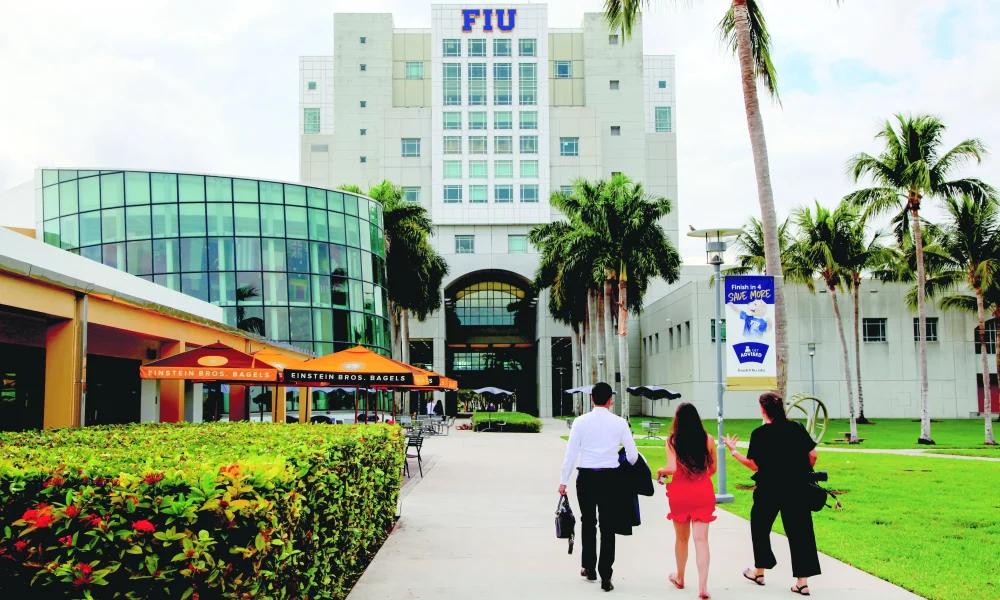
In Florida, the largest higher education institutions serve a majority Hispanic or Latino student body. Florida International University (FIU) in Miami reports that 66.5 percent of its students are Hispanic, while Miami Dade College (MDC) has 71.9 percent.
You Might Be Interested: “My Son Just Wanted to Be a Doctor”: The Story of Yerri Estrada, Detained and Tortured by the Dictatorship
Other affected educational institutions would include the Polytechnic University of Puerto Rico–Miami and Albizu University in Miami, which top the list with 100 and 88.9 percent Hispanic student populations, respectively, making them the institutions with the highest Latino representation in the state. They are followed by Ana G. Méndez University in Orlando, with 69.0 percent; South Florida State College, with 42.2 percent; and Broward College in Fort Lauderdale, with 36.0 percent.
LA PRENSA reached out to MDC and FIU authorities to understand the potential impact if the HSI program were ultimately canceled; however, no response had been received by the time of publication.
From September 8 to 14, HACU announced that National HSI Week will be celebrated amid the legal uncertainty threatening hundreds of thousands of Latino students nationwide, calling attention to the essential role these institutions play.