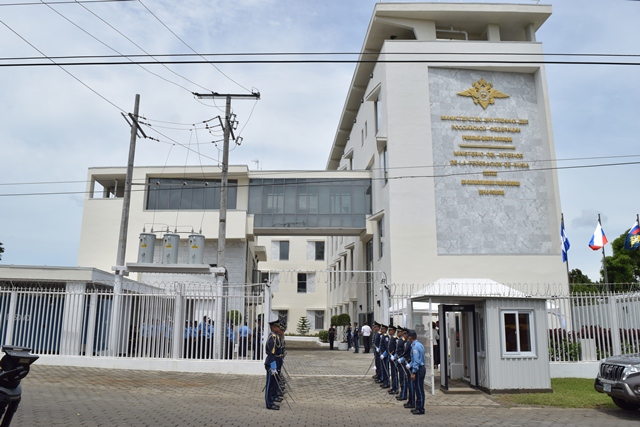
The Russian Embassy in Costa Rica on June 24 rejected statements made by Costa Rican Foreign Minister Manuel Tovar, who had denounced the presence of Russian military personnel and terrorist organizations such as Hamas and Hezbollah in Nicaragua during his address to the General Assembly of the Organization of American States (OAS) in Panama a day earlier.
“We believe these statements do not fully reflect the reality of the situation and that the concerns expressed are unfounded,” the embassy said. However, in its official response, Russia acknowledged the presence of “a group of military advisers and specialists” in Nicaragua.
The embassy said these personnel are involved in “activities related to the exchange of experience,” “personnel training,” and assistance with humanitarian tasks, including “search and rescue operations during emergencies and natural disasters.”
The crisis in Nicaragua was among the key issues discussed during the OAS General Assembly. Tovar condemned ongoing human rights violations in the country and raised concerns about Russia’s role during a session in which the United States called for “zero tolerance” toward authoritarian regimes in the Western Hemisphere.
Read also: The OAS Sends a Strong Message to Nicaragua’s Ortega-Murillo Regime
Costa Rican Concerns Stated by Minister Tovar
“Costa Rica is deeply concerned about the continued and growing presence of Russian military forces and terrorist organizations such as Hamas and Hezbollah. Just yesterday, several individuals belonging to or linked to Hamas were detained by law enforcement authorities in my country,” Tovar said.
Russia’s alliance with the government of Daniel Ortega and Rosario Murillo has strengthened over the 19 years their administration has remained in power in Nicaragua. Beyond raising concerns across the region, the relationship has also come under increasing scrutiny in Washington.
The Trump administration’s security doctrine seeks to limit the influence of powers it considers adversaries in the hemisphere, including Russia and China, both close allies of the Nicaraguan government. In late January, U.S. Secretary of State Marco Rubio described Nicaragua as Russia’s operational base in the Western Hemisphere during testimony before the Senate.
In response to criticism from the U.S. State Department, the Ortega-Murillo government has signed a series of agreements, many of them negotiated by Laureano Ortega Murillo, son of the ruling couple and the administration’s key liaison with Russia, China, and Iran.
The Russian Embassy in Costa Rica also expressed regret over comments made by Tovar during a recent trip to Europe, where he voiced concern over the presence of Russian armed forces in Nicaragua.
Humanitarian Mission Claims, but Questions Remain
The Russian diplomatic mission argued that its personnel are invited under the same framework that allows military contingents from the United States, Mexico, Cuba, and Central American countries to enter Nicaragua. Such deployments require authorization from Nicaragua’s National Assembly.
According to the embassy, the authorization applies to these countries in order to facilitate international cooperation programs of a humanitarian, educational, rescue, or similar nature. It described the mechanism as the legal basis for any foreign military presence in Nicaragua.
In late May, Nicaragua’s legislature approved the entry of foreign military personnel under Presidential Decree No. 05-2026. The decree authorizes the deployment of 230 Russian military personnel between July 1 and December 31, 2026.
Although the decree emphasizes humanitarian cooperation, military analysts have for years criticized the lack of transparency surrounding agreements signed between the Nicaraguan government and its Russian ally. One of the most controversial projects is a police training center in the Las Colinas district, which Ortega himself acknowledged in 2023 had been used to support the repression of political opponents.
“This center is designed to better combat drug trafficking, organized crime, coup plotters, and terrorists,” Ortega said at the time.
You may be interested: Roberto Samcam’s Assassination and the Democratic World’s Duty to Act
Deepening Ties and Regional Influence
Security and defense analyst Javier Meléndez recently told La Prensa that Russia’s growing presence in Nicaragua has been evident for at least 15 years. Cooperation extends beyond military and police matters to include media collaboration, he said.
The relationship has manifested itself through military agreements and support from Russian state media outlets such as RT and Sputnik for the propaganda apparatus controlled by the Ortega-Murillo administration. In return, Nicaragua has backed Russia’s invasion of Ukraine.
According to Meléndez, Russian influence extends well beyond Nicaragua.
“It reaches other countries through media networks, political connections, training programs, academic activities, and disinformation campaigns,” said Meléndez, director of the Central American think tank Expediente Abierto.
A 2022 study by researchers Douglas Farah and Marianne Richardson highlighted not only security cooperation between Russia and Nicaragua but also the GLONASS satellite navigation system, Russia’s equivalent of GPS.
“According to reports from Nicaragua, Brazil, and Chile, GLONASS facilities possess a level of sophistication exceeding what is required for comparable geolocation systems, raising the possibility that they may be used for other purposes,” the study, titled Dangerous Alliances: Russia’s Strategic Incursion into Latin America, concluded.
Read also: Report Maps Russian Propaganda Network in Nicaragua and Across Latin America