*Second and final article in this series, presented in partnership with Expediente Público
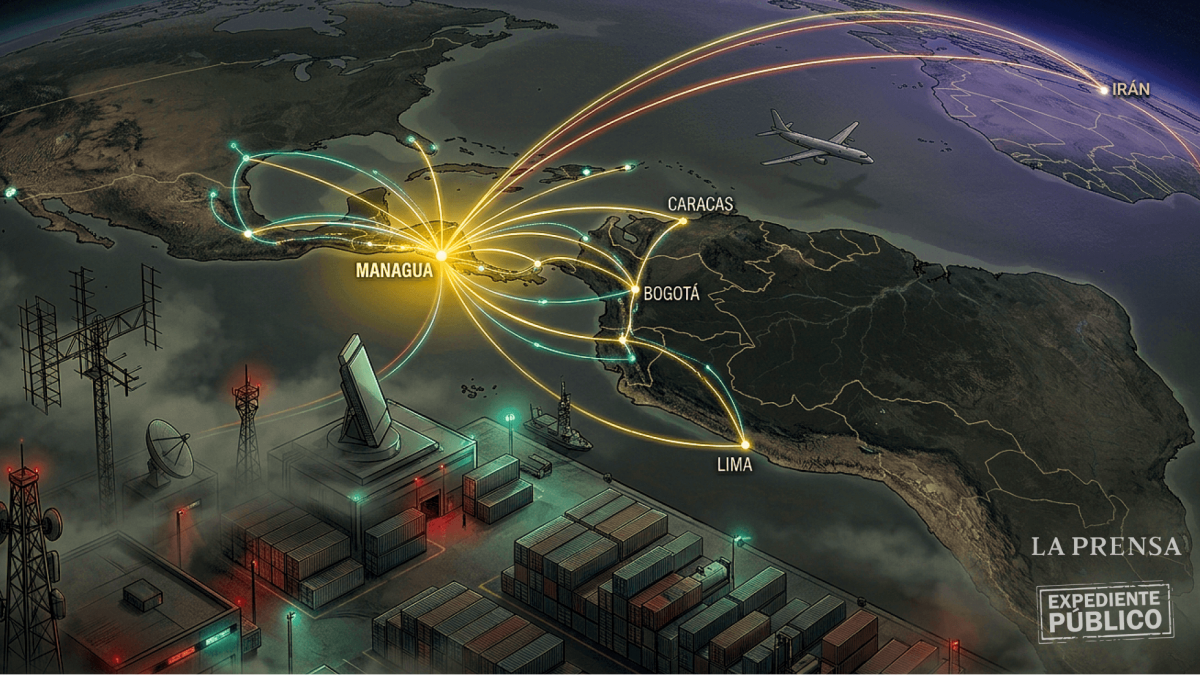
After years of unfulfilled promises and cooperation that has yielded few economic results, the relationship between Nicaragua and Iran takes on a different dimension when viewed through the lens of security and strategic projection.
More than a significant partner, Nicaragua has become a functional gateway for Iran in the Western Hemisphere. Its value lies in the conditions it offers: territorial access, institutional opacity, and a foreign policy aligned with anti-American extra-regional actors.
Security expert José Gustavo Arocha, senior associate researcher at the Center for a Secure Free Society, warns that the Nicaraguan regime has gained relevance not only because of its relationship with Tehran, but because of the conditions it provides as a platform for expansion into the Western Hemisphere.
“There is no place more comfortable right now than Nicaragua (…). Its permissiveness and its ties with Iran, Russia, and China make it a key point,” Arocha told Expediente Público.
Read also: Alliance Iran-Nicaragua Expands Ortega’s Anti-U.S. Geopolitical Strategy
For Arocha, a Venezuelan military officer exiled in the United States, one of the most sensitive issues is migration.
“(The Iranians) use companies as a cover or dual-purpose mechanism, only to later pursue what they really want,” he said.
Analysts consulted by Expediente Público warned that the dictatorship has relaxed entry requirements for Iranian officials and delegations in order to circumvent restrictions imposed across multiple Western jurisdictions.
This factor makes Nicaraguan territory a particularly relevant access point within the Western Hemisphere.
Agreements Without Implementation, but of Dual Use
Adding to this is the broad scope of signed agreements, many of which involve strategic sectors such as energy, technology, infrastructure, and even areas linked to security and technical cooperation. Although many of these accords lack implementation, their formal scope opens channels of interaction that go beyond strictly economic ties.
Various specialists agree that these relationships should be analyzed not only for their visible results, but also for their strategic potential.
In contexts like Nicaragua’s, where institutional oversight is weak, broad and opaque agreements facilitate dual-use cooperation dynamics in which civilian initiatives coexist with political or international projection objectives.
Arocha said this type of relationship follows a familiar pattern.
“Everything has a dual purpose; it starts with diplomacy, moves into culture and commerce, but eventually incorporates industrial and military dimensions,” he stated.
More than an important economic partner, the dictatorship has offered Iran political, geographic, and institutional conditions that allow it to expand its room for maneuver in a region historically sensitive to U.S. security interests.
According to Arocha, this positioning is no accident.
“After losing ground in countries like Venezuela, the Iranians need to relocate, and Nicaragua has become the fundamental pillar at this moment,” he said.
An Ecosystem of Extra-Regional Alliances
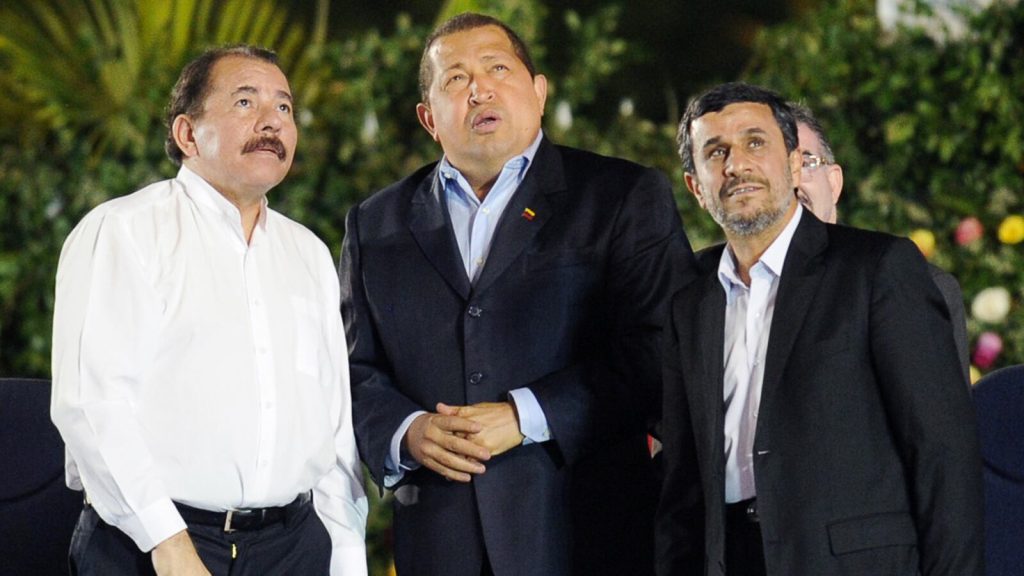
ENGLISH: Daniel Ortega with Mahmud Ahmadinejad and Hugo Chávez at his inauguration in 2012.
For academic Félix Maradiaga, a former presidential hopeful and Nicaraguan opposition figure living in exile, the relationship with Iran is part of a broader architecture. In his view, the Ortega-Murillo regime has enabled the convergence of extra-regional actors in sensitive sectors where Russian cooperation, Cuban intelligence presence, and technological ties with China intersect, particularly in state-controlled telecommunications.
“What exists is not an isolated relationship, but an ecosystem that expands capabilities for access to information within the country,” he said.
In his view, this interpretation gains relevance when examining the evolution of agreements signed in recent years, which include cooperation in nanotechnology and telecommunications, as well as technical exchanges involving information systems.
You may be interested: Ortega Regime Returns Seized Gold Plant to U.S. Mining Firm BHMB After $80 Million Lawsuit
The relationship has also advanced institutionally. Among the most significant instruments is a memorandum signed between Iran’s Ministry of Justice and Nicaragua’s Supreme Court, which includes exchanges in legal training, drafting of regulations, and strengthening technical capacities within the judicial system.
Specialists consulted noted that these types of agreements, combined with the opacity surrounding strategic sectors, increase the possibilities for information exchanges under state confidentiality frameworks.
In addition, bilateral documents show both countries’ interest in expanding cooperation in energy, technology, and infrastructure — many projects lacking verifiable implementation, yet carrying potential uses beyond the civilian sphere.
The Void Left by Venezuela
Maradiaga argues that the relationship with Iran cannot be measured by completed projects, but rather by what Nicaragua has ceded. The balance, he said, is unequal and reflected in the access the regime has granted in sensitive areas, from mobility to institutional spaces.
This concession becomes more significant when examining the type of cooperation incorporated in recent years. Official records show agreements in telecommunications, technology, and information systems that, while lacking visible results, expand interaction in strategic sectors.
Concerns over institutional cooperation are compounded by an even more sensitive indication. A report by The New York Times, based on leaked U.S. intelligence documents from 2023, revealed that Nicaraguan officials expressed willingness to deepen ties with Tehran during a visit to Managua by Foreign Minister Hossein Abdollahian, who died in a helicopter crash in May 2024.
According to that report, the interest went beyond diplomacy and included discussions about military cooperation. This precedent reinforces concerns that run throughout the Nicaragua-Iran dossier.
The issue lies not only in announced projects or signed agreements, but in the possibility that the relationship has evolved into less visible forms of cooperation that are far more difficult to track publicly.
For this reason, Arocha believes the regional realignment following the decline of Chavismo opens a new scenario for Tehran. In his view, after losing its principal platform in South America, the Ortega-Murillo dictatorship has gained weight as a support point in Central America.
“Nicaragua has been the country operating under the radar, skillful enough not to arouse suspicion,” Arocha warned.
Read also: Trump Would Only Move Against Ortega for Political Gain, Ex-Diplomat Says
From his perspective, the Venezuelan experience offers a clear signal. Relations with Iran may begin with political, cultural, or commercial cooperation and gradually shift toward areas of greater strategic sensitivity.
According to Arocha, Nicaragua’s geographic location, its proximity to migration and transit corridors toward the United States, and the low level of international scrutiny make the regime an especially useful partner for a historic adversary of Washington and Israel — one that will continue seeking ways to maintain its presence, expand its networks, and preserve operational capacity in the Western Hemisphere.
Arocha recalled that in Venezuela, cooperation with Iran evolved from diplomatic and commercial engagement into more sensitive areas under dual-use schemes combining civilian activities with strategic objectives. This precedent, the Venezuelan expert argues, illustrates the potential scope the relationship between both nations could eventually reach.
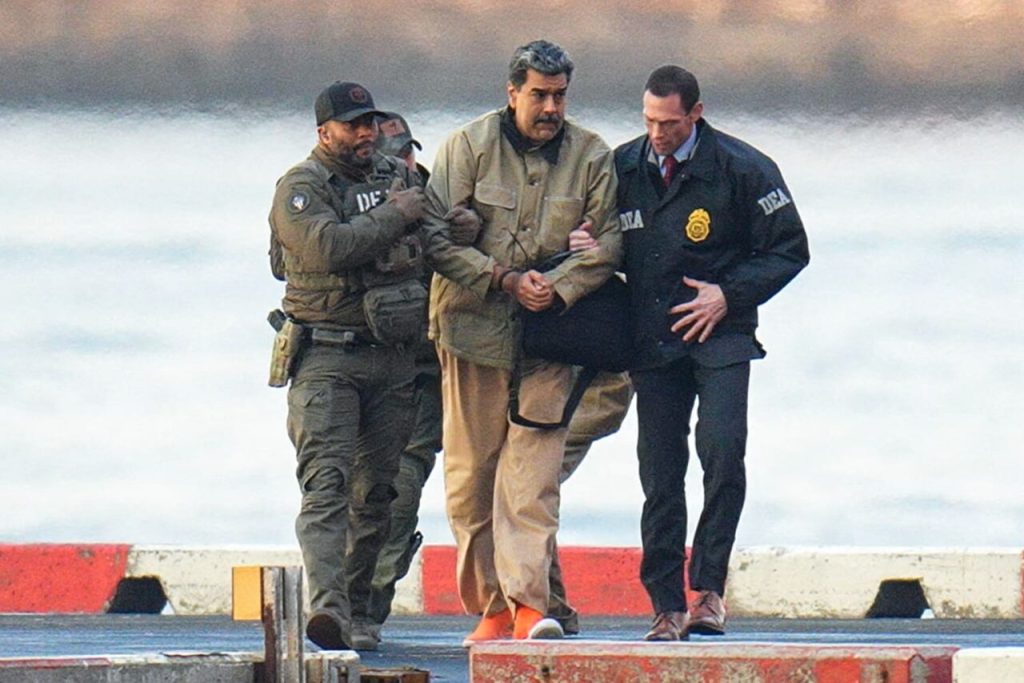
Nicaragua’s role as a support point for Iranian interests in the hemisphere has begun to attract attention in international security circles. Concerns are not limited to bilateral cooperation, but also to the potential use of the territory as a logistical platform to expand Iranian presence and facilitate movement throughout the region.
Douglas Farah, a specialist in transnational crime and hemispheric security at IBI Consultants, argues that Islamic-Iranian penetration in Latin America must be analyzed within this framework.
“Efforts to project influence in the region are real, although they do not necessarily imply an immediate operational capability,” he told Expediente Público. In his view, the principal risk is not military, but intelligence-related, heightened by the geographic proximity to the United States.
Iran gains access to the region through proxies
Arocha agrees that the geographical factor is a critical variable. In his view, the political model governing Managua offers more direct access to the northern part of the continent and lower levels of international scrutiny, which increases its value within Iran’s strategic vision for the hemisphere.
In his view, Tehran uses flexible networks and indirect structures. “They use proxies: companies or intermediaries that allow them to move resources, information, and operations without direct exposure,” he explained.
Robert Evan Ellis, a professor at the U.S. Army War College, notes that this type of alliance takes on greater relevance in scenarios of regional reconfiguration. He argues that, following the fall of Nicolás Maduro in Caracas, Iran is seeking spheres of influence in the Western Hemisphere.
“There is evidence of ties between the Ortega regime in Nicaragua and Iran, including groups such as Hezbollah, dating back at least to 2007. While this relationship has not been as deep as the one established with the Chávez-Maduro axis in Venezuela, Nicaragua today represents a strategic alternative for Iran,” Ellis said.
He added that “given the pressure on Cuba and the crisis in Venezuela, the Ortega regime could serve as a platform for Tehran to seek ‘soft targets’ in the Western Hemisphere, especially in the context of its tensions with the United States.”
The U.S. scholar added that the dynamics between these two countries should not be interpreted should solely in economic or diplomatic terms. In his analysis, the relationship could offer Tehran opportunities to identify vulnerabilities and take direct action in a region that has historically been considered a priority for U.S. security.