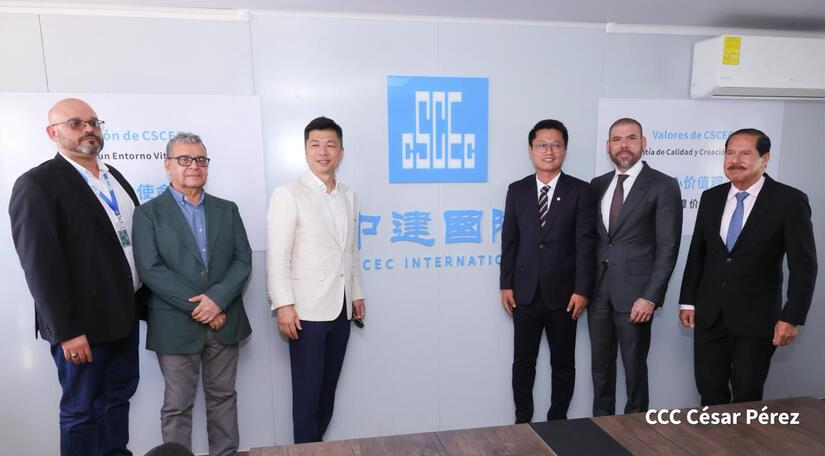
China State Construction Engineering Corporation (CSCEC), the Chinese company participating in the expansion and upgrading of the runway at Augusto C. Sandino International Airport in Managua, has a limited direct presence in Latin America. In the region, it typically operates through its subsidiary, China Construction America (CCA), which is better known in countries such as Panama.
In Panama, CCA partnered with a local company to build the Amador Convention Center, a project that accumulated more than 2,500 reported flaws and omissions and was subject to a court-ordered asset seizure due to overdue payments. CSCEC was founded in 1982, and its subsidiary China Construction America was established in 1985 and is headquartered in New Jersey. Despite its global reach, CSCEC has relied largely on subsidiaries rather than direct operations in Latin America.
In Nicaragua, the government has not only signed an agreement with CSCEC for the airport project, but also entered into several additional contracts with the Chinese firm. These include agreements for Phase II of the Coastal Highway (La Costanera) and the National “New Victories” Housing Program. CSCEC was one of four companies that signed a Memorandum of Understanding with the government of Daniel Ortega and Rosario Murillo on February 10, 2022.
You may read: Eager to get respect for their own regime´s «sovereignty», Nicaragua´s Ortega and Murillo kowtow to China
CSCEC president Zheng Xuexuan is an alternate member of the 20th Central Committee of the Chinese Communist Party. According to the company’s website, CSCEC has operated in more than 100 countries and is involved in real estate development, construction financing, engineering, and design. It has 38 second-tier subsidiaries, eight publicly traded companies, and a workforce exceeding 360,000 employees.
The company claims responsibility for more than 90 percent of China’s skyscrapers, three-quarters of its major airports and satellite launch bases, one-third of urban utility tunnels, and half of the country’s nuclear power plants. CSCEC also describes itself as a leading representative of China’s Belt and Road Initiative.

Troubles with a project in Panama
According to CCA’s website, the subsidiary carried out three projects in Panama: the San Isidro Bus Terminal, the Ciudad Esperanza social housing project in Arraiján, and the Amador Convention Center.
CCA took full control of construction of the Panama Convention Center—also known as the Amador Convention Center—in April 2019. Previously, in 2016, it had formed a consortium with the Panamanian firm Construcciones Civiles Generales S.A. (Cocige) to complete the project.
Construction had been stalled for two years after the original contractor abandoned the site in late 2013 due to financial difficulties. The project was initially scheduled for completion in October 2014.
In February 2019, Panama’s Tourism Authority (ATP) identified more than 2,500 flaws in the work carried out by the consortium, including unauthorized design changes, missing final plans, lack of personnel, and construction without proper permits. Following an ultimatum from the ATP to terminate the contract, CCA remained as the sole company in charge, while Cocige exited the project.
The consortium also faced a court-ordered seizure due to unpaid debts to the company responsible for installing the air-conditioning system. At the time, Cocige was reported to have lost more than $80 million in public contracts and faced additional claims from local suppliers.
Despite deadline extensions, the project was not delivered until August 2021. The total cost reached $207 million.
CSCEC’s expanding footprint in Nicaragua
In November 2023, Nicaragua signed an agreement with CSCEC to develop seven road infrastructure projects. These include the expansion of the Chinandega–Somotillo, Mateare–Empalme Izapa, and Sébaco–Matagalpa highways, as well as the construction and expansion of the Portezuelo–Las Mercedes road, three highway overpasses, and multiple bridges.
That same year, CSCEC was designated by the Chinese government to execute Nicaragua’s National “New Victories” Housing Program.
Read also: Government Grants New Mining Rights to Little-Known Chinese Company in Nicaragua
In June 2024, Nicaragua and China signed a credit facility agreement for Phase II of the Coastal Highway project. According to the Ministry of Transport and Infrastructure, the contracts cover two sections totaling 97 kilometers, with an investment of 2.123 billion yuan—approximately $292 million at the time.
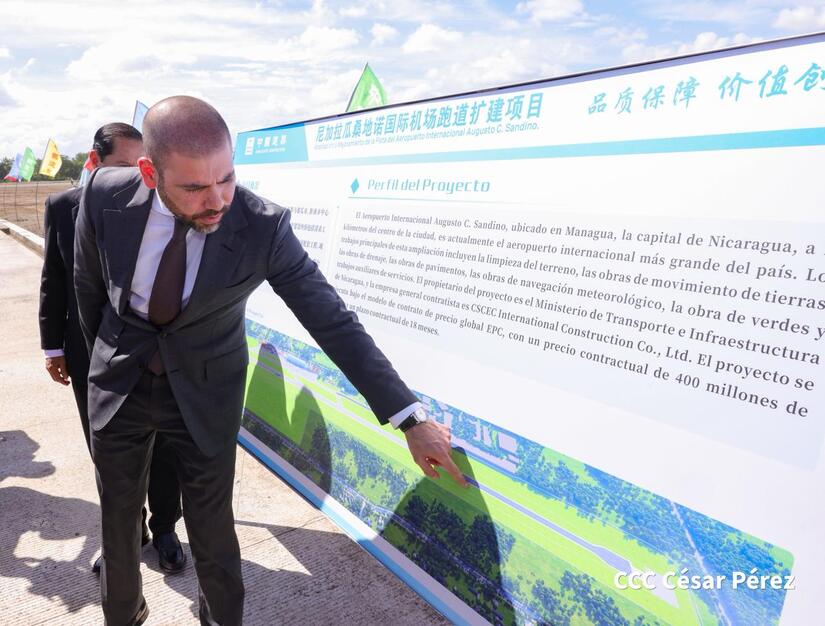
On December 13, during the inauguration ceremony for the runway expansion at Augusto C. Sandino International Airport, pro-government media reported the presence of Cui Yan, CSCEC’s Central America representative, alongside Laureano Ortega, presidential adviser and son of the ruling couple.
Official information indicates that the airport’s runway will be extended from 2,442 meters to 3,330 meters. The project also includes the construction of a new parallel taxiway, a rapid-exit taxiway, and additional infrastructure that will upgrade the airport’s classification from 4D to 4E.
The modernization plan includes new turning platforms, wind barriers, relocation of navigation and meteorological equipment, improved lighting and drainage systems, inspection roads, and perimeter fencing. The contract’s total cost has not been disclosed, and the project is scheduled for completion within 18 months.