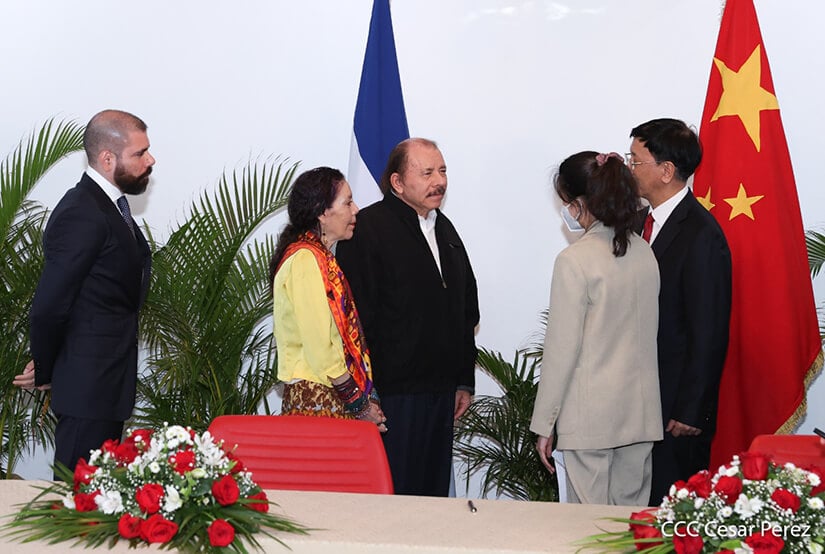
The Nicaraguan regime marked four years of the reestablishment of diplomatic relations with communist China (which had been broken in the 1990s) with a promise that they will cooperate in international forums, according to an official statement, to guarantee “respect for international law” and the “defense of sovereignty.”
“Basically, this political alliance is one of survival for the regime because they know difficult times are coming,” said political scientist José Antonio Peraza. To join Beijing’s axis, the dictatorship of Daniel Ortega and Rosario Murillo broke a decades-long relationship with the Republic of Taiwan (in 2021), while strengthening ties with Russia. All of it was part of a strategy of diplomatic self-isolation that coincided with the international community’s demand that they be held accountable for human rights abuses committed since 2018.
The Nicaraguan executive branch reiterated its stance of adhesion to China, in addition to celebrating the “historic ties” of “brotherhood” between the two countries. Both share the view of rejecting the accusations against them, and Ortega and Murillo have claimed they were victims of an alleged coup d’état and therefore demand that the international community respect their sovereignty.
Read also: U.S. imposes new tariffs on Nicaragua starting January 2026, but avoids changing DR-Cafta terms
“We will continue to strengthen our bilateral relations and actively cooperate in international forums to ensure respect for international law, the defense of sovereignty, and our peoples’ desire to live in a safe world, free from impositions, free from hegemony, and free of threats,” the statement reads. It quotes a meeting with the entire diplomatic corps, attended by the president of the National Assembly, Gustavo Porras, the dictators’ son Laureano Ortega Murillo, and the new Chinese ambassador, Qu Yuhui.
What has the China–Nicaragua relationship achieved?
However, experts consulted by LA PRENSA, including Peraza himself, view this diplomatic relationship with caution. While some say this new rapprochement has other priorities, such as trade—evident in the Nicaraguan rush to sign a Free Trade Agreement lacking economic logic—others point to a merely political convergence. Whatever the case, the political scientist says the dictatorship has gained very little.
Data from Nicaragua’s Central Bank indicate that the Central American country’s exports totaled 70.1 million dollars as of September 2025. During the same period, imports reached 1.4 billion dollars—roughly twenty times more. There are also questions surrounding Chinese loans that have been turned into promises of development through propaganda but have not resulted in the inflow of resources, according to a LA PRENSA report from last July.
Read also: Ortega-Murillo Linked Company Could Earn $100 Million a Year from Nicaragua’s Gold Plant
Ortega and Murillo, meanwhile, have granted extensive mining concessions and promised tax exemptions to Chinese investors in an attempt to entice them to provide funds. “The Chinese have left promises, debts, buses, and the illusion that they will defeat the United States—just as people once believed the Soviet Union would,” said former congressman and political analyst Eliseo Núñez.
Allies in trouble
While China and Ortega display much rhetoric about their alliance, the United States has continued to demand the release of Nicaraguan political prisoners and has launched a series of inquiries into labor rights and human rights as part of an evaluation of Nicaragua’s permanence in its trade agreement with Central America and the Dominican Republic, known by its English acronym DR-CAFTA.
The Office of the U.S. Trade Representative, empowered under Section 301 of the Trade Act of 1974 to conduct that analysis, concluded that tariffs will be imposed and increased over the next two years, though Nicaragua will remain in the agreement.
Ortega’s historical allies, such as Venezuela, have also faced criticism for human rights violations for many years. The Venezuela dictator Nicolás Maduro and the Chavista leadership have been accused by the United States of drug trafficking. At the same time, the U.S. Navy has deployed powerful air and naval resources in the Caribbean Sea.
Peraza says he is convinced that Ortega and Murillo clearly understand their situation. “They know no one is going to come from the other side of the world to defend them,” he said. Thus, kissing China´s hands follows a logic he describes as a short-term one. “It’s a palliative supposed to give the appearance of prosperity, but later the price must be paid,” he warns.