In the current century, China’s influence in Panama has been steadily growing, a phenomenon that intensified after 2017. However, there is no evidence that the administration of the Panama Canal is under Chinese control.
According to data from the independent think tank Inter-American Dialogue, investments by the People’s Republic of China (PRC) in Latin America and the Caribbean reached $187.5 billion between 2003 and 2022.
Meanwhile, estimates from the U.S. House Foreign Affairs Committee indicate that, as of 2022, Chinese investment in Panama totaled approximately $2.5 billion. Various reports from the Panamanian press place the figure at over $5 billion by 2023. The primary investments are in port and land infrastructure, trade, and communications.
Panama severed diplomatic ties with Taiwan in 2017 and established relations with the PRC. Since then, China has increased its economic, commercial, and political influence.
«China has turned Panama into a geographical and commercial hub, a strategic ‘hub’ for its political, commercial, and military expansion in the region,» said Professor Euclides Tapia of the School of International Relations at the University of Panama to the digital site Diálogo Américas in an article published on March 29, 2024.
Numerous Chinese companies have established regional logistics centers in the Colón Free Trade Zone or in the Panama Pacifico area, benefiting from tax exemptions and more flexible labor regulations, according to analyst R. Evan Ellis, Professor of Latin American Studies at the U.S. Army War College’s Strategic Studies Institute.
The companies Hikvision and Dahua have a dominant position in the local security systems market.
At least four major Chinese banks operate in Panama
In the financial sector, the Bank of China, the China Development Bank, the Export-Import Bank of China, and ICBC operate in the Central American country. They are licensed to carry out international operations from Panama. In 2021, the Superintendency of Banks fined the Bank of China $1 million for deficiencies in money laundering prevention and $250,000 for violations of banking regulations, the highest fines ever imposed by the supervisory body.
The second country with the greatest Chinese influence in Latin America
According to Evan Ellis, the Chinese have built and cultivated a network of relationships with influential people in all sectors. A chapter of the Confucius Institute — which promotes Chinese culture and the study of the Mandarin language worldwide — operates in Panama City. Around 30 study scholarships are awarded annually to Panamanians, and invitations to visit the Asian nation are extended to influential individuals.
According to Evan Ellis, Panama is the second country after Peru under the greatest influence of the Asian giant in Latin America.
This assessment is based on investment amounts, the presence of companies, involved sectors, and its importance to the country’s economy. The port built in Chancay, Peru, is currently unmatched by other Chinese projects in Latin America.
Who controls the road?
In an unexpected statement, President-elect Donald Trump claimed that Chinese soldiers operate and control the Panama Canal. He stated that Panama charges «exorbitant, ridiculous» fees to U.S. vessels and demanded that the Panamanian government reduce the fees for the U.S. or, otherwise, the country should «quickly, without question» return the Canal to the superpower.
There is no evidence to support Trump’s claims, according to local press and international media outlets such as The New York Times.
President José Mulino, a right-wing businessman and politician with strong pro-U.S. views, rejected the claim and stated that the Canal is under the exclusive control of the Panama Canal Authority. On the other hand, he ruled out negotiating any modifications to the treaties and reaffirmed Panama’s sovereignty.
Former Foreign Minister Jorge Ritter highlighted that one of Mulino’s first acts as president was to sign an agreement with President Joe Biden’s government to address the wave of illegal migration from South America.
Six percent of total global trade and 57.5 percent of the containerized cargo transported from Asia to the U.S. East Coast pass through the Panama Canal.
Presence in and around the Canal
The most significant and attention-grabbing Chinese presence is in the areas of the Canal and its surrounding regions, especially following the remarks made by U.S. President-elect Donald Trump, who has suggested that China might be exercising control over the Canal.
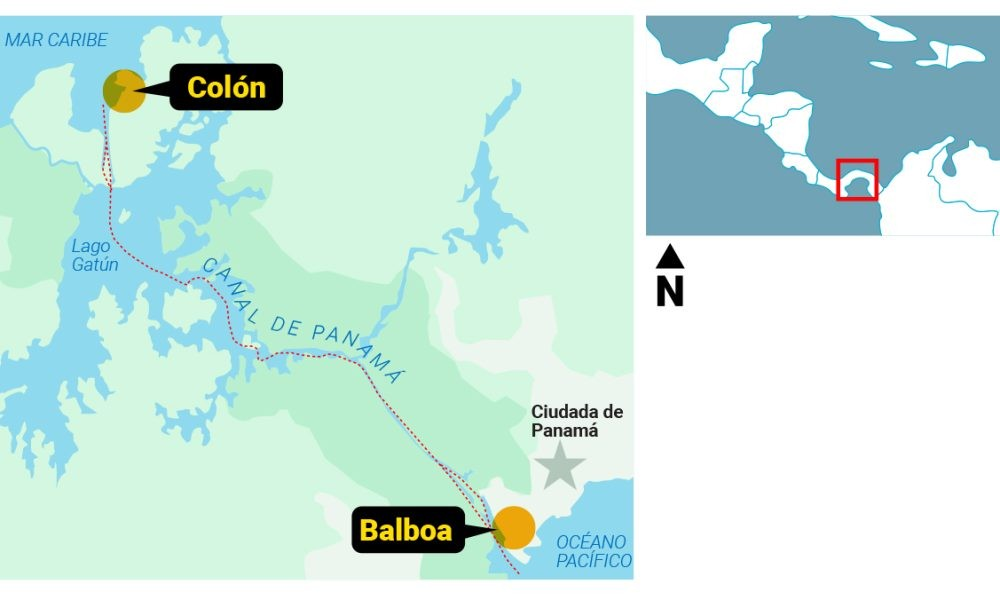
CK Hutchison Holdings, a company based in Hong Kong, manages two ports at the entrances: Cristóbal, in Colón, in the Caribbean, and the other in Balboa, in the Pacific.
Although there is no evidence of Chinese military presence, as claimed by U.S. President-elect Donald Trump, according to international media, there are security concerns because these facilities are of dual-use; that is, they can also serve military purposes.
On the other hand, the parent company, Hutchinson Whampoa, is known for its ties to the People’s Liberation Army (PLA), the name still used for the Chinese military.
Expert Evan Ellis told Diálogo Américas that from these facilities, it is easy to monitor all maritime and naval activity, including the passage of ships and their destinations. In other words, intelligence gathering. On the other hand, there is a lack of full transparency regarding the operations of the Chinese administrator.
Furthermore, the Chinese company Panama Colon Container Ports (PCCP) had won a contract to build a container terminal on Isla Margarita, Colón, for one billion dollars. However, due to China’s failure to meet obligations, the Panama Maritime Authority (AMP) reportedly canceled the contract that PCCP was to develop in 2022.
In substitution, the AMP awarded contracts to the companies Nortarc Management Group, a firm registered in the Bahamas with subsidiaries in the United States, Panama, the United Kingdom, and the United Arab Emirates, according to its website; and to the shipping line Mediterranean Shipping Company, based in Switzerland.
Concerned Southern Command
In statements before the House Armed Services Committee last March, General Laura Richardson, head of U.S. Southern Command, assured that Beijing is betting on the long term with the development of dual-use sites and facilities.
«The PRC presents its investments as peaceful, but in reality, many serve as future multi-access points for the PLA and naval concentration,» Richardson told the lawmakers.
«These investments include critical infrastructure such as deep-water ports, cyber centers, and space-related facilities. In Panama, Chinese state-owned companies continue construction projects related to the Canal, a global strategic point.»
U.S. presence
The United States remains the largest user of the Canal, accounting for three-quarters of the total cargo transported through the waterway, followed by China with just over 20 percent.
Additionally, the U.S. has special privileges, such as expedited passage for Navy vessels, allowing them to bypass queues, stated former Panamanian Ambassador to the OAS, Guillermo Cochez, in a televised interview with NTN24 published on January 1, 2025, on YouTube.
Corruption in the break with Taiwan?
In a recent interview with the former Panamanian ambassador to the OAS, Guillermo Cochez, on NTN24, he stated that there were corrupt motives behind the break in diplomatic ties with Taipei.
«I believe that Mr. Trump’s remarks are more directed at the Chinese presence that has developed in Panama due to a policy that former president (Juan Carlos) Varela tried to play in 2017, wanting to play in the big leagues without any experience in the Chinese field. Varela, who is said to have received 141 million dollars to change the diplomatic relationship with Taiwan, had a 38-million-dollar contract for China to buy products from his rum factory,» said Cochez.
Under the Varela administration, China signed several massive and questionable contracts. A US$4 billion deal to build a high-speed rail line between the capital and David; a US$1 billion natural gas plant; a cruise terminal in Amador; a new building for the Chinese embassy at the entrance to the Canal; a convention center; and a fourth bridge over the Canal.
For Professor Euclides Tapia from the University of Panama, Beijing aimed to trap the country in the «debt trap» as it has done in Africa and Asia, forcing highly indebted countries to cede control of ports or other assets.
The administration of Laurentino Cortizo reviewed and abandoned the high-speed rail agreement, as it was deemed unnecessary in an area with good connectivity. The project for the new embassy was canceled due to negative reactions from the population and pressure from the United States, according to Panamanian media. The bridge is still under construction. The gas plant contract was also canceled.
After significant delays from the Chinese construction company China Harbour Engineering Company, a cruise terminal in Amador was inaugurated last year.
Cochez assures that the Panamanian management has been «very efficient»
The Canal was inaugurated in 1914. Washington administered it until its transfer to the Panamanian state on December 31, 1999, as agreed upon in the Torrijos-Carter Treaties signed on September 7, 1977, by Presidents Omar Torrijos and Jimmy Carter (1977-1981).
«China does not control the ports. It is a Hong Kong company that controls them, but there are other very large companies, one from Seattle, USA, another from Taiwan, and another from Singapore. The idea that they control the ports is not entirely true, and Panama has been very protective of the control of its ports through the Maritime Authority, and it will continue to do so to prevent drug trafficking, smuggling, and illicit activities,» added the former diplomat.