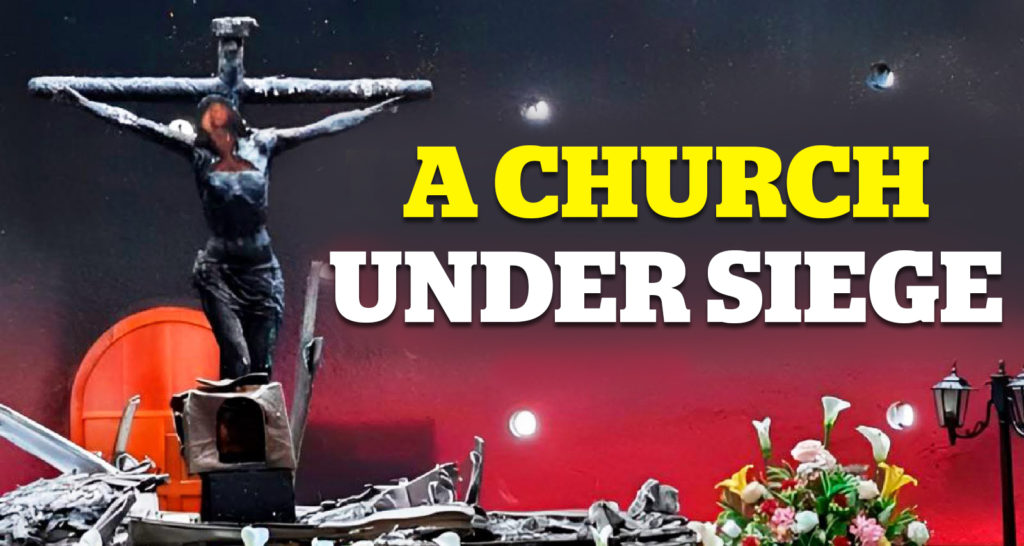
LA PRENSA begins with this report the first in a series of articles that will delve into the persecution by the dictatorship against the Church. With this article we also begin our new English section as part of our effort to make this website a global source of information about the situation in Nicaragua and the plight of Nicaraguans.
This series on the Nicaraguan Catholic Church will not be published consecutively, but we aim for it to document for posterity this dark period of our history. This initial article explains how Daniel Ortega and the Sandinista Front have attempted for 44 years to control the Catholic Church in the country, and if unable to control it, then to destroy it.
La Prensa
In the beginning, the dictator left Nicaragua. The people celebrated in the streets. If Anastasio Somoza could be overthrown, any other challenge seemed possible. In Latin America, many celebrated the triumph of the Sandinista revolution as if it were their own. The music of Carlos Mejía Godoy echoed in unimaginable corners of the world, serving as a musical backdrop for the dreams of freedom of diverse peoples.
In the country, there was optimism all around. After all, «dawn had ceased to be a temptation,» as the lyrics of the Sandinista Front’s anthem suggest. The same anthem that in another stanza says, «we fight against the Yankee, enemy of humanity,» yet even the «enemies,» far from fighting them, were preparing to assist. In the United States Congress, a bill was being discussed that included humanitarian aid for the young revolution.
At that moment, the Sandinistas had no enemies. The Nicaraguan Episcopal Conference (CEN) greeted the triumph of «the boys,» as they were called in the Nicaragua of the 1970s. In a document published in June 1979, days after the revolution’s triumph, the Episcopal Conference legitimized it.
«The extremes of revolutionary insurrections pain and affect all of us, but their moral and legal legitimization cannot be denied in the case of evident and prolonged tyranny that gravely threatens fundamental human rights or damages the common good of the country,» read the declaration of the Nicaraguan bishops.
The CEN seemed to have boarded the revolution’s ship. Would the slogan «there is no contradiction between Christianity and revolution» become a reality? That was important for the Sandinista Front if they wanted to consolidate their plan for total and perpetual control of a country whose population, at the start of the 1980s, was considered 90 percent Catholic. However, in reality, the relationship between the Catholic Church and the Sandinistas was then and now filled with contradictions.
The Sandinista Front and Archbishop Obando
Upon entering Managua, the Sandinistas had reason to be hopeful about having a good relationship with the Church. After all, the then-Archbishop of Managua, Monsignor Miguel Obando y Bravo, who was the dominant figure in the Episcopal Conference, had served as the quintessential intermediary for political crises.
Their first mediation occurred in December 1974 when a Sandinista commando raided a Christmas party at the residence of Somoza’s minister, José María «Chema» Castillo. Among the guests were high government officials, and the US ambassador had left the party minutes before the assault.
The Sandinista commando demanded that Obando serve as a mediator between them and the Somoza dictatorship. One of their demands was the release of imprisoned members of the Sandinista Front, including Daniel Ortega.
Other mediations followed: during the takeover of the National Palace in 1978, during the end of the Contra war in 1989, and even during the crises provoked by Daniel Ortega against Violeta Chamorro’s government after his electoral defeat when Ortega «governed from below.»
However, according to Commander Dora María Téllez, they never felt that Obando was an ally.
«Obando was always against it, completely against it, although he was willing to play a role as an intermediary for the transition of power to the Government Junta» in July 1979, recounted the guerrilla commander Dora María Téllez, who is now in exile and had first met Obando during the takeover of the National Palace.
First attempt, the Liberation Theology and the attacks
Téllez recalls that the bishops in the then-CEN, and the majority of the clergy, viewed the revolution with at least suspicion. But if the hierarchy were to fail them, the Sandinistas still had a card to play: the Liberation Theology, which had reached its peak in the 1970s, and a small group of priests in Nicaragua had fully embraced it, aiming to blend their Christian vocation with the revolutionary cause.
Among them, the most internationally famous was the Trappist priest and poet Ernesto Cardenal, his brother Fernando Cardenal, Uriel Molina, and Antonio Castro, to name a few.
The presence of Catholic priests in the revolutionary government cabinet not only unsettled the Nicaraguan Church but also the Vatican itself. When Pope John Paul II arrived in Nicaragua for his first visit in 1983, he didn’t wait to speak privately with the poet Cardenal. Instead, in front of cameras on the runway, the Pope admonished Cardenal with a pointed finger, warning him: «You must resolve your situation with the Church.»
Neither Cardenal nor any other priests following Liberation Theology paid heed to the Pope and continued supporting the revolution. Many of these priests became involved in a project aiming to form a church that the Catholic hierarchy considered an attempt to supplant the true Church. The so-called Popular Church was a project that failed to achieve its purpose, prompting the government to take other measures to diminish the influence of the Catholic Church.
The attacks by the Sandinistas against the Church in the 1980s
Pope John Paul II’s visit to Nicaragua in 1983 set the stage for the Sandinista government to commit a significant disrespect against a pope. The Sandinista state apparatus went to work to attempt to manipulate the visit. They positioned mothers of young men from the Military Service who had died in the war in front of the platform where the pope would officiate a mass. They equipped them with microphones and a supportive crowd urging, «We want peace.»
The visibly upset pope repeatedly requested silence from the mothers who, backed by a boisterous crowd, interrupted his words. «Silence… silence… silence…» insisted the Holy Father, only to explode moments later with his firm response: «The first one who wants peace… is the Church.».
During the 1980s, Ortega expelled several priests, including the bishop of Juigalpa, Pablo Vega, then vice president of the CEN, accusing him of having an «anti-patriotic and criminal attitude» for allegedly supporting the anti-Sandinista guerrilla known as the Contras.
Priest Bismarck Carballo was also a victim of Ortega’s first government. Carballo was set up in an operation where he was made to appear supposedly involved in a love triangle. Carballo later explained that Maritza Castillo Mendieta contacted him, urgently asking him to come to her house for lunch as she needed to discuss a personal problem. Upon arrival, as Carballo sat at the table, a man identified as Alberto Téllez Medrano barged in, assaulted him, forced him at gunpoint to undress, and pushed him out onto the street.
At that «precise» moment, a demonstration of Sandinista sympathizers passed by, calling for an end to the Contra war. Official television cameras filmed the naked priest and reported on the supposed «love triangle.»
«The police, instead of protecting and clothing me, dragged me towards the vehicle in front of the cameras. As I worked with the media, I knew the journalists who were there,» Carballo recounted in an interview with LA PRENSA in 2001.
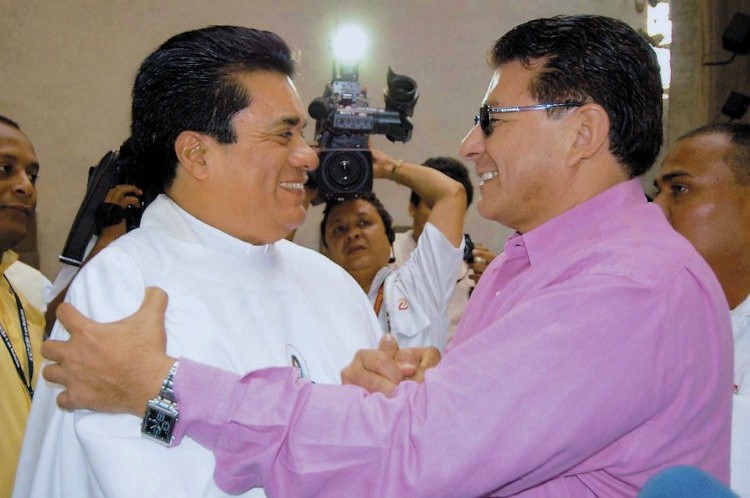
What many fail to understand today is how Carballo, like Obando y Bravo, became close to Ortega’s government.
Unable to control the Church, they fear it
According to the guerrilla commander Moisés Hassan —now also forced into exile—, his former comrades in the struggle have always feared the Church and suffer from paranoia. «They would prefer that not a leaf moves from a tree without their permission,» he says.
The obsession with control has its explanation. Among Daniel Ortega and Rosario Murillo’s worst nightmares is the electoral defeat of 1990. It was a moment when, whether forced or due to overconfidence, they relinquished control and lost power in the elections on February 25, 1990. From February 26 onward, they were guided by one idea: to reclaim power by any means necessary.
They hoped to regain power in the 1996 elections, but then came «el viborazo.» The then-Cardinal Miguel Obando y Bravo held a mass on October 17, 1996, just three days before the presidential elections. The mass was televised, and in his homily, Obando quoted a fable to warn Nicaraguans «not to give warmth to a half-dead viper.» Ortega and the Sandinistas believe that they lost the elections because of that homily.
Ortega finally managed to return to the presidency in 2007 and has since remained in power through electoral fraud and violence, facing strong criticism from the Church as a result.
Second attempt: Obando’s conquest
Obando y Bravo, from the early 2000s, had chosen to be close to Daniel Ortega, despite the many differences they had over the years. His reasons remain a subject of speculation.
In April 2005, Pope John Paul II accepted Obando’s resignation, which bishops are required to submit to the pope upon reaching 75 years old. He was 79 years old at the time.
From 2007 onward, elderly and devoid of any real power within the Church, Obando y Bravo aligned even more closely with Ortega. However, this didn’t provide much advantage for the dictator. Obando passed away on June 3, 2018, at the age of 92, while the protest barricades still obstructed the country’s main roads.
His successor, Cardinal Leopoldo Brenes, has a softer personality, avoiding confrontation. His supporters say he is «prudent, conciliatory.» Detractors view him as «indecisive» or ambiguous, while others label him as fearful.
The 2018 revolt
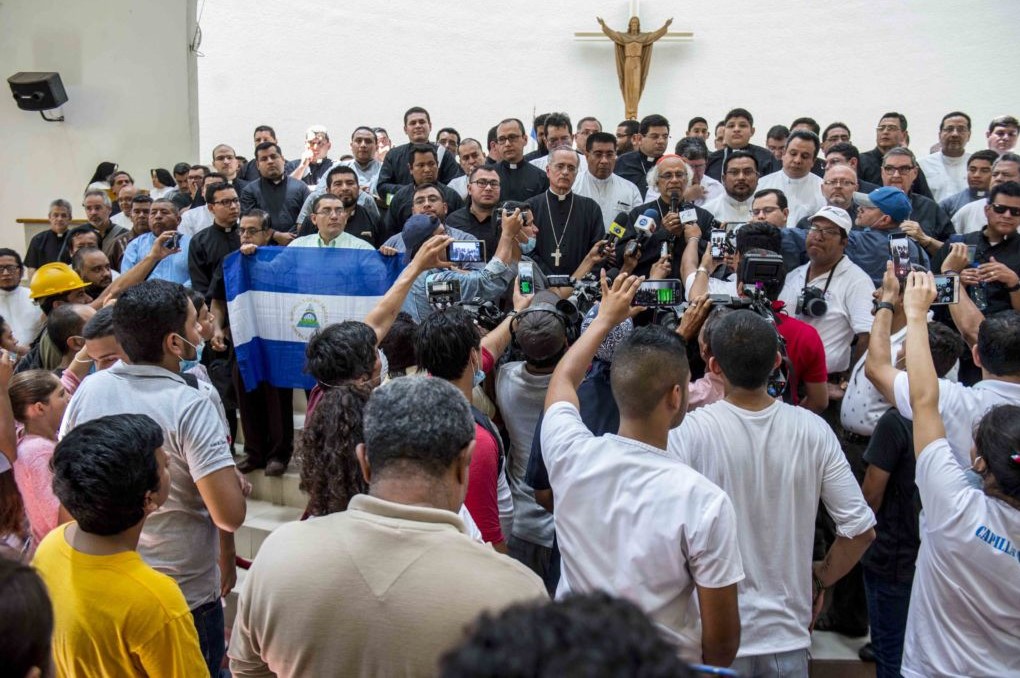
That perception became entrenched during the harshest moments of repression against students and the population at the roadblocks in 2018. Auxiliary bishop Silvio Báez, from Managua, and Matagalpa´s bishop Rolando Álvarez, were among those who most frequently and forcefully raised their voices in defense of the protesters.
The protests had originated from an unconsulted reform to the pensions of the Nicaraguan Social Security Institute, which disadvantaged retirees. However, the regime reacted with excessive violence. In the first three days, there were 18 protesters killed, and the death toll continued to rise. Yet, as each day brought more repression, it also brought more roadblocks, more barricades, more occupied universities, and increasingly larger marches demanding Ortega’s resignation.
For Hassan, the dictatorship’s fear of the Church escalated in 2018 when they found themselves cornered by the demonstrations, roadblocks, and barricades, and when many priests clearly sided with the protesters.
«They dread many independent priests,» between 2018 and 2021, there were quite a few priests who, in their sermons, criticized the government. «In their own way, they were influencing people and using the reality and the respect they have among the parishioners to hit them hard,» Hassan says.
Protesters sought refuge inside churches. There, medical students tended to their injured comrades. And priests rang the bells of their parishes to alert protesters about the advance of the police and paramilitaries. The dictatorship hastily organized them to crush the rebellion, unable to do so solely through the police force.
Bishops Silvio Báez, auxiliary of Managua, and Rolando Álvarez, of Matagalpa, expressed their support for the protesters. «Do not fall for provocations,» Monsignor Báez told them in a message after a mass at the Cathedral of Managua. «Do not let yourselves be swayed by violence. Your protest is just, and the Church supports you… (applause) and not only do we support you, but we urge you, we encourage you to not cease in your protest.»
«I would just like to recall two phrases from our beloved Pope Francis… the first… ‘History does not depend solely on the will of the powerful but above all on the ability of peoples to organize.’ Do not forget this. The second thing that the Pope told the youth in Chile… ‘The young person who does not love their homeland will not be able to love either Jesus or God,'» he said.
Meanwhile, from his pulpit at the San Pedro Cathedral in Matagalpa, in the north of the country, Bishop Álvarez framed the confrontation between the people and the Government in the context of the eternal struggle between God and Satan. And if God was with the people, there was little doubt about whom the dictatorship had allied itself with.
Álvarez pronounced and recorded a prayer of exorcism written by Pope Leo XIII, which was broadcast repeatedly throughout the day and night by the media in his Diocese. The dictatorship of Daniel Ortega and his wife and co-president, Rosario Murillo, is not only labeled by many Nicaraguans as abusive, repressive, cruel, or murderous. A very common adjective used is «diabolical.»
Cornered, Ortega calls for a National Dialogue
Amidst multiple protests, roadblocks, and brutal repression against students, farmers, and the citizenry at large rising against the government, the dialogue began in May. The Episcopal Conference made efforts to play its role as a mediator, but there was no one to dialogue with.

The protests were an amorphous amalgamation: students occupying universities, farmers erecting roadblocks, citizens setting up barricades in cities like León, Jinotepe, Masaya, or Matagalpa, and massive marches in Managua. These were groups with little or no communication among themselves. The bishops even had to organize their representatives to attend the Dialogue.
«This is not a dialogue table, we are here to demand your resignation» student leader Lesther Alemán told Daniel Ortega on the first day, seizing the floor in front of the cameras of the Church’s television channel, while the bishops of the Episcopal Conference observed impassively.
The dialogue led nowhere, but Ortega used it to buy time and organize bands of paramilitaries, mostly led by «historic fighters» from the 1970s or ex-military from the 1980s, who directed members of the Sandinista Youth in support of the police in the so-called «Cleanup Operation.» By mid-July, this operation had left a toll of 325 protesters killed.
From mediators to «coup-plotters»
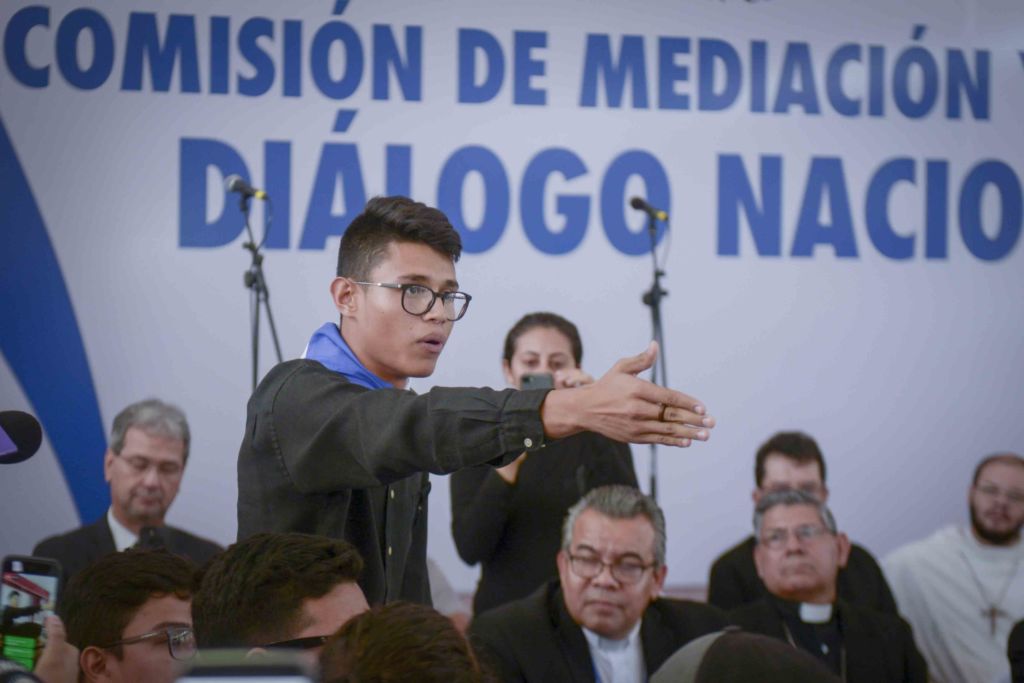
Once the rebellion was crushed, Ortega seized the opportunity to hold the bishops accountable for Lesther Alemán’s televised statement. Furthermore, the bishops had proposed an accelerated timeline for holding elections that were scheduled to take place in November 2021 as a way to resolve the rebellion. This convinced him that the Episcopal Conference intended to orchestrate «a coup d’état.»
In that mindset, if the Church had been on the brink of overthrowing him, he saw it as an opportunity to finish it off once the rebellion in 2018 was crushed. Following that, between 2019 and 2021, he prepared and executed the elimination of all opposition through imprisonment and exile.
Báez left the country on orders from pope Francis in April 2019. The US Embassy in Managua informed the Vatican of a plan to assassinate Báez. The pope ordered his transfer to the Vatican but later agreed for him to be in Miami, close to Nicaraguans exiled there.
Then, in November 2019, the Police laid siege to the San Miguel Arcángel Church in Masaya when Father Edwin Román opened its doors to a group of mothers of political prisoners who began a hunger strike.
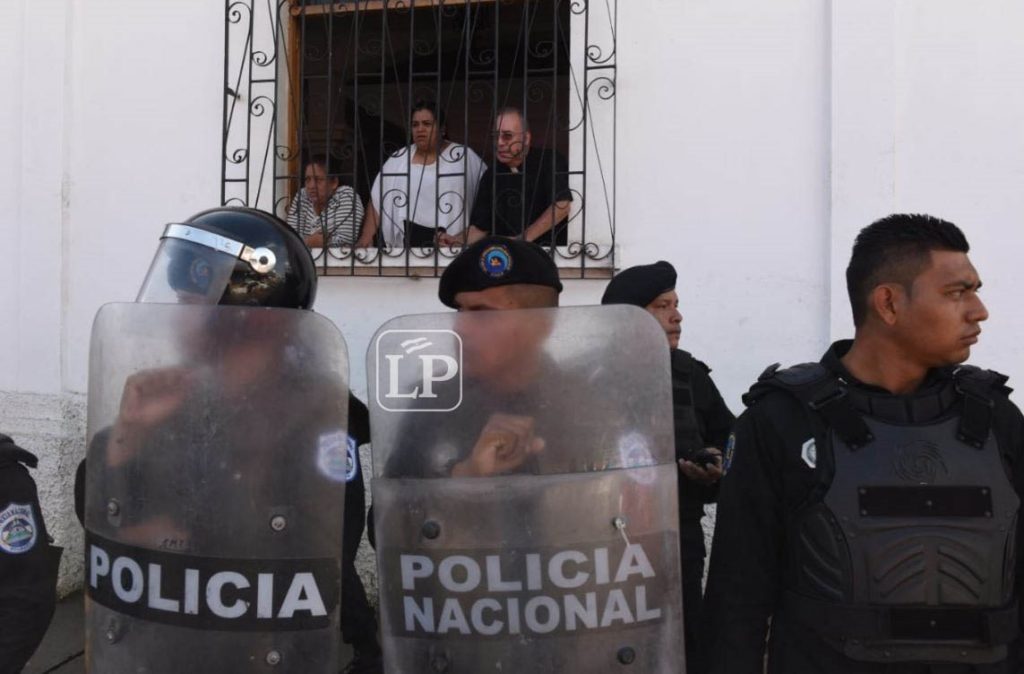
Despite the priest being inside, the Police didn’t allow anything or anyone to enter or leave. They cut off electricity and water supply and prevented them from receiving water or medication. Days passed, and Father Román ran out of his diabetes medication, causing him to have complications at least three times.
Faced with this situation, the mothers suspended the hunger strike to be able to leave. However, this was only possible after the Archbishop of Managua, Leopoldo Brenes, and the Apostolic Nuncio, Waldemar Stanisław Sommertag, had to intervene with the dictatorship, which showed a lack of sensitivity. Father Román is now in exile in Miami.
Third clash: a silenced Church
Since then, the persecution against the Church has not ceased. This persecution has been documented by a Nicaraguan lawyer who has been outraged by the silence surrounding the abuses committed against the Catholic Church. Martha Patricia Molina, now in exile in the United States, has already published four editions of her report titled «Nicaragua: a Persecuted Church.»
Molina has documented an intensification of aggressions against the Church in the year 2023, with a total of 203 acts of aggression compared to 90 in 2018.
The Diocese of Matagalpa, one of the nine in the country and which has been led by Monsignor Rolando Álvarez, has been the most heavily hit with attacks of all kinds. With 28 parishes, Matagalpa has suffered 144 attacks. The Archdiocese of Managua, with 114 parishes, has suffered 242 attacks.
Since 2021, a large number of priests, nuns, and religious individuals have been expelled from the country or have not been allowed to return once they leave. However, in recent months, the dictatorship has gone even further: 10 priests, two seminarians, and a deacon, who were being held under arrest, and in spite of being Nicaraguan born, were deported and stripped of their citizenship. Another seven priests have also been deported without being arrested.
Furthermore, Bishop Álvarez, detained in August 2022 at the Episcopal Palace of Matagalpa, remains imprisoned in a maximum-security cell, with a sentence of 26 years in prison without a trial, after refusing twice to leave prison on the condition of being exiled. The Monsignor staunchly refused to go into exile and leave the congregation behind.
The Episcopal Conference has been decimated
The Nicaraguan Episcopal Conference, which stood against Ortega and demanded early elections in 2018, now sees a significant transformation. Only Bishop Carlos Herrera of Jinotega and Bishop Jorge Solórzano of Granada remain in the country from those who faced Ortega.
Báez is in exile, Álvarez is in prison, and Bishop Abelardo Mata of Estelí resigned due to old age and his diocese remains vacant.
Three other bishops, appointed by Pope Francis in 2020—Bishop Marcial Guzmán of Chontales, Bishop Francisco Tigerino of Bluefields, and in 2021, Bishop Isidro Mora of Siuna—have exhibited characteristics of silence, prudence, and a low profile similar to Archbishop Leopoldo Brenes of Managua. Meanwhile, Bishop Sócrates Sándigo of León has openly aligned himself with the dictatorship.
Among younger, less experienced priests, a sense of abandonment has taken hold. Speaking to the digital outlet Confidencial, a disheartened Catholic priest expressed feeling like sheep without their shepherd. «We are disappointed. Anything can happen to any priest, and the Conference, the bishop, do not speak out. We feel like sheep without a shepherd,» he conveyed.
The priests interviewed by Confidencial spoke anonymously, as is common in Nicaragua, fearing repercussions from the government or reprimand from the Catholic hierarchy for speaking without authorization. The silence is demanded by the dictatorship, adhered to by the Episcopal Conference, and followed by most priests, religious individuals, and parishioners alike.
Meanwhile, the dictatorship continues to tighten its grip on Catholics by prohibiting all public Church activities, including those related to the novena for the Virgin of Conception, known in Nicaragua as «La Purísima,» which can now only be celebrated within the confines of the temples.
It’s reminiscent of the times of the catacombs—no guiding light, no whistle to lead. All that’s heard is the silence of extreme prudence or perhaps fear.