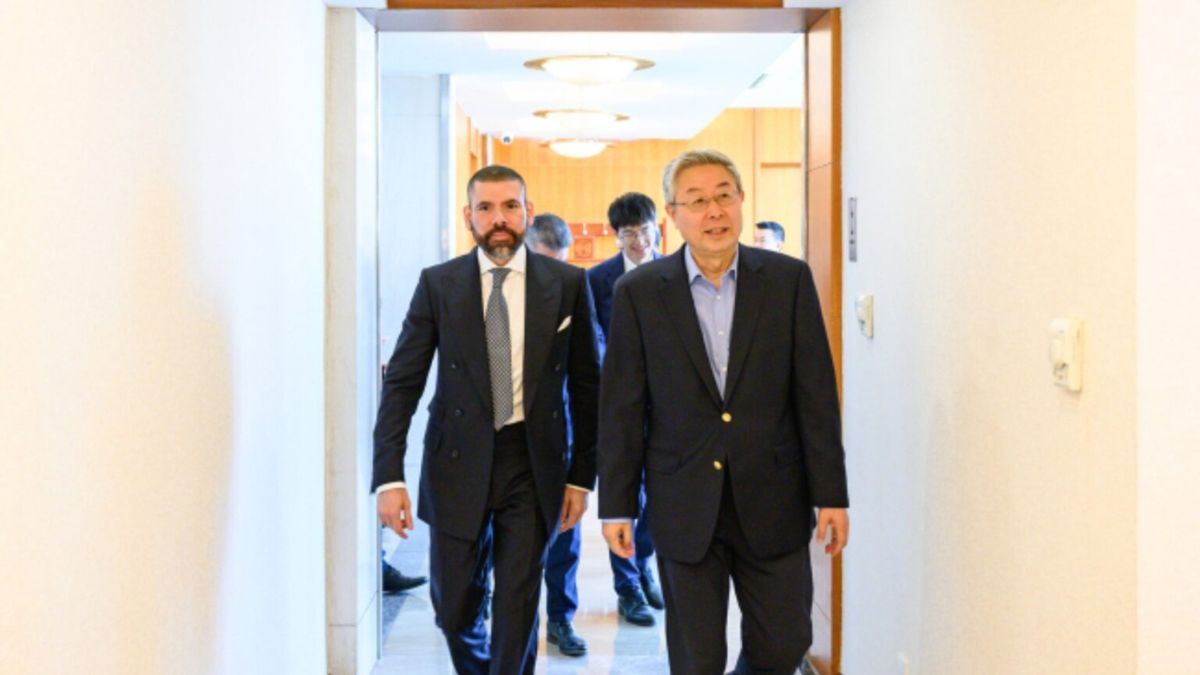
A senior official from the Chinese Communist Party (CCP) has pledged continued support for Nicaragua’s ruling regime, telling Laureano Ortega Murillo that China will stand by the country in defending «its sovereignty, national dignity, and chosen development path» while opposing what Beijing describes as «external interference.»
According to the platform Friends of Socialist China, Ma Hui, deputy head of the International Department of the CCP Central Committee, met with Ortega Murillo on June 22 during the visit of a Nicaraguan delegation to China. The meeting reflects the deepening relationship between the two governments since Nicaragua restored diplomatic ties with Beijing in December 2021, severing its longstanding relations with Taiwan.
The meeting took place on the sidelines of the Fourth China International Supply Chain Expo, attended by a Nicaraguan delegation led by Laureano Ortega. Nicaragua’s state-controlled media briefly reported the meeting on the day it occurred but provided no details. Four days later, the International Department of the CCP Central Committee released an official statement describing the talks.
Read also: Five Reasons Why Daniel Ortega Is Considered a Threat to the U.S. and the Region
During the meeting, Ma discussed President Xi Jinping’s vision for party building and an educational campaign promoting what China calls «a correct view of government performance.» The emphasis on sovereignty aligns closely with the Nicaraguan government’s longstanding narrative, as the Ortega-Murillo administration has increasingly isolated itself from the international community to avoid accountability for the serious human rights violations documented since the 2018 political crisis.
Expert: Chinese support could strengthen repression
According to César Santos, a researcher at the think tank Expediente Abierto specializing in liberalism and China’s authoritarian influence in Latin America, the Chinese Communist Party’s public commitment to the Ortega-Murillo government is likely to reinforce authoritarian practices in Nicaragua.
A recent Expediente Abierto report argues that China has turned Nicaragua into a strategic partner for expanding its influence in Central America. The study concludes that Beijing’s backing enhances the regime’s capacity for surveillance, political control, and repression.
Following Ma Hui’s meeting with Laureano Ortega, Santos said he has little doubt that «this support will, to a greater or lesser extent, have repercussions for authoritarianism and repression» in Nicaragua.
Daniel Ortega has remained in power for more than 19 years, while his wife, Rosario Murillo, has steadily consolidated her influence in what critics describe as an effort to establish a dynastic political system. In April 2018, the government violently suppressed nationwide anti-government protests. According to the Organization of American States (OAS), the crackdown left more than 350 people dead between April 2018 and July 2019, alongside hundreds of injuries, arbitrary detentions, and thousands of displaced citizens.
Party training extends beyond ideology
Santos argues that China’s support carries implications because one of the International Department’s core responsibilities is training political party cadres abroad.
The Mexican scholar, who holds degrees in philosophy and social sciences from Veracruzana University, said such training includes ideological instruction in «socialism with Chinese characteristics» as well as education on surveillance technologies and methods of social control.
«In several African countries, it has been well documented that China shares potential applications of video surveillance technologies and artificial intelligence for social control, along with governance practices aligned with Chinese authoritarianism,» Santos said. «Over the medium term, similar systems could be implemented in Nicaragua.»
He added that while the CCP would likely not directly train Sandinista officials in methods of repression, party education programs could promote AI-assisted early warning systems—such as so-called Smart Cities or City Brain platforms developed by Chinese technology companies including Lenovo and Tencent—to monitor and neutralize potential social mobilization. Such programs could also include exchanges on authoritarian governance models, disinformation strategies, and media coordination similar to those China and Russia have reportedly conducted with journalists in other countries.
«It would not surprise me to see the International Department of the Chinese Communist Party establish this kind of training school for the Sandinista Front in Nicaragua,» Santos said. «Ultimately, it all relates to repression.»
Exporting China’s political model
Santos pointed to examples of CCP-backed ideological training institutions established in countries such as Zambia, Peru, and El Salvador. He also noted reports indicating that Chinese officials have provided training to members of Venezuela’s ruling movement on aspects of China’s socialist system.
He said the growing relationship between the CCP and Nicaragua’s ruling Sandinista National Liberation Front (FSLN) should be understood as part of the Chinese party’s decades-long effort to deepen ties with political parties across the Global South, regardless of ideological orientation.
«The CCP works with both left- and right-wing parties,» Santos said, «but its primary interest is in strengthening authoritarian and anti-liberal networks.»
In Nicaragua’s case, he argued, the relationship is particularly significant because it extends beyond economic cooperation to include technology transfers, political exchanges, and party-to-party collaboration.
You may be interested: Russia’s Growing Influence in Nicaragua Extends Far Beyond Humanitarian Aid
¿Limited impact on U.S.-Nicaragua relations?
Despite the geopolitical implications of China’s support for the Ortega government and its criticism of U.S. influence in Latin America, Santos believes the latest meeting is unlikely to significantly alter the already strained relationship between Managua and Washington.
Although the United States has devoted considerable attention to countering Chinese influence in critical infrastructure and technology, Santos said Washington has paid comparatively little attention to Beijing’s political outreach through the CCP’s International Department.
«While the United States has closely monitored China’s involvement in areas such as infrastructure and technology, there has been relatively little response to the growing political and party-to-party engagement between Latin American elites and the Chinese Communist Party,» he said.
Nonetheless, the U.S. State Department continues to scrutinize Nicaragua’s expanding ties with China, Russia, and Iran as part of Washington’s broader security strategy aimed at limiting the influence of powers it considers strategic rivals.