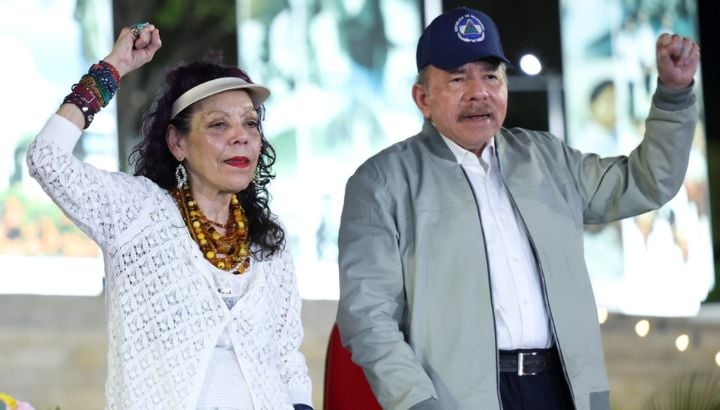
The Trump administration has at least five reasons to regard the regime of Daniel Ortega and Rosario Murillo as a threat to the security of the United States and the Western Hemisphere, according to Juan Sebastián Chamorro García, coordinator of Citizens for Liberty in Exile (Ciudadanos por la Libertad en el Exilio). Chamorro made the remarks during an appearance on En Contexto, a program on Panama’s Eco TV hosted by journalist Adela Coriat.
Chamorro said Nicaragua’s ruling regime openly identifies itself as a «sister revolution» to Iran’s government. He recalled that during Ortega’s 2022 inauguration ceremony, the head of Iran’s Revolutionary Guards was among the attendees.
He also pointed to the government’s close ties with Russia, particularly in police cooperation and intelligence matters. According to Chamorro, Nicaragua hosts Russian data transmission facilities as well as a ground station for Russia’s GLONASS satellite navigation system.
In addition, Chamorro highlighted what he described as an increasingly close relationship with China. He argued that the bilateral Free Trade Agreement grants Chinese companies preferential treatment that is not extended to U.S. businesses.
«The last time I checked, Americans are sensitive to ensuring equal treatment around the world,» he said.
Chamorro also cited Chinese involvement in Nicaragua’s mining sector, noting that companies from China have received gold mining concessions covering nearly nine percent of the country’s territory.
Read also: Russia’s Growing Influence in Nicaragua Extends Far Beyond Humanitarian Aid
Religious Persecution and Migration as a Political Tool
The fourth factor Chamorro identified concerns religious persecution. He accused the Ortega-Murillo government of targeting Catholics, Protestants, and U.S.-affiliated churches, an issue he argued is of particular concern to a conservative administration such as President Donald Trump’s.
Chamorro also alleged that Ortega turned Nicaragua’s international airport into a «logistical bridge» through which approximately 700,000 migrants transited. He linked the claim to recent statements by Costa Rica’s foreign minister regarding the detection of individuals allegedly connected to Hamas and Hezbollah passing through Central America.
«Seven hundred thousand people crossed through Central America,» Chamorro said. «It began with Cubans and Haitians, and later included Senegalese and people from Central Asia. Ortega used migration as a political weapon.»
Chamorro described Ortega and Murillo as a «deranged couple» who, in the later stages of their lives—Ortega is 81 and Murillo 75—exercise absolute control over the Nicaraguan state.
He alleged that the government has even imprisoned former allies on charges of what local political analysts have described as «unauthorized corruption,» referring to illicit activities carried out without the approval of the country’s ruling leadership.
Growing U.S. Pressure
In recent months, the U.S. State Department has stepped up pressure on Nicaragua, while Washington has simultaneously engaged in discussions with Cuba’s leadership amid the island’s ongoing crisis and continued its hardline policy toward Venezuela.
Secretary of State Marco Rubio has described Nicaragua’s government as an «enemy of humanity.» He has repeatedly condemned its human rights record, called for the release of political prisoners, and challenged the legitimacy of Rosario Murillo’s position within what he has characterized as the country’s increasingly totalitarian political system under Ortega’s 19-year rule.
Last week, the Trump administration denounced Nicaragua’s government before the Organization of American States (OAS), where Deputy Secretary of State Christopher Landau called for «zero tolerance» toward totalitarian regimes in the hemisphere.
The Ortega government’s ties with Russia, China, and Iran remain under close scrutiny in Washington as the United States advances a security doctrine aimed at limiting the influence of powers it considers strategic adversaries in the Western Hemisphere. All three countries maintain close relations with Nicaragua’s government.
You may be interested: The OAS Sends a Strong Message to Nicaragua’s Ortega-Murillo Regime