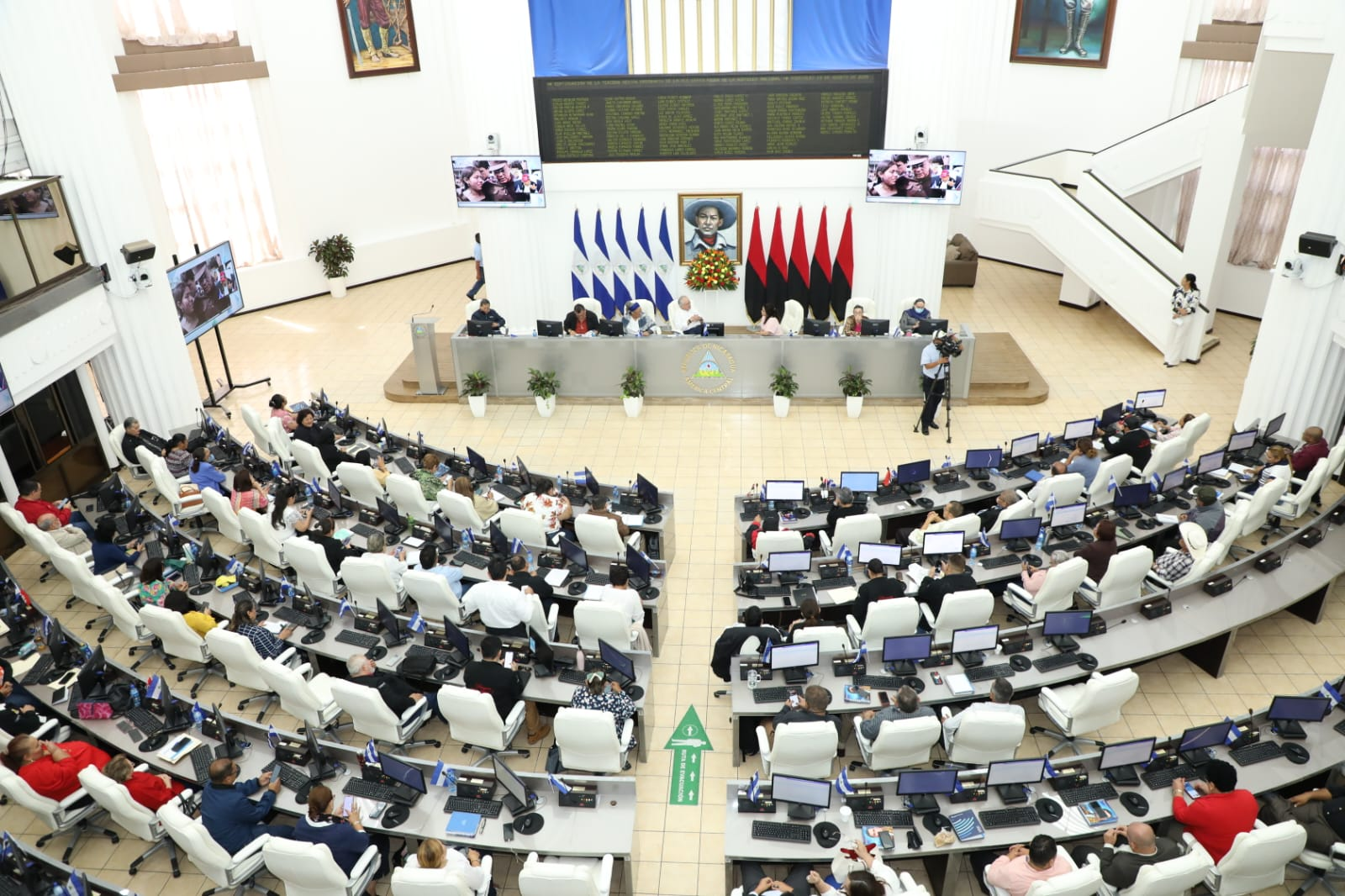
The regime of Daniel Ortega has ordered a package of reforms affecting five laws that, at their core, grant greater powers to the Ministry of the Interior over non-profit organizations, introduce new entities subject to anti-money laundering regulations, and expand the scope of assets that may be confiscated from individuals prosecuted under anti-terrorism legislation—a law that has previously been used to punish and dispossess opponents of the dictatorship.
The dictatorship sent to the National Assembly a reform initiative covering Law 977, the Law Against Money Laundering, Terrorism Financing, and the Financing of the Proliferation of Weapons of Mass Destruction; Law 976, the Financial Analysis Unit Law; Law 641, which contains the Criminal Code; Law 406, the Criminal Procedure Code of the Republic of Nicaragua; and Law 735, the Law on the Prevention, Investigation, and Prosecution of Organized Crime and the Administration of Seized, Forfeited, and Abandoned Assets.
Read also: Report Maps Russian Propaganda Network in Nicaragua and Across Latin America
The regime justifies the amendments as necessary to comply with “recommendations made by multilateral organizations, based on updated standards and international conventions.” Legal experts argue, however, that the dictatorship continues to manipulate international regulations in order to maintain pressure on political dissidents.
Under the pretext of meeting international obligations, the reform package gives the dictatorship “greater capacity for interference and close monitoring of a wide range of operations and individuals through a repressive body such as the Ministry of the Interior (Mint), a former lawmaker—who requested anonymity for fear of reprisals—said. Mint powers are being expanded, when the recommended approach is for oversight to be exercised by an autonomous, politically independent body staffed by professionals.”
Greater Control Over NGOs
Under amendments to Law 977, Article 37 now explicitly places non-profit organizations under the supervision of the Ministry of the Interior (Mint), granting the institution broad authority over the organizations that survived the mass closure of entities whose legal status was revoked in recent years.
Previously, Article 37 did not identify the Ministry as the regulator, instead referring generally to “public entities with powers and responsibilities related to the regulation, supervision, and sanctioning” of non-profit organizations in matters concerning money laundering.
Among the Ministry’s expanded powers is the authority, through its Directorate General for the Registration and Control of Non-Profit Organizations, to rapidly share information about organizations with relevant authorities whenever there are suspicions that an entity is being used for illicit activities or purposes outside its original objectives. Such information may be used to initiate investigations.
Authorities have frequently used similar justifications in recent years to shut down more than 3,000 organizations, many of them dedicated to civic participation and the promotion of democracy.
The Ministry will also be required to ensure that competent authorities have access to information concerning the administration, finances, and management of any non-profit organization suspected of financing or supporting terrorism—a term the dictatorship has used even to describe social protests.
The Ministry must report suspicions that an organization is being used to evade asset-freezing measures or to provide other forms of support for terrorism.
It must also report suspicions that an organization is “concealing or covering up the clandestine diversion of funds intended for legitimate purposes but redirected for the benefit of terrorists, terrorist organizations, or persons linked to terrorism financing operations.”
Among the new obligations imposed on non-profit organizations is the requirement to grant Ministry-designated personnel access to their computer systems and to comply with anti-terrorism financing prevention rules established by the Ministry, including reporting requirements.
“It is obvious that for the Ortegas the priority is to strengthen their repressive capacity and use it selectively against opponents while shielding the ruling family, its vast business network, and its associates who enrich themselves through a corrupt, captured state,” the legal expert said.
Asset Freezes
Another key component of the reform package concerns the procedures authorities must follow when the dictatorship orders the freezing of assets belonging to individuals or legal entities under investigation for terrorism financing or money laundering.
Article 42 of Law 977 orders all natural and legal persons—public or private, domestic and even foreign individuals residing in or merely passing through the country—to search their databases for assets or property linked to a person under investigation and proceed to freeze them before notifying the Financial Analysis Unit.
Before the reform, only entities specifically subject to anti-money laundering regulations were required to comply with this procedure. The amendment now extends the obligation even to foreigners transiting through Nicaragua who possess relevant information regarding a person under investigation or suspicion.
You may be interested: Mario Díaz-Balart and Jeb Bush Urge Accountability for Ortega-Murillo Regime After Brooklyn Rivera’s Death
New Obligated Entities and Remittances
After allowing savings and credit cooperatives to enter the National Financial System and compete with banks for public deposits, the Ortega regime has amended the anti-money laundering law to classify cooperatives engaged in regular financial intermediation activities and holding assets of at least 100 million córdobas as entities subject to the law.
Factoring companies, financial leasing firms, and fiduciary service providers will now fall under the supervision of the Superintendency of Banks and Other Financial Institutions, rather than the Financial Analysis Unit.
The reform also introduces a provision prohibiting remittance service providers from maintaining transactions or partnerships with foreign counterparts that are not officially registered in the countries where they operate.
Stricter Oversight of Beneficial Ownership
Amendments to Article 13 of Law 977 broaden the definition of “beneficial owner,” extending it to include settlors and beneficiaries of trusts linked to entities subject to the law, among others.
Cooperatives will now be required to declare their beneficial owners before the Nicaraguan Institute for Cooperative Development as a prerequisite for obtaining legal status. Non-profit organizations must do the same before the Ministry of the Interior.
Foreign legal persons and structures seeking to establish commercial relations in Nicaragua will also be required to comply.
In addition, public and private institutions must now require legal entities to submit or update beneficial ownership declarations in all administrative procedures.
“The submission of such a declaration shall constitute an indispensable requirement for the admission, continuation, or resolution of the corresponding procedure,” the reform states.
Other Legal Changes
Amendments to the Criminal Code modify provisions related to the classification of offenses according to their severity and to minor penalties.
Changes to Article 112, concerning asset forfeiture, expand the range of assets that may be seized to include virtual assets and legally obtained funds, which may be used to compensate victims for damages.
As already established under current legislation, seized assets and instruments may be sold to satisfy the civil liabilities of convicted individuals.
The reform, as in Law 977, explicitly states that authorities may seize financial assets, economic resources, virtual assets, tangible and intangible property, movable and immovable goods, bank credits, ownership interests in funds or other assets, traveler’s checks, bank checks, postal money orders, letters of credit, dividends, and other property belonging to individuals prosecuted under anti-money laundering legislation or other activities deemed illicit.
You may also want to read: How Nicaragua’s Deepening Ties to Russia and China Could Backfire Under Trump’s Donroe Doctrine
Expanded Police Powers
The dictatorship is also amending Law 406, which contains the Criminal Procedure Code, to broaden the powers of the Ortega-controlled National Police.
Under the reform, police will be authorized to conduct searches and raids deemed necessary for investigations, extract information from electronic and computer devices, and carry out examinations, inspections, and inquiries they consider appropriate, among other powers.
The amendment to Law 735 is limited to revising the definition of funds, property, and other assets, incorporating the categories of assets that may be confiscated from individuals affected by the laws described above.