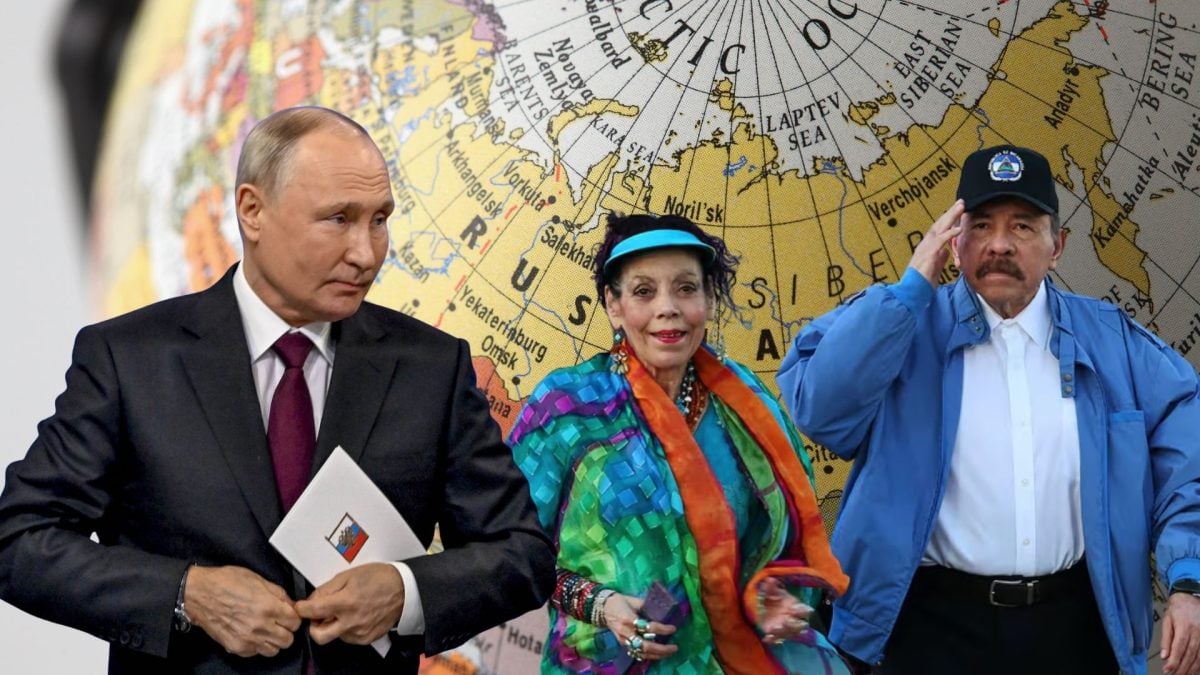
More than a thousand content creators, journalists, and influencers across Latin America have been trained by Russia to disseminate disinformation campaigns in eight countries in the region, according to a report presented in the United States by the Digital News Association (DNA). In Nicaragua, this effort is said to be led by Daniel Edmundo Ortega Murillo, who serves as media coordinator for the regime’s Council of Communication and Citizenship.
From that position, he oversees pro-government media outlets, institutions, universities, and party structures. He also promotes meetings, training sessions, and exchanges with international actors—particularly from Russia and China—in areas such as digital storytelling, audiovisual production, and artificial intelligence. These activities form part of a broader communications strategy aimed at promoting and reinforcing the official narrative.
The other Latin American countries where Russia has reportedly exerted influence are Argentina, Bolivia, Chile, Colombia, Cuba, Mexico, and Venezuela.
Investigation reveals scope of Russian propaganda in Nicaragua
An investigation by Reporters Without Borders (RSF), titled Nicaragua: A Latin American Platform for Russian Propaganda and published in September 2025, states that since 2022 the country has become a hub for expanding the narrative of Russian political power, known as the Kremlin. This development stems from collaboration between the government of Daniel Ortega and Rosario Murillo and Russian state media outlets such as RT en Español and Sputnik.
The report warns that this alliance has enabled the insertion of content, production methods, and training into Nicaragua’s state media, in a context where “the vast majority of independent media outlets have been shut down, confiscated, or forced into exile,” facilitating the unchecked reproduction of official narratives.
RSF details that this network has been consolidated through formal agreements, exchanges, and resource transfers. Since 2022, RT and Sputnik have provided “training, international exchanges, professional equipment, and Kremlin-influenced content,” while national state media “reproduce the narratives of two authoritarian regimes.”
The report adds that such content is often framed as a defense of truth, promoting the idea of “defending real truth” against “fake news manufactured by NATO media corporations,” thereby reinforcing an ecosystem aligned with official narratives and generating disinformation.
Joint Russia–China strategy to expand narratives
For its part, the DNA report documents a structured strategy deployed in at least eight countries, including Nicaragua, through aligned communication networks and the creation of at least 16 websites that mimic well-known media outlets to mislead audiences.
Among the methods identified are emotional manipulation of content, selective presentation of facts, dissemination of conspiracy theories, construction of false equivalencies, and amplification of extreme discourse—forming a digital ecosystem designed to distort public debate and erode trust in information.
A Nicaraguan communications expert told La Prensa that joint efforts by Russia with governments, political forces, media outlets, and content producers in Latin America aim to establish an alternative narrative to that of the United States, which has framed the region as part of a “Greater North America.” In both cases, the expert warned, truth becomes the primary casualty.
“We live in an era where truth is whatever each person believes and asserts as true,” the expert said. “In Nicaragua, these efforts began in 2008, when a centralized and tightly controlled communication strategy was established under Rosario Murillo. From the outset, the government made clear it would not trust the media or journalists, and set out to delegitimize, neutralize, and eliminate them.”
Ortega-Murillo regime sought to win over audiences
The expert noted that between 2018 and 2020, the Ortega-Murillo government became convinced that most of the population did not believe its version of events—neither regarding the 2018 massacres nor the COVID-19 pandemic.
“They needed to win audiences and undermine the credibility of voices and outlets they did not control, but did not know how to do so at scale,” the source said. “That is when they devised agreements with the Russians and later with the Chinese.”
According to the expert, Russia has demonstrated significant capacity in disinformation strategies, as evidenced by its interference in the 2016 U.S. elections. China, by contrast, excels in constructing positive narratives that downplay conflict and emphasize government achievements.
The regime’s advantage, the source added, lies in its control over laws, resources, equipment, budgets, and time. With these agreements—combined with its own use of artificial intelligence tools and bot networks—it now only needs to produce engaging content that, even if not fully believed, can capture audience attention.
Meanwhile, independent voices and media outlets face a crisis due to lack of resources, personnel, access to primary sources, and new technologies.
What audiences are saying
“They are betting that by telling the truth, people will remain on their side. But who knows?” the expert reflected. “Most audiences have been saying since 2021 that there is no information or independent media in Nicaragua, and that credibility in these voices has declined compared to the period before 2018. It’s not that they believe the government narrative—they are simply unwilling to fully trust anyone.”
The expert added that the version of reality each person accepts ultimately shapes their attitudes and decisions, influencing daily life in the country. Through disinformation, the regime seeks to expand social control—a goal that, according to the expert, is already yielding results.
“Within the country, voices that question the official narrative promoted by Rosario Murillo have practically disappeared,” the source said, adding that “the social fabric that could filter or challenge it has also been weakened.”
To sustain this control, nearly 6,000 civil society organizations—particularly those linked to science, education, research, human rights, and environmental protection—have been dismantled, the expert noted.
The few remaining voices persist mainly through media outlets operating with reduced structures and under crisis conditions, relying on the hope that audiences will continue seeking out content that challenges the regime.
Nicaragua as a hub for information control
Guillermo Medrano, a member of the Voces del Sur network, also analyzed the impact of these dynamics, warning that Nicaragua plays a specific role within this disinformation framework.
“This recent report, along with findings from international organizations, confirms that Nicaragua has become a regional laboratory for information control tactics imported from regimes with extensive experience in state censorship,” he said.
Medrano explained that the presence of communicators linked to Russian and Chinese state media serves a clear objective: “They are not seeking to improve journalistic quality—far from it. Their goal is to train regime cadres.”
This training includes building narratives around digital sovereignty to justify control over social media, creating “troll and bot farms,” and automating propaganda to silence critical voices through digital harassment and so-called “virtual lynching.”
Disinformation’s impact on independent press
As a result of these practices, Medrano warned, journalism is being transformed into propaganda, “completely distorting its social function by turning communicators into political agents.” This model eliminates verification as a principle and reduces reporting to the repetition of a single version of reality.
According to Medrano, this promotes “message homogenization,” creating an “informational monologue” in which all spokespersons repeat the same script—undermining political pluralism and independent journalism.
He emphasized that this has direct implications for human rights, as freedom of expression is a fundamental right that enables the defense of others. Its restriction facilitates impunity by preventing the documentation and denunciation of abuses.
Medrano also warned that these dynamics extend beyond Nicaragua, describing the country as “an experiment, a hub, or a regional center for disinformation,” where “the regime acts as an amplifier of anti-democratic narratives and geopolitical disinformation,” projecting these practices across the region.
The effects of disinformation in Nicaragua
Regarding its impact on the population, Medrano said disinformation has become central to state control, aiming to construct a parallel reality that shapes citizens’ decisions—especially in an environment where access to independent sources is limited and information itself can be criminalized.
He added that this strategy seeks to delegitimize and dehumanize those who do not align with the official narrative, often labeling journalists, human rights defenders, and others as “terrorists” or “traitors to the homeland.” This, he said, helps justify persecution, deepens social polarization, erodes trust in institutions, and fragments societies—ultimately weakening democracies and enabling the expansion of authoritarian models.
Finally, Medrano argued that the primary objective of this strategy is not to persuade the international community, but to secure internal control by imposing narrative dominance—where the official version of truth is the only one accepted—while fostering an atmosphere of fear and confusion that suppresses expression and participation.
Although he acknowledged that these dynamics have achieved a degree of control over the information space, he noted they have failed to establish credibility, leaving limited but persistent space for independent journalism.