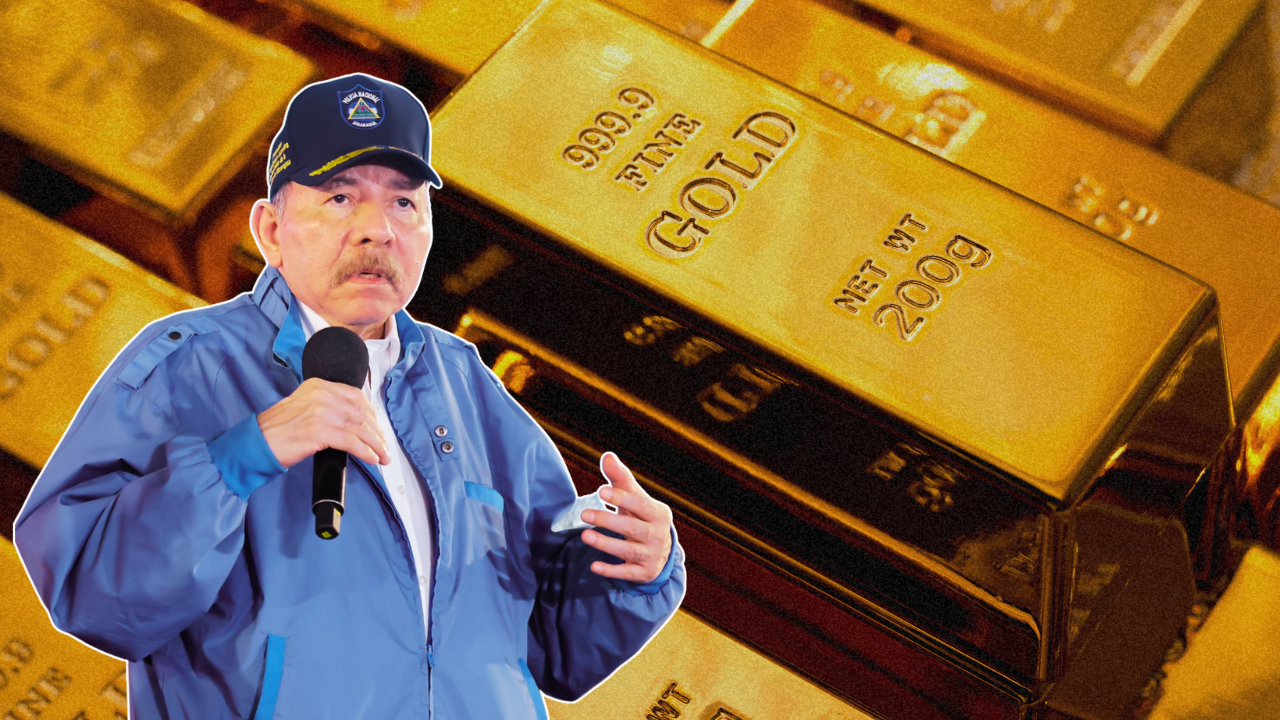
A web of companies linked to the family of Daniel Ortega and Rosario Murillo has capitalized in recent years on Nicaragua’s lucrative gold business, even as the state publicly awarded mining concessions to little-known Chinese firms whose combined holdings, as of October 2025, covered more than six percent of the national territory.
Unlike the highly publicized granting of concessions to Chinese companies—announced in the official gazette La Gaceta—this parallel corporate network, which generates large amounts of cash, has been built quietly.
“Mario,” a miner from northern Nicaragua who asked to remain anonymous to speak with LA PRENSA, said that last year he was visited by representatives of Capital Mining Investment Nicaragua, a company controlled by Laureano Ortega Murillo, son of the ruling couple.
Mario had long worked with artisanal miners on his property. The standing arrangement was that he kept 20 percent of what was extracted from his land, and his partners were free to do as they wished with the rest. Capital Mining, however, proposed a different model: instead of keeping and selling their share independently, miners were instructed to send all extracted material to a processing plant in Villanueva, Chinandega.
Read also: After more than 240,000 Cubans used it, Nicaragua shots down visa-free bridge to U.S.
The mill belongs to Grupo Minero Xiloá, S.A. (Grumixsa), run by individuals close to the Ortega-Murillo family. Though they appear unconnected at first glance, Capital Mining and Grumixsa form part of a single structure through which the family operates in the gold sector.
“The model allows for control of the gold market, steady income through fees charged to small miners, a mechanism for money laundering, and an export monopoly with double profitability,” said a source familiar with the operations.
Exact revenue figures are difficult to determine. But conservative estimates based on the plant’s annual processing capacity suggest that companies tied to the Ortega-Murillo family may have earned more than $80 million from Grumixsa and Capital Mining alone since implementing what miners describe as an extortion scheme. That figure does not include gold exports.
The business is largely managed in the shadows. Low-profile individuals—office workers, little-known lawyers, and accountants—appear in corporate records, obscuring the senior figures linked to the ruling inner circle.
In 2025, one of the hemisphere’s poorest countries is experiencing a full-blown gold rush. According to Energy and Mines Minister Salvador Mansell, Nicaragua projected in August that it would close the year with 434,622 troy ounces of gold production, leading Central America in extraction.
“We’re talking about eight strong companies already operating [in industrial mining] and expanding their potential. But, as in the energy sector, a number of Chinese companies have joined, bringing significant dynamism. Around 12 to 14 Chinese firms have begun investing in exploration and are moving into exploitation and commercialization,” Mansell said in August 2025.
Soaring international gold prices have fueled exports. Between 2022 and 2025, Nicaragua exported $4.309 billion in gold, according to Central Bank statistics. Those figures reflect concessionary mining companies but exclude production by artisanal miners, which also represents millions of dollars.
Extortion of artisanal miners
Capital Mining was incorporated in Managua on November 16, 2020—three months after Grumixsa was founded. The latter was examined in a November 2025 investigation by LA PRENSA titled “Mining Company Operating from Offices of Sanctioned Eniminas Has Direct Ties to Ortega.”
The opportunity to exploit the gold market drew the Ortega-Murillo family, which has conducted business with the state in construction, media, advertising, and oil.
Testimonies and documents reviewed by LA PRENSA indicate that Capital Mining charges artisanal miners a 5 percent commission to process extracted material. The company operates primarily from offices in San Carlos, Río San Juan, and San Ramón, Matagalpa.
Its legal representative is 32-year-old lawyer Julio Enrique Espinoza Rivas, a little-known figure. Another key player is Dennise Díaz Rodríguez, 43, who under contract is authorized to receive payments from miners and acts as a close aide to Minister Mansell, often accompanying him to executive meetings.
Under a 2022 contract, Capital Mining’s compensation amounts to “5 percent of payments made to artisanal miners for delivered ore.” A confidentiality clause stipulates that “the parties agree not to disclose, directly or indirectly, the terms of this authorization and collaboration agreement.”
Mario describes the arrangement more bluntly. In addition to the 5 percent paid to Capital Mining, miners must also pay Grumixsa. Because they only transport raw material to Chinandega, Grumixsa ultimately pays them 40 percent of the invoice value, retaining 60 percent for “processing,” including profit.
Payments are calculated according to a fixed scale. Upon arrival at the plant, the truckload is weighed to determine tonnage, and a sample is analyzed to measure gold content per ton. A document reviewed by LA PRENSA indicates that miners receive 50 percent if the ore yields five grams of gold per ton. From that amount, the 5 percent fee to Capital Mining is deducted—creating what critics describe as a double stream of income for the Ortega-Murillo network.
Since Grumixsa began operations in October 2024, the company has imported $303,967 worth of cyanide through September 2025, according to U.S. trade platform ImportGenius. Cyanide is used to separate gold from waste material.
Read also: Nicaragua’s Top Foreign Investors Revealed — and China Isn’t Among Them
Secrecy extends to payments, which are made exclusively in cash
“The miner never sees the gold,” Mario said. “They don’t pay you in gold. They pay at the international price, and you never receive the metal. It’s all cash. No accounts, no checks, no receipts.”
He estimates that decent land in his area yields about five grams of gold per ton. Currently, 24-karat gold is paid at 5,200 córdobas per gram. Capital Mining representatives closely monitor production, asking how much material miners can send and how often.
“If material collection slows down, that affects them,” Mario said. “That’s when Capital Mining steps in. They’re always visiting, always asking how much material you have and when the next shipment is coming.”
The Laureano Ortega link
U.S. authorities have publicly exposed Laureano Ortega Murillo’s role. On May 15, 2024, the Treasury Department sanctioned Capital Mining and Compañía Minera Internacional, S.A. (Comintsa), stating that Capital Mining operates as a gold-sector intermediary under the direct control of the president’s son.
“Capital Mining is an intermediary in the sector that charges other mining companies to do business in Nicaragua. The company is controlled by Laureano Ortega Murillo … and designated individual Mansell Castrillo,” the Treasury Department said.
According to U.S. authorities, Comintsa is owned by Minister Mansell, though its official representative is industrial engineer Nelson Francisco Sobalvarro. On January 26, 2026, Comintsa transferred the 4,131-hectare “La Reyna II” concession to Chinese firm Thomas Metal—an apparent effort to evade U.S. sanctions, carried out with the regime’s approval.
On February 11, the ruling-party-controlled National Assembly stripped the Mining Directorate from the Energy Ministry and transferred it to the Attorney General’s Office, created last year by order of Murillo—further consolidating family control over the mining business.
LA PRENSA attempted at least three times to contact Espinoza Rivas and Mansell without success. Emails sent to Capital Mining addresses listed in contracts bounced back.
Grumixsa’s ties to the Ortega-Murillo family were detailed in a previous LA PRENSA investigation. The company is managed by Marlon José Salinas López, a former employee of the “Che Guevara” power plants. Crucially, Grumixsa counts Urbanizadora Industrial (URBISA) as a partner—part of a network of 22 companies reportedly controlled by the ruling family through proxies, according to a 2022 investigation by Confidencial.
Grumixsa has been authorized to operate the Chinandega plant since October 1, 2024, with an annual capacity of 30,000 ounces of gold. Experts estimated in November that the facility could generate around $100 million in revenue per year.
Conservative calculations suggest Grumixsa may have earned $80 million in 16 months of operations, working at full capacity and retaining 60 percent of incoming ore value. Adding Capital Mining’s 5 percent cut would bring total revenue from the scheme to an estimated $83 million since October 2024.
For artisanal miners, the situation is untenable.
“People don’t like this,” Mario said. “If you travel to collect your money, since it’s paid in cash, you take a risk carrying it. But if you refuse to work with them, you could run into problems with the state. Nobody wants that.”

“Suministro” and extortions
A separate private document reviewed by LA PRENSA indicates that the Ortega-Murillo network also charges commissions to companies that work with artisanal miners, through another firm: Suministro y Montaje Electromecánico. Its representative is public accountant Omar Javier Cortez Moncada.
According to the document, Suministro collects 5 percent “of annual gross sales of substances extracted, produced in the country and supplied by artisanal miners.” A financial expert who analyzed the contracts at the newspaper’s request said that although the wording references artisanal miners, the fee in practice constitutes a direct charge on companies—“a brazen form of extortion,” paid monthly.
“If a company produces $5 million worth of gold in a month, it must pay $250,000 to Suministro for that month. Both companies are used to collect extortion payments—one from miners as a kind of protection fee, the other directly from companies. Both are under Ortega control,” the analyst said.
There are no public figures on how much revenue this stream generates for the family. LA PRENSA contacted representatives of Equinox Gold, formerly Calibre Mining, the largest mining company operating in Nicaragua, to ask about Suministro. They had not responded by the time of publication.
For Mario, the entire scheme amounts to money laundering. “Gold turns into cash wherever it’s placed, and there’s no public trail to follow.”