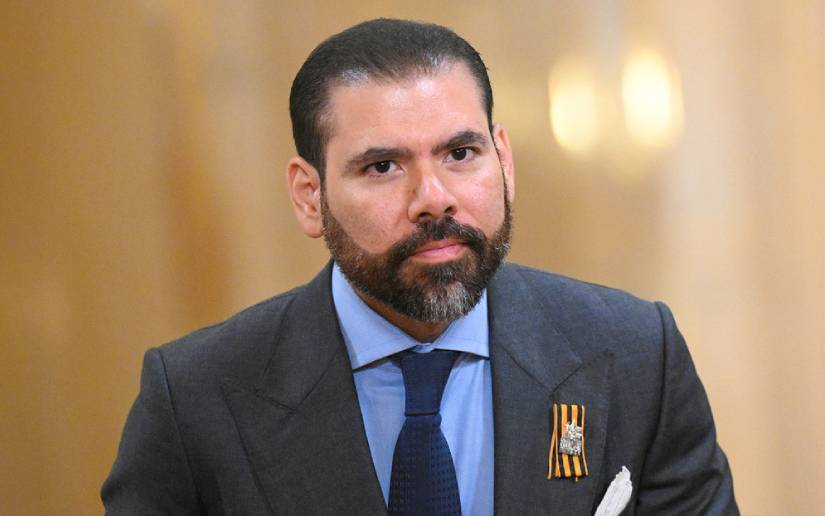
As part of the Ortega-Murillo dictatorship’s policy of aligning with authoritarian regimes, their son Laureano announced this week in Moscow Nicaragua’s “strong support for the global security initiatives promoted by Russia and China.”
He made the remarks during an interview on May 29, held in the context of the “XIII International Meeting of High Representatives for Security Issues,” an international forum hosted in Moscow.
The interview was broadcast by Russian state media and confirms the dictatorship’s strategy of positioning itself as the main ally of Moscow and Beijing in Latin America.
“Equitable and Indivisible Security”
Ortega Murillo expressed support for what he called an “equitable and indivisible security architecture,” referring to proposals put forward by Vladimir Putin and Xi Jinping. However, these initiatives have been strongly criticized by human rights organizations and democratic governments, as they aim to undermine multilateral institutions and legitimize repressive regimes.
One of the most alarming aspects of the speech was the praise for military cooperation with Russia. Nicaragua has maintained a close relationship with the Russian armed forces for years and continues to receive military advice and support from them.
According to international observers, this collaboration has less to do with public security and more with strengthening the regime’s internal repressive apparatus.
Calls Ukrainians Nazis
In his remarks, Ortega Murillo also reiterated the Nicaraguan regime’s “solidarity” with Russia regarding the invasion of Ukraine, echoing the Kremlin’s narrative about the supposed threat of “Western Nazism.”
“They have clearly shown how they continue trying to promote Nazism once again in Ukraine, funding it and providing it with all the means to confront Russia, which is impossible,” said the son of the dictators.
This position has been widely rejected by the international community, which considers the Russian invasion a flagrant violation of international law.
Identification with the One-Party System
Ortega Murillo also praised ties with China, claiming there is a “deep ideological alignment” between both totalitarian regimes.
This closeness has resulted in multimillion-dollar agreements focused on infrastructure and technological cooperation—many of them signed under opaque conditions and carrying serious implications for national sovereignty.
The “Dream” of Joining the BRICS
The speech also included Nicaragua’s aspiration to join the BRICS group, as part of its strategy to align with a “new global power bloc.”
This can be interpreted as an attempt to seek international legitimacy amid the regime’s growing diplomatic isolation, as it faces accusations of systematic human rights violations and the elimination of all forms of internal opposition and civil liberties.
The narrative of a “new multipolar world order” thus becomes a smokescreen to justify repression and silence dissent.
With these latest statements from Laureano Ortega, the dictatorship reaffirms its authoritarian profile, distancing itself from the democratic international community and embracing those who promote a “security model” that excludes basic freedoms.