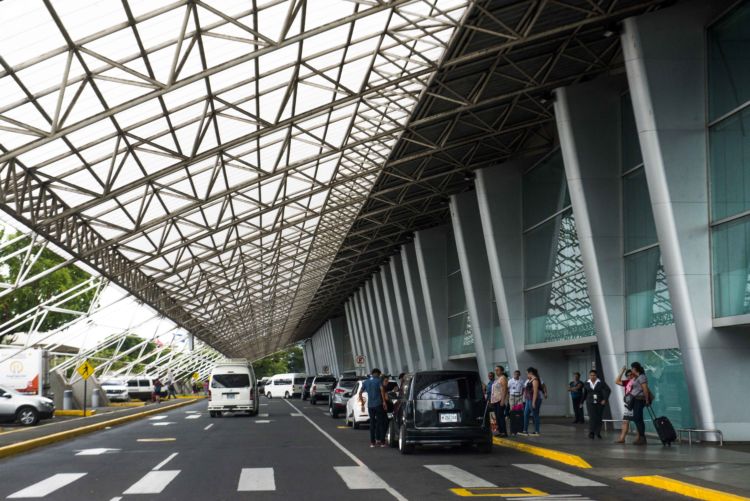
While the government of Joe Biden continues without taking decisive actions to address the migration policy of Daniel Ortega’s regime, the Managua International Airport is overwhelmed by the influx of migrants from different parts of the world trying to reach the United States.
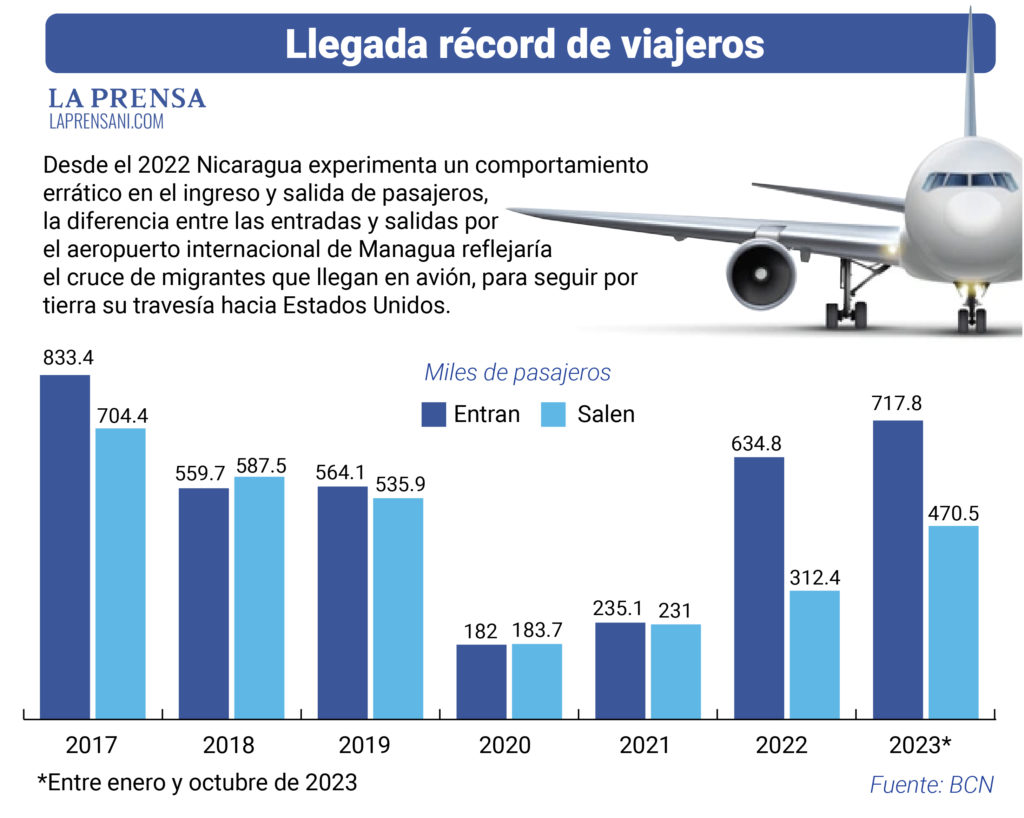
A recent data update from the Central Bank of Nicaragua (BCN) revealed that between September and October of last year, 241,700 individuals disembarked at the Managua International Airport, of which only 94,500 departed the country via that terminal. This suggests that 147,200 continued their journey by land.
The immense increase in people crossing through the airport wouldn’t be explained by a proportional rise in tourists visiting Nicaragua. Anasha Campbell, co-director of the Nicaraguan Institute of Tourism (Intur), stated yesterday in a pro-regime media outlet that last year, the number of travelers surpassed one million throughout 2023.
A number far from the record of 2017
«In general terms, the year 2023 was a year of significant movement, substantial growth. We estimate that last year, we surpassed the million-tourist mark, and tourism contributed $600 million to our local economy. We’re already seeing active recovery in the sector. Overall, stakeholders in our sector are very pleased, satisfied not only with the year-end and New Year’s season but also with the entirety of 2023,» Campbell stated.
With the milestone of surpassing one million tourists in 2023, Nicaragua still hasn’t recovered the levels of travelers seen before 2018, primarily those entering through land borders. The Managua International Airport has consistently held the second position in terms of incoming travelers in Nicaragua.
In 2017, for instance, before the crisis of 2018 disrupted the flow of tourists into Nicaragua, the country welcomed 1.79 million tourists (excluding cruisers and day visitors). Out of this total, 603,277 arrived through the Managua International Airport, while the remainder entered via Peñas Blancas, El Guasaule, and other land entry points.
Nearly 250,000 heading towards the United States
The INTUR hasn’t updated the statistical yearbook since 2022, and the last one released was in 2021. If published, it would confirm the origins of the travelers who have entered through the Managua International Airport, where flights with migrants are arriving directly from Europe, something not observed before 2022.
According to figures disclosed by the Central Bank, based on reports from the Airport Administration Company, in the first10 months of the year, the Managua airport served a total of 717,800 disembarked travelers. However, during that period, only 470,500 departures were reported.
At least 247,300 travelers who entered through Managua decided to continue their journey by land, with the United States being their likely destination. The U.S. is facing a migrant crisis at its borders that remains unresolved, particularly drawing arrivals from Cuba and now increasingly from other regions around the world.
Investments at the entrepreneurship level
Campbell didn’t explain the discrepancy between the number of travelers entering through the Managua International Airport and those departing from the same terminal, she merely mentioned that they have observed tourists entering more via air travel than through border checkpoints.
However, this flow of «tourists,» as Campbell referred to the migrants, hasn’t spurred private investors. When asked about investment in the tourism sector by one of the propagandists from the official media outlet, Campbell responded: «I believe that last year, what stood out was public investment. We saw many municipal governments undertaking projects to beautify precisely those public spaces for family recreation. Puerto Salvador Allende is a great example. The Park of La Alegría was one of the most visited during this season. In San Carlos (in southern Nicaragua), renovations and beautification works on the Malecón were inaugurated.»
Regarding private investment, Campbell mentioned investments at the entrepreneurship level, such as cafés, bars, or eateries. That is to say, there haven’t been reports of hotel investments from chains attracted by the increased travelers through the Managua Airport.
New records at the Managua International Airport
In October alone, 126,200 travelers disembarked at the Managua Airport, marking a historic level in the monthly records of the terminal, where LA PRENSA has confirmed the substantial presence of African and Haitian travelers.
Out of that monthly total in October, only 45,500 returned to Nicaragua. Another 80,700 continued their journey by land in pursuit of the «American Dream».
In fact, figures from Honduras show that last year, 85,969 Cubans and 82,242 Haitians crossed through its territory. Additionally, there are individuals of other nationalities such as Chinese, Senegalese, Guineans, Mauritanians, Uzbeks, among others, who are arriving from Nicaraguan territory.
Venezuelan airlines continue to arrive
In November of last year, the United States announced visa restrictions for flight operators facilitating irregular migration. Shortly after, executives from Aruba Airlines confirmed the suspension of these flights. Other airliners followed, including the Dominicans Sky High Aviation Services and Air Century, as well as the Honduran Aviatsa.
However, Aruba Airlines has not ceased landing in Managua and now confirms its schedule for January 2024. According to reports from Cuban media outlets, authorities confirmed that flights departing from José Martí International Airport in Havana to Managua will operate on Mondays, Thursdays, and Saturdays. Additionally, contingent upon demand, flights will depart from the International Airport in Holguín to Managua with a layover in Aruba.
Furthermore, the Venezuelan airline Conviasa has 19 scheduled flights to Managua in January of this year. This reflects that the announcement made by the United States to impose sanctions on flight operators continues to have no effect on Ortega’s policy of transporting migrants to the U.S. border, a pressure strategy aimed at prompting negotiations regarding the sanctions, according to political analysts.
A well-organized trafficking network
«There is an organized traffic of people at a great scale, with branches in almost every region of the world. We are talking about three continents with open routes. This reflects a very well-structured organization, capable of gathering dispersed resources and, through centralized direction, ensuring that migration flows via Managua, reaching historical levels, as has happened,» says a political analyst who, out of fear of reprisals, requests not to mention their name.
«Many airlines offer these charter flights, and the number of people arriving in Managua via these flights is immense. The logistics receiving them upon arrival in Managua and then guiding them to Honduras are also extensive. It’s a complete network of traffickers involved, and this level of organization reflects not only tolerance but also determined governmental participation. That’s why security analysts are viewing it as a political decision to challenge the United States through the promotion of irregular migration,» states the analyst.