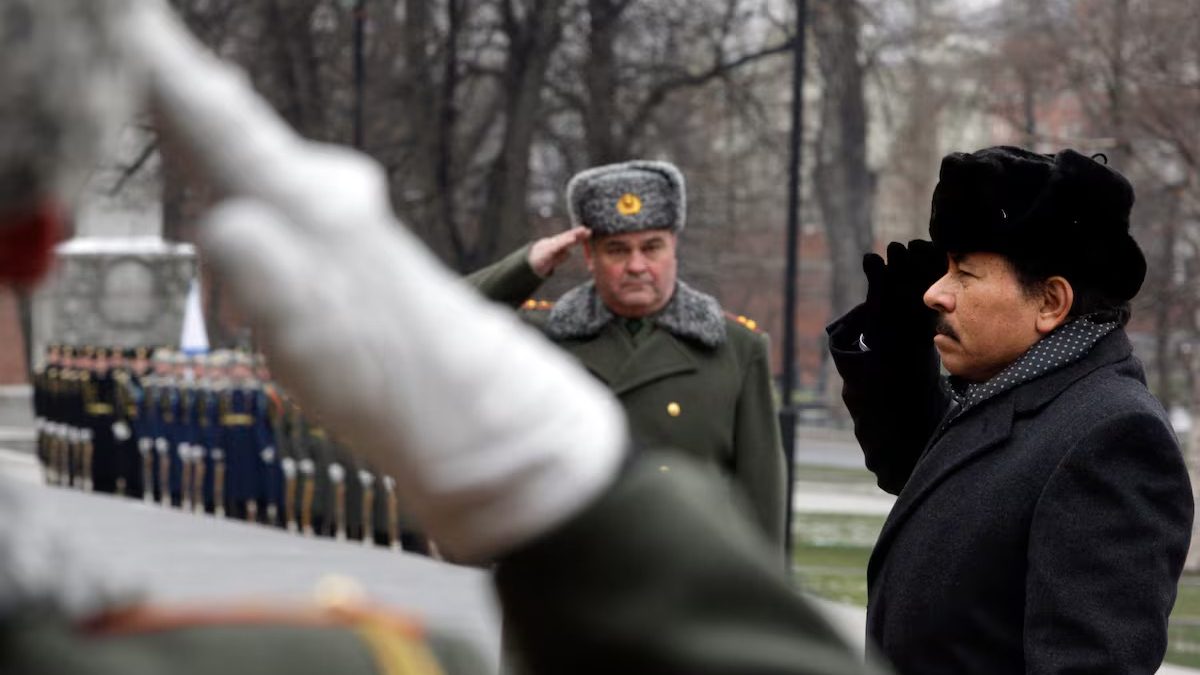
When Daniel Ortega reclaimed the Nicaraguan presidency on January 10, 2007 —through democratic elections—, one of the most high-profile guests at his inauguration was then-Iranian President, Mahmoud Ahmadinejad.
At the time, Iran emerged as one of the most promising partners for the new Sandinista government. In the months that followed, Tehran announced hundreds of millions of dollars in prospective investments: a hydroelectric dam, a deep-water port, manufacturing plants, housing developments, tractors, and food processing facilities.
Russia was still rebuilding the privileged relationship it had maintained with the Sandinistas during the 1980s, while China had no formal diplomatic relations with Nicaragua at all.
Nearly twenty years later, that hierarchy has completely inverted. China, the last arrival, is now the foreign power gaining ground fastest in Nicaragua. Russia has cemented itself as a long-term anchor, particularly across defense, intelligence, and police training. Iran, meanwhile, despite its initial grandiose promises, maintains close political and ideological ties but lacks the economic capacity to turn rhetoric into tangible investments and infrastructure.
This shifting geopolitical alignment was highlighted in research conducted by Gil Guerra, a researcher at the Hudson Institute and author of the website “Nicaragua Research”. Guerra presented his findings on September 30, 2026, before the U.S. Senate Foreign Relations Subcommittee on Western Hemisphere, Transnational Crime, Civilian Security, Democracy, Human Rights, and Global Women’s Issues.
Guerra places Russia and China in a fundamentally different tier than Iran. He noted that Moscow and Beijing have materially reinforced the position of Daniel Ortega and Rosario Murillo’s authoritarian regime, whereas cooperation with Iran remains «largely symbolic.»
While all three nations share a common posture of confrontation with the United States and close political alignment with Managua, each offers distinct assets. China primarily provides financing, infrastructure, technology, technical training, and access to a massive market.
Russia has spent years cultivating a privileged relationship with the Nicaraguan Armed Forces, the National Police, and state security apparatuses. Iran offers diplomatic backing rooted in anti-American rhetoric and a shared narrative that draws parallels between the 1979 Islamic Revolution and the Sandinista Revolution.
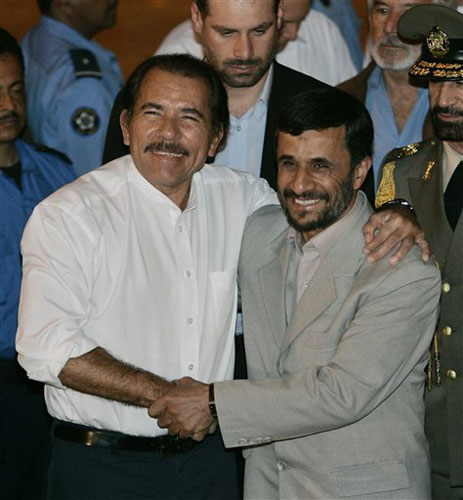
Iran Arrived First
Of Ortega’s three current extra-regional allies, Iran was the first to gain prominence after his return to power. Diplomatic ties dated back to the initial Sandinista government in the 1980s, but had largely faded during Ortega’s 16 years in opposition.
Ahmadinejad visited Managua in January 2007, and the Nicaraguan dictator reciprocated five months later. Ortega arrived in Tehran on June 10, 2007, meeting with Ahmadinejad and other top Iranian officials as both governments framed their revolutions as sister movements standing against American influence.
It was also an era of sweeping promises. Iran announced plans for power generation projects, low-income housing, industrial and agricultural facilities, and the construction of a deep-water port in Monkey Point on Nicaragua’s Caribbean coast.
The port project alone was valued at roughly $350 million at the time. Bilateral talks also covered four hydroelectric plants, thousands of housing units, cement factories, tractors, buses, and farm equipment. The vast majority never materialized.
This trend became the hallmark of Managua-Tehran relations: high political intensity paired with minimal economic delivery. High-level visits continued, memoranda were signed, and both governments maintained a steady chorus of solidarity, but Iran never established an economic presence in Nicaragua proportional to its promises.
Ahmadinejad returned to Managua in January 2012 for another Ortega inauguration. In August 2016, Iranian Foreign Minister Mohammad Javad Zarif included Nicaragua on a Latin American tour, reiterating pledges of cooperation in agriculture, energy, banking, and even the proposed interoceanic canal.
The rapprochement gained renewed momentum after 2021. In February 2023, Iranian Foreign Minister Hossein Amir-Abdollahian visited Managua, followed in June by President Ebrahim Raisi as part of a regional tour that included Venezuela and Cuba. Raisi landed in Managua on June 13, met with Ortega and Murillo, and addressed the National Assembly the following day.
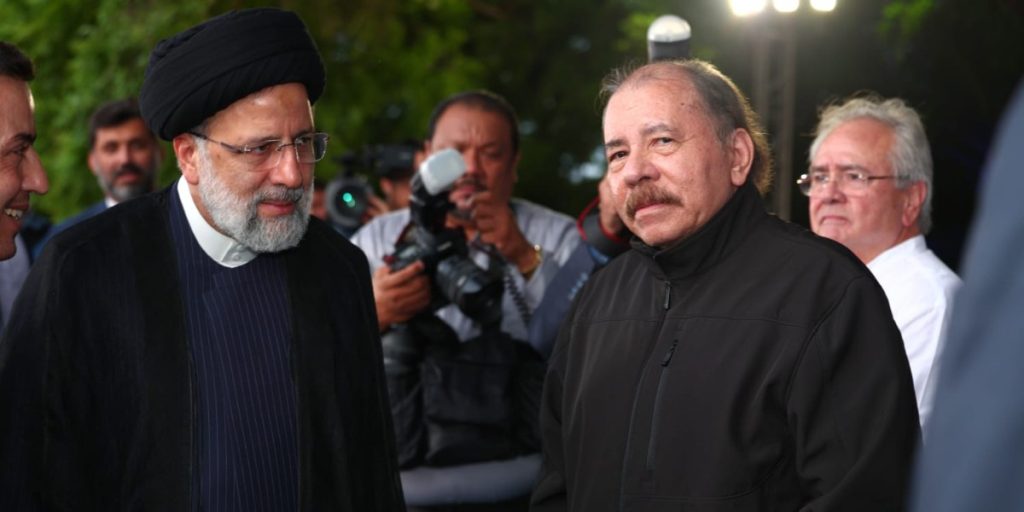
Once again, agreements were signed. The two governments executed memoranda covering economic, commercial, scientific, and technical cooperation, alongside judicial cooperation and shipments of pharmaceuticals and medical equipment. Broadened trade relations were touted once more.
Yet these deals failed to yield an economic footprint anywhere near what Beijing was building concurrently.
Raisi’s death in a helicopter crash on May 19, 2024, underscored the close political alignment between the two regimes. Nicaragua declared official mourning and maintained active diplomatic channels with Tehran. In July 2026, a delegation led by Foreign Minister Valdrack Jaentschke traveled to the Iranian capital for meetings with Foreign Minister Abbas Araghchi and other senior officials.
Russia Revives Soviet-Era Ties
Russia followed a different trajectory. Moscow did not need to build its relationship with the Sandinistas from scratch, as the Soviet Union had served as a primary political, economic, and military backer during the 1980s.
Thousands of Nicaraguans studied in the USSR, and the Sandinista Armed Forces were equipped with Soviet hardware ranging from rifles to helicopters, tanks, and anti-aircraft systems.
The FSLN’s electoral defeat in February 1990, followed by the dissolution of the Soviet Union in December 1991, drastically curtailed those links. Ortega’s return to power created the conditions to rebuild them.
An early diplomatic gesture occurred in September 2008, when Nicaragua recognized the independence of Abkhazia and South Ossetia following the Russo-Georgian War. Managua was one of only a handful of governments globally to align with Moscow’s move.
Three months later, Ortega traveled to Russia. On December 18, 2008, he met in Moscow with then-President Dmitry Medvedev to sign bilateral cooperation agreements aimed at restoring a core component of their 1980s alliance: military and security cooperation.
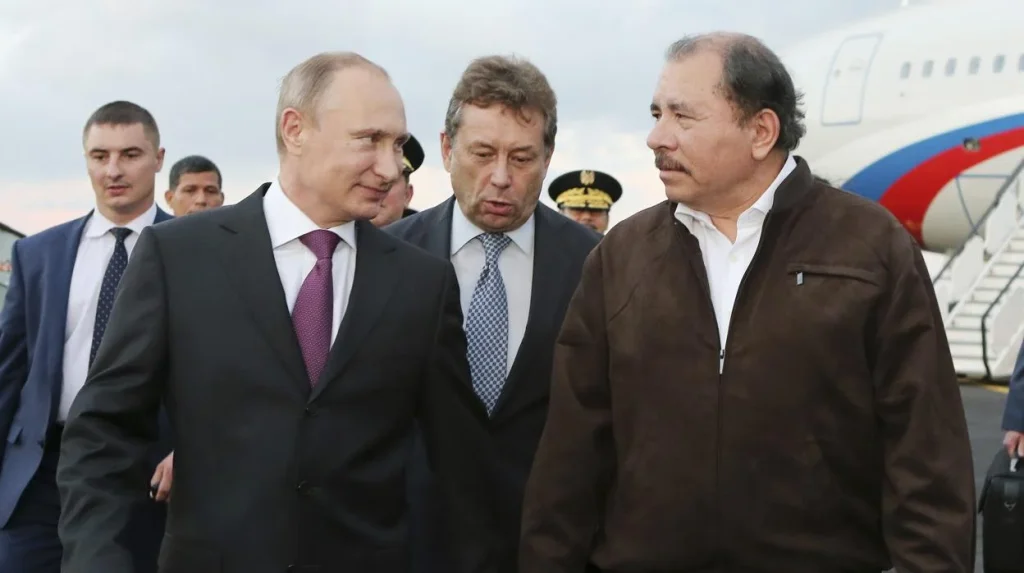
July 11, 2014, marked another key milestone when Vladimir Putin made a stopover in Managua during a Latin American tour, meeting with Ortega and Murillo in the first-ever visit by a sitting Russian president to Nicaragua.
Beginning in 2009, Russia supplied Nicaragua with armored vehicles, helicopters, patrol boats, and other military hardware. In 2016, Moscow initiated the delivery of 50 T-72 tanks—a deal valued at approximately $80 million that raised national security concerns in neighboring Costa Rica and across Central America.
However, the most significant dimension of the renewed alliance extended beyond conventional weaponry.
In 2017, a ground station for Russia’s GLONASS satellite navigation system became operational near Managua. That same year saw the inauguration of the National Police Professional Training Center, built with Russian assistance and linked to the Russian Ministry of Internal Affairs.
This facility highlights the operational distinction between Russia and China. Moscow has not emerged as a major creditor or financier of large-scale infrastructure like highways, airports, ports, and housing. Instead, its influence is concentrated in high-sensitivity sectors: the military, police, state security, intelligence, and operational training.
These security links endured following Russia’s full-scale invasion of Ukraine in February 2022. In June of that year, Ortega reauthorized the entry of Russian troops, naval vessels, and aircraft for joint training, military cooperation, counter-narcotics operations, and humanitarian assistance.
An analysis by the Washington-based Center for Strategic and International Studies (CSIS) estimates that up to 3,700 Russian personnel participated in training programs and exchanges with the Nicaraguan Armed Forces between 2014 and 2024.
As with Iran, high-level Russian visits have maintained the cadence of the relationship. Russian Foreign Minister Sergey Lavrov visited Managua on April 19, 2023, meeting with Ortega. On February 28, 2024, Nikolai Patrushev —then Secretary of the Russian Security Council and a close Putin confidant— arrived for high-level talks with Ortega and Murillo.
Reciprocal visits have been equally frequent. Laureano Ortega Murillo, the ruling couple’s son and chief envoy for relations with Russia and China, has made repeated trips to Moscow and St. Petersburg. Army Commander General Julio César Avilés has also traveled to Moscow for defense and security consultations.
Throughout 2025 and 2026, Russia and Nicaragua established new legal cooperation frameworks, culminating in June 2026 with bilateral treaties on extradition and the transfer of sentenced persons. By May 2026, Moscow had ratified a broader defense agreement facilitating security training alongside military port calls and aircraft visits.
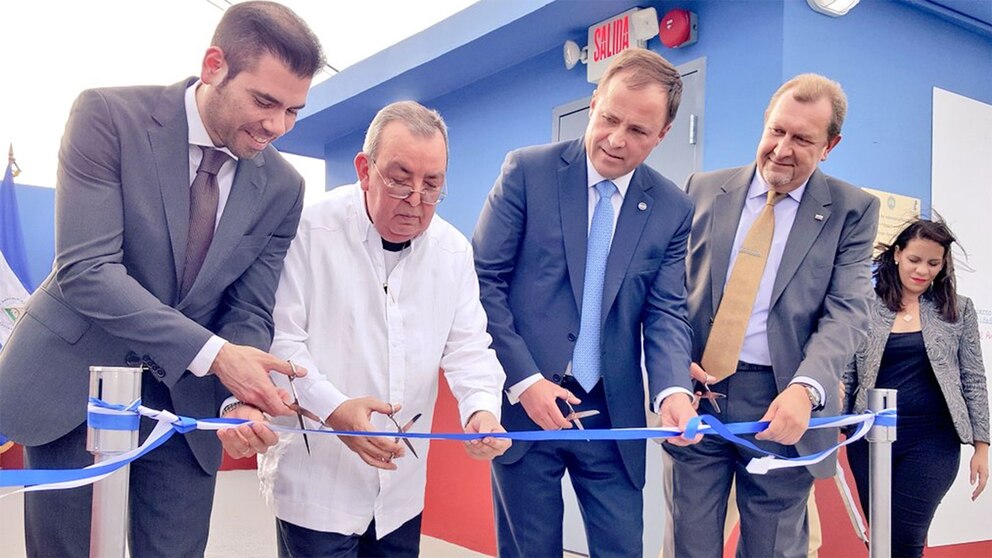
Nicaraguan Police Chief Francisco Díaz reported that roughly 500 police officers receive training annually from the Russian Ministry of Internal Affairs, including specialized coursework in intelligence and counterintelligence.
However, analysts note a shift in public posture. Researcher Gil Guerra observed that Rosario Murillo stopped publicly citing Russia as a security partner in her daily broadcasts beginning in late 2025, even as operational cooperation deepened.
Guerra suggests the regime may be attempting to lower the public profile of its security ties to avoid further provoking Washington. Moscow’s influence is not diminishing; rather, the public visibility of a relationship operating in sensitive intelligence spheres is being intentionally muted.
China: From Zero to Strategic Partner
China’s entry represents the most rapid expansion, building a comprehensive bilateral relationship almost entirely in under five years.
Until December 2021, Nicaragua maintained official diplomatic relations with Taiwan rather than the People’s Republic of China. That dynamic shifted on December 9, 2021, when the Ortega administration severed diplomatic ties with Taipei.
The pivot was swift. The following day, December 10, a Nicaraguan delegation led by Laureano Ortega Murillo signed a joint communique in Tianjin formally re-establishing diplomatic relations between Managua and Beijing.
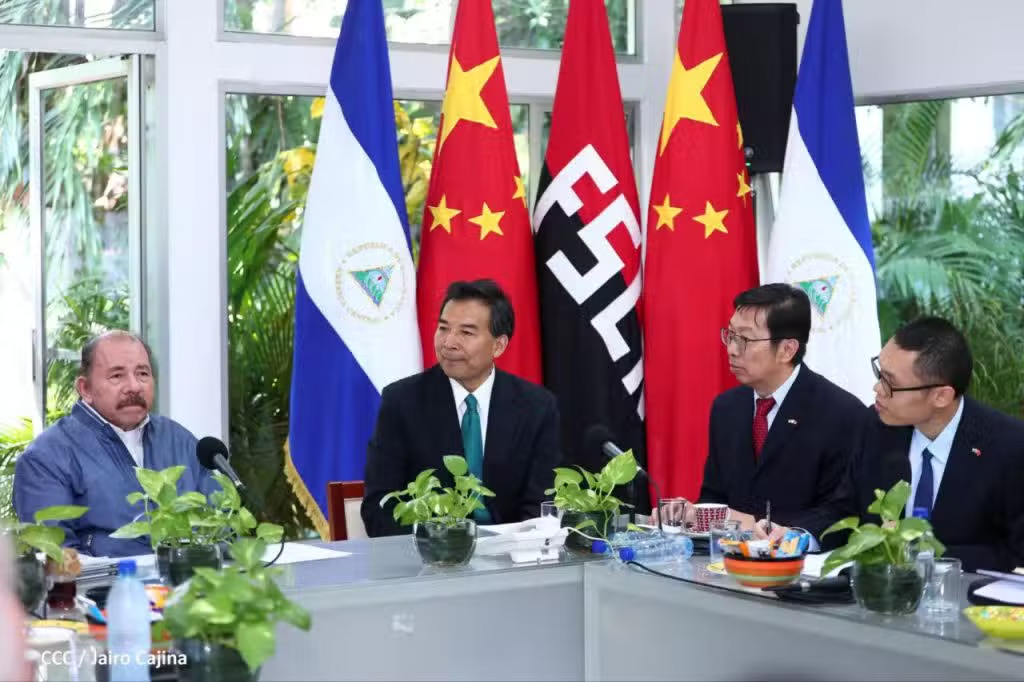
Since then, Beijing has expanded its footprint at a pace unmatched by Moscow or Tehran. Commercial agreements began in 2022, culminating in the negotiation and signing of a Free Trade Agreement (FTA) in 2023, which took effect on January 1, 2024. Concurrently, state-backed Chinese firms launched projects across highways, public housing, energy grid modernization, public transit, telecommunications, airport infrastructure, and mining.
Diplomatic visits accelerated alongside economic integration. Laureano Ortega assumed the role of key political interlocutor, leading a delegation of economic ministers to China in February 2023.
On July 11, 2023, Laureano Ortega met in Beijing with Wang Yi, the director of the Central Foreign Affairs Commission of the Chinese Communist Party, returning to the Chinese capital in November for further political talks.
On December 19, 2023, Xi Jinping and Daniel Ortega held a formal phone conference, officially elevating bilateral ties to a «Strategic Partnership», just two years after restoring diplomatic relations.
Unlike Iran, which produced non-binding memoranda and stalled projects, China possessed the capital and state-backed capacity to execute large-scale infrastructure. And unlike Russia, whose engagement remained concentrated in defense and intelligence, Beijing entered multiple economic sectors simultaneously.
The expansion of Punta Huete International Airport serves as a prime example. Funded via Chinese state credit lines and executed by the state-owned China CAMC Engineering Co., Ltd., the project sits alongside major contracts for highways, public buses, energy projects, and the planned deep-water port at Bluefields.
According to data presented by Guerra to the U.S. Senate, the Chinese firm managing the Punta Huete expansion secured an additional $210 million in contracts for the Bluefields port project between July and September 2026. During the first half of 2026, the Nicaraguan government allocated nearly as much funding to the Punta Huete project as it did to its entire defense budget.
China’s footprint is expanding most rapidly in the extractive sector. Since January 2024, entities linked to Chinese capital have secured 80 out of 102 new mining concessions issued by Managua, covering roughly 10 percent of Nicaragua’s national territory.
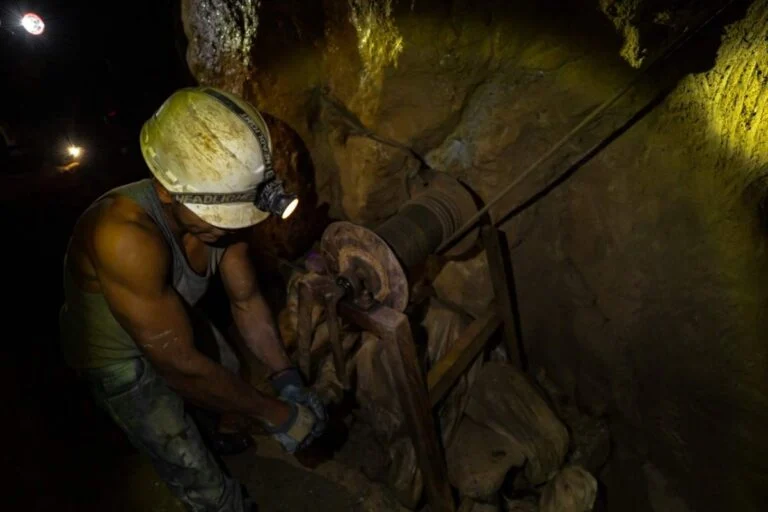
Guerra estimates that mining properties connected to Chinese firms expanded from approximately 238,000 hectares (588,000 acres) in August 2024 to 1.57 million hectares (3.88 million acres) by September 2026, a more than sixfold increase in two years.
Beijing’s influence is no longer limited to commerce and infrastructure. It is moving directly into domain areas historically dominated by Moscow: domestic security and intelligence.
General Julio César Avilés has traveled to both Moscow and Beijing for security consultations, and the Nicaraguan National Police now maintains formal training pipelines with both powers.
While Russia trains approximately 500 police officers annually, China’s Ministry of Public Security trains an additional 400 officers each year, offering coursework focused on facial recognition, digital surveillance, and artificial intelligence tools.
Furthermore, in August 2026, an emergency response center constructed by China was inaugurated in Momotombo, featuring advanced communications, data processing, and monitoring capabilities.
Guerra cautioned in his Senate testimony that these technical capabilities create potential dual-use (civilian-military) applications for the facilities, though he noted that such operational deployments remain speculative at present.
China is increasingly overlapping with Russia’s core operational footprint in Central America. The key distinction lies in timeline: while Moscow built its leverage over decades of Sandinista history, Beijing required less than five years to embed itself across Nicaragua’s economic, structural, and security apparatus.
This article was translated from its original in Spanish with the assistance of artificial intelligence and reviewed and edited by a human editor.