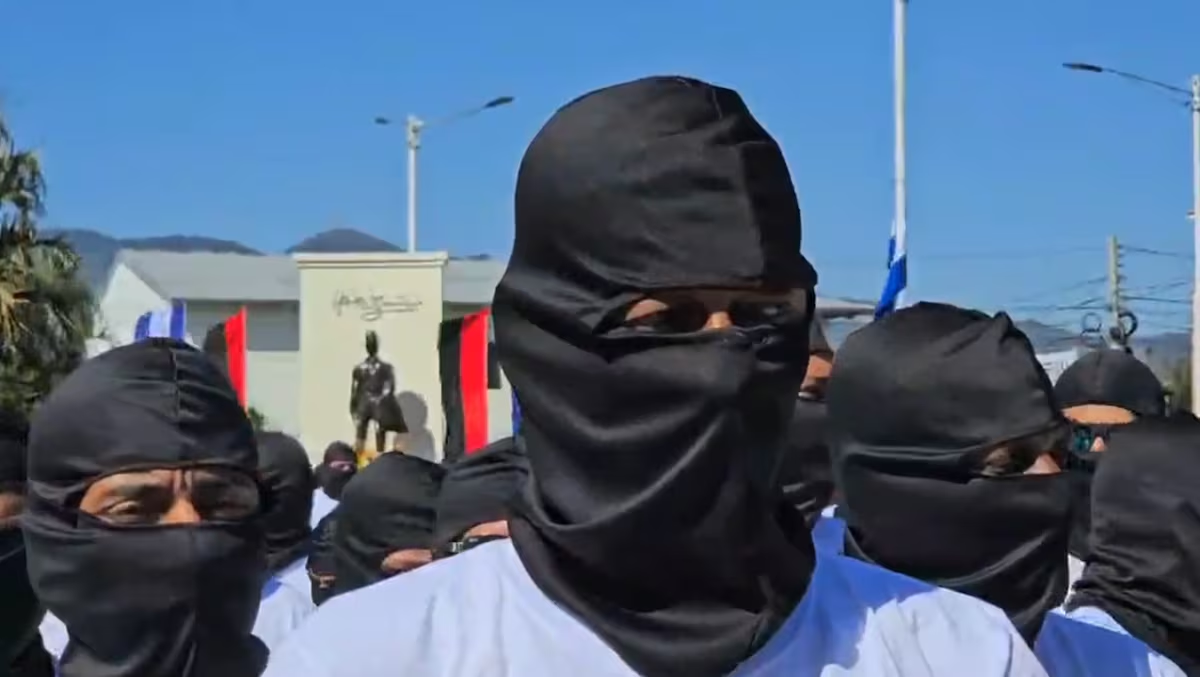
The Sandinista dictatorship of Daniel Ortega and Rosario Murillo is accelerating the swearing-in of volunteer police officers, strengthening its network of control and surveillance. In just five days, the Ortega-controlled police force has sworn in 7,504 volunteer officers across four departments, with León hosting the largest number of these personnel.
On January 15, the police swore in 1,204 volunteer officers in Madriz and another 1,300 in Estelí. On January 17, 1,400 were sworn in at Ocotal, the departmental capital of Nueva Segovia, and on January 20, an additional 3,600 were added in León.
Octavio Álvarez, political coordinator of the Sandinista National Liberation Front (FSLN) in Madriz and Nueva Segovia, admitted that the goal of incorporating more volunteer police officers is to counteract «destabilizing actions,» a term the dictatorship uses to refer to opposition protests.
According to a consulted specialist, although the network of volunteer police has existed since the 1980s, the recent mass display of personnel aims to send a message of intimidation to the population.
An old network with new intentions
A security expert, who requested anonymity, explained to La Prensa that the network of volunteer police is not new, but the Sandinista dictarorship is expanding its reach to strengthen control in the areas where these officers have been sworn in.
The expert noted that the mass presentation of these groups aims to instill fear among the population.
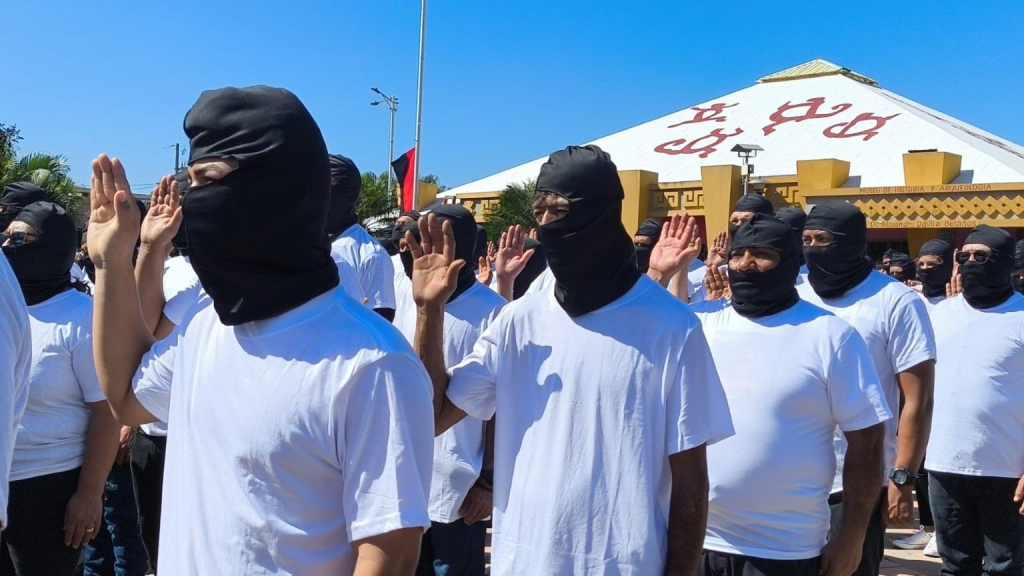
“Displaying these groups of uniformed and masked paramilitaries aims to send a message of intimidation, discouraging the population from expressing their discontent,” he stated.
Díaz insists on a Constitutional error
The director of the National Police, Francisco Díaz, reiterated during the swearing-in ceremony in the city of León, 55 miles west of Managua, that the volunteer Police have «constitutional status.»
«The volunteer Police have constitutional status, made up of Nicaraguan men and women who offer their service voluntarily to defend peace and security,» Díaz stated.
Additionally, he stated that the volunteer Police officers «will continue protecting the peace of the people and the achievements of ‘the good government’, as every volunteer police officer represents a family committed to peace, security, and the revolution.»
However, the current Constitution does not recognize this role. This concept is only included in the new Constitution promoted by the Sandinista regime, suggesting that the regime is laying the groundwork to impose a totalitarian state backed by that new constitution.
The nature of the «volunteer Police» was distorted after 2018
Law 872, on the Organization, Functions, Career, and Special Social Security Regime of the National Police, includes the figure of the volunteer Police, defining it as a form of community participation. This auxiliary and support body is made up of citizens who offer their service voluntarily and temporarily. However, after the protests of 2018, the Sandinista dictatorship has used this figure to arm its paramilitary forces and give it somewhat legality.
Article 24 of Law 872 grants volunteer police officers rights such as necessary supplies, financial assistance, legal defense in trials related to their duties, and compensation or a pension in the event of death or disability during service.
Article 25, on the other hand, stipulates that volunteer police officers must wear uniforms and insignia, although it does not specify their characteristics. Additionally, their work must be supervised by a member of the National Police and limited to support tasks, such as surveillance, patrols, traffic regulation, and assistance in natural disaster situations. They must also collaborate with authorities if they become aware of criminal activities.
Since the sociopolitical crisis of April 2018, the volunteer Police have been identified as a component of the paramilitary groups organized by the Ortega-Murillo regime to repress protesters, a connection further reinforced by statements from Daniel Ortega himself in international media.